Get Full Government Meeting Transcripts, Videos, & Alerts Forever!
Get email alerts on the Towing topic
No spam. Unsubscribe anytime.
York County adopts uniform police-requested towing rules after year-long advisory board work
Summary
After a year of work by a county-appointed Towing Advisory Board, the York County Board of Supervisors adopted a new ordinance that sets equipment, storage, fee and dispute-resolution standards for law-enforcement-requested tows; the ordinance takes effect Oct. 1, 2025.
The York County Board of Supervisors on July 15 approved a new county ordinance that creates uniform standards for police‑requested towing, including equipment and storage requirements, a county-maintained rotational towing list, a fee schedule and a dispute-resolution process.
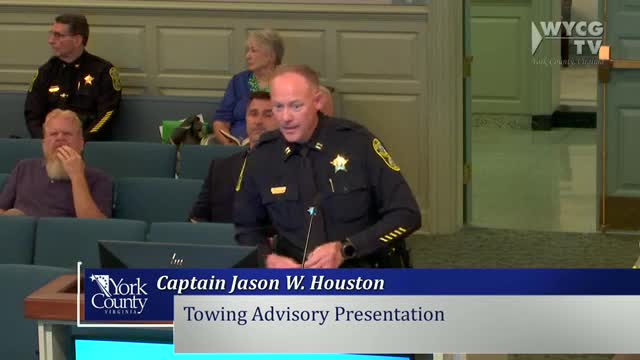
The ordinance formalizes recommendations produced over the past year by the York County Towing Advisory Board and was presented to the supervisors by Captain Jason Houston of the York County Sheriff’s Office. Captain Houston said the rules apply only to tow trucks requested by law enforcement and not to private tows called by vehicle owners. “This does not affect private citizens calling their own tow trucks,” he said during the July presentation.
Why it matters: County officials and towing operators said inconsistent practices and widely varying bills for motorists—especially at crash scenes on the interstate—prompted the advisory-board effort. County leaders said the ordinance aims to protect residents who cannot choose their tower when law enforcement clears a crash, and to standardize business requirements for companies that want to serve on the county’s police-requested rotation list.
Key provisions and standards
- Voluntary rotational list: The ordinance creates a voluntary rotational list of companies that accept police‑requested tows. Dispatch will call companies in rotation. Companies choose to apply for the list; admission requires meeting the ordinance’s qualifications.
- Equipment, inspection and insurance: Companies admitted to the rotation must meet minimum equipment standards for light‑ and heavy‑duty wreckers, maintain required signage and have required liability insurance and yearly inspections. The code requires maintenance of records and allows inspections to verify compliance.
- Secure storage and vehicle release: Tow companies must maintain secured storage facilities for towed vehicles and post clear signage with company name, phone number and hours. The rules describe how vehicle owners or their agents may retrieve vehicles and require tow yards to document releases.
- Fee schedule and access rules: The ordinance establishes a baseline fee schedule for common tows and specialized equipment, sets storage rates and limits how often vehicle owners may access a stored vehicle without additional charges (two no‑charge accesses during normal business hours; third access or accesses outside normal business hours may incur fees). The code distinguishes normal business hours (Monday–Friday, 8 a.m.–5 p.m.) and permits higher after‑hours rates.
- Dispute resolution and enforcement: Vehicle owners who believe charges or service did not follow the code may file a complaint with the Sheriff’s Office. The sheriff’s office will investigate, compile evidence (body/worn camera, receipts) and forward a report to the Towing Advisory Board, which can recommend discipline, including probation or removal from the rotation list.
Public and industry reaction
Captain Houston and several towing operators said the draft draws on municipal codes from other jurisdictions and input from the local towing community. William Chenault, president of Commonwealth Recovery Service, thanked officials and urged patience, noting, “I’ve been on the county list rotation list for 35 years.”
Some operators expressed concerns about fixed fee levels and how they would affect firms with different cost structures. Jason Miller, a local towing company owner, said the proposal could prompt some businesses to relocate: “I don’t think it’s fair, to regulate us,” he told the board.
Board and procedural details
The county will maintain and administer the rotational list through the Sheriff’s Office and the county’s communications/central dispatch. The ordinance sets a staged enforcement ladder: written notices and opportunities to correct smaller violations, escalating to probation and potential removal from the rotation list for repeated violations. The board accepted a drafting clarification that a third substantiated offense in a five‑year rolling period would prompt removal from the list; removal would include a two‑year suspension from the rotation before an operator could reapply.
Implementation and effective date
The supervisors set an effective date of Oct. 1, 2025 to allow the sheriff’s office and towing operators time to prepare required forms, update websites and ensure compliance with training and licensing requirements the ordinance calls for.
Ending
Supervisors and towing representatives said they expect to reconvene the advisory board after the ordinance takes effect to review implementation and recommend adjustments. Captain Houston told the board he would return with updates and that the towing industry and sheriff’s office will continue to refine operational details.