Get Full Government Meeting Transcripts, Videos, & Alerts Forever!
Get email alerts on the Fiscal Year 2026 Budget topic
No spam. Unsubscribe anytime.
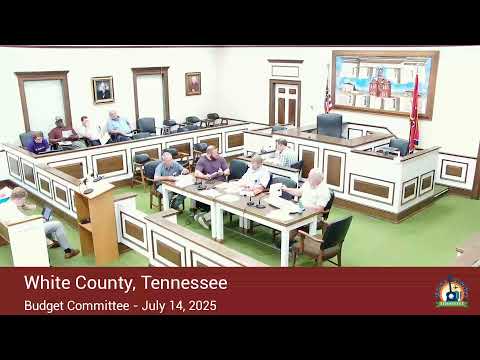
White County budget committee reviews proposed FY2026 spending, forwards plan to full court
Summary
The White County budget committee met to review a proposed fiscal year 2026 budget that has been posted for public hearing and will go before the county's full court for a vote on July 21.
The White County budget committee met to review a proposed fiscal year 2026 budget that has been posted for public hearing and will go before the county's full court for a vote on July 21.
The meeting focused on clarifying line-item changes and assumptions in the proposed budget and answering commissioners' questions. Committee staff and commissioners discussed salary adjustments, department funding sources, revenue forecasts and several capital projects.
Why it matters: The proposed budget contains countywide salary adjustments and targeted increases that affect multiple departments and volunteer fire agencies, uses conservative revenue estimates for volatile sales and mineral severance taxes, and includes several county-building projects whose costs will be borne from the county buildings fund.
Key clarifications and staff comments
Chad Markham, the staff member responsible for the budget presentation, confirmed that the committee cannot make amendments at this meeting because the proposal has been advertised for public hearing. “That would be correct,” Markham said when asked to confirm that changes could not be made tonight.
Markham told commissioners he had corrected one line item after receiving updated figures from the University of Tennessee extension office: his earlier estimate overstated the cost by roughly $10,000. “It was about a $10,000 decrease from what I'd estimated,” Markham said.
Pay adjustments and longevity
The budget includes an across‑the‑board adjustment of $4,000 to affected full‑time employees. For hourly employees, staff explained the $4,000 was annualized and converted to an hourly increase based on a 40‑hour workweek: “we took the $4,000 divided by 52 weeks, and then divided that by 40 hours,” Markham said. Overtime remains calculated at the 1.5 rate and the $4,000 uplift was applied against the base 40‑hour week. For salaried employees, the $4,000 was added directly to annual pay.
Longevity and benefits costs were reviewed; the committee was given an estimated total longevity payout of roughly $1.51 million (with benefits pushing the approximate total higher when full‑time benefit rates are applied).
Parks and recreation; grants
Committee members reviewed the longstanding funding mechanism for parks and recreation—two pennies on the tax rate—that has been used for general maintenance since the late 1990s. Staff said the appropriation line in the resolution would remain unchanged even if a specific parks position were removed from the detailed budget, and that a grant currently anticipated would offset some costs if awarded.
Fire protection funding and county buildings projects
The proposed budget contains a $100,000 addition for fire protection that will run through Emergency Management (EMA). Staff described the allocation as $90,000 for volunteer fire departments and $10,000 for the county rescue squad for the year; the package includes funds for the city of Dole. Putting the money through the county budget, staff said, ensures purchases follow county procurement procedures and creates accountability for larger, consolidated purchases.
Several county‑owned building projects are included in the county buildings fund (line 51‑800), totaling projects listed in the fund's roughly $193,000 package. Examples noted in the meeting are a roof for the Mount Gilead Fire Department (a county‑owned building), laboratory work at the county jail and carpet replacement at the public library.
Revenue assumptions and code adjustments
Staff described the county’s sales tax projections as cautious: after strong increases in fiscal years 2022–2024, collections weakened during the 2024 holiday season, and staff settled on a projected $100,000 increase for the coming year that they said felt prudent given the tax's volatility.
Mineral severance tax estimates were reduced from prior projections after anticipated quarry activity did not materialize; that lowered the 2526 estimate to better align with expected maintenance‑of‑effort requirements for the highway public works fund.
Property tax revenue in the proposed budget includes an allowance for a 5% delinquency rate; staff said that percentage has historically tracked well with actual collections.
Grant coding and dedicated revenues
Commissioners asked about coding of a school resource officer (SRO) grant. Staff said a $600,000 SRO grant (noted as $75,000 per school) was listed under an incorrect state‑revenue code (46‑290) and that it should be moved to the correct code (46‑240) in the revenue ledger.
Building permits, passports and fee changes
Staff reported a change in the building‑permit fee structure that went into effect Feb. 1. Through May, building permit fees collected totaled approximately $246,376; an accounting transfer processed in June will further increase the year‑to‑date total. Passport fee revenue collected by the library through May was reported at $14,920.40. Staff said the fee structure change is intended to cover the department’s costs and that permit revenue is presently part of the general fund; the budget presentation noted staff planned to restrict those funds if appropriate.
Other items
Workers' compensation premiums rose significantly and account for a notable increase in the county buildings fund budget; staff cited several claims and higher premium costs countywide. The proposed budget does not include opioid abatement funds because those dollars must be appropriated for specified uses; staff said future budget amendments will handle opioid‑related appropriations.
The county's regular contribution to the regional 9‑1‑1 service was described as a standing commitment of $254,110; staff said that contribution has been increased recently and is treated as a continuing funding obligation that the county follows as part of its maintenance of effort.
Votes at a glance
- Motion to approve minutes from the July 7 meeting: motion passed by voice vote (no roll‑call tally recorded). - Motion to adjourn: passed by voice vote.
Next steps and public comment
The budget will be the subject of a public hearing and a full‑court vote scheduled for Monday night, July 21. The committee announced it will accept public comment during the full‑court meeting; the next budget committee meeting was scheduled for August to continue follow‑up after the full‑court action.
Speakers and attributions in this report are limited to individuals identified in the committee meeting transcript and staff presentation; direct quotes are attributed to those speakers as recorded in the meeting.