Get Full Government Meeting Transcripts, Videos, & Alerts Forever!
Get email alerts on the Sunshine Ordinance topic
No spam. Unsubscribe anytime.
Ethics Commission takes no action now on Sunshine Ordinance referral involving SFPD; leaves door open for willfulness complaint
Summary
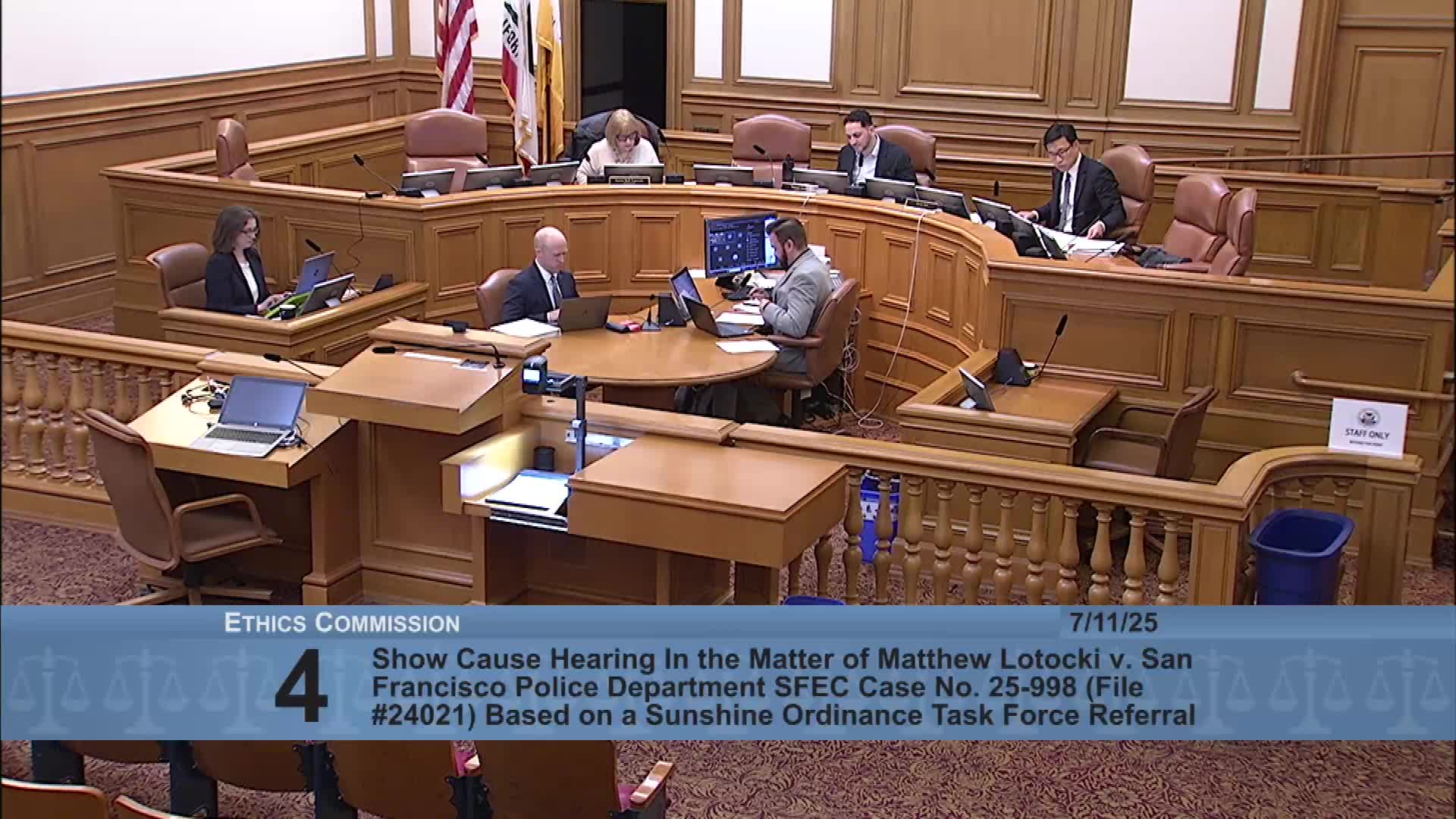
The San Francisco Ethics Commission voted 3-0 on July 11 to take no action on a Sunshine Ordinance Task Force referral regarding Matthew Latoki’s request for San Francisco Police Department records, saying the matter may be refiled as a willful-violation complaint.
Acting Chair Vice Chair Salahi and two other commissioners voted unanimously on July 11 to take no action on a referral from the Sunshine Ordinance Task Force about a records order for the San Francisco Police Department, while leaving the matter “without prejudice” so the petitioner or the task force may pursue a willfulness complaint under the commission’s standard enforcement process.
The vote followed extended legal discussion about whether the Ethics Commission can enforce non-willful violations of the Sunshine Ordinance. Enforcement staff recommended against action on the referral, saying the regulations do not authorize monetary penalties or other remedies for non-willful violations. Director of Enforcement Matthews told the commission the staff’s view was that "the regulations do not provide for monetary penalties or other remedies upon a finding of a non willful violation," and recommended no action on that basis.
The item began as a May 2, 2025 referral from the Sunshine Ordinance Task Force under San Francisco Administrative Code section 67.35(d) about the Police Department’s refusal to comply with an order of determination. Acting Chair Salahi framed the legal choice the commission faced: whether to adjudicate the merits of whether records must be disclosed or to determine only whether a city official willfully ignored a task force order. Salahi said, "the question is simply whether or not there was a willful violation of an order by the Sunshine Ordinance Task Force," and urged colleagues to focus on that narrower question.
Dean Schmidt, who appeared for the Sunshine Ordinance Task Force, told commissioners the task force had issued an order to produce records and had not made a majority finding of willfulness; he said the task force believed the petitioner could bring a willfulness allegation to the Ethics Commission. Schmidt explained the task force’s view that the ordinance’s drafters intended alternative administrative remedies and that some referrals should be eligible to come before the Ethics Commission.
Petitioner Matthew Latoki participated by phone and told the commission he believes the Police Department committed "a willful violation of the order of determination," and urged the commission not to require him to refile the case. Sergeant Walter Ware appeared for SFPD but said he had limited information beyond prior participation by Lieutenant Jonathan Ozil. Director Matthews and the City Attorney’s representative both reiterated that the notice accompanying the referral and the task force’s own referral language were framed as a non-willful referral and that a willfulness complaint should proceed through the Ethics Commission’s ordinary complaint and investigation process if the petitioner or the task force prefers that route.
After discussion, Commissioner Yeh moved to take no action on the referral without prejudice to Mr. Latoki or the Sunshine Ordinance Task Force presenting the issue as a willful-violation complaint under the regular enforcement procedures; the motion was seconded and passed on a 3-0 roll call. Commissioner Yeh, Commissioner Francois and Acting Chair Salahi each voted “Aye.” The commission’s action leaves open the option for the petitioner or the task force to file a willfulness complaint under the standard Section 10(a) complaint process, which would trigger the commission’s formal investigation and probable-cause procedures.
The commission did not impose penalties or make any finding about the merits of whether the records at issue are disclosable under the Sunshine Ordinance or the California Public Records Act. Commissioners and staff repeatedly emphasized that the current question was procedural and jurisdictional rather than a merits adjudication of the underlying records dispute.
The commission’s discussion flagged divergent interpretations of Administrative Code sections 67.21, 67.34 and 67.35(d) and the limitations imposed by the City Charter on the Ethics Commission’s remedial authority. Commissioners and staff said the debate over jurisdiction and remedies will inform a broader discussion later in the meeting about proposed amendments to the Ethics Commission’s enforcement regulations.