Get Full Government Meeting Transcripts, Videos, & Alerts Forever!
Get email alerts on the Land Use topic
No spam. Unsubscribe anytime.
Woodland Park planning commission agrees to relabel draft 'open space' rules as lot coverage standards, moves code toward legal review
Summary
At its July 10 work session, the Woodland Park Planning Commission discussed a draft Unified Land Development Code, agreed to relabel and clarify lot-level 'open space' provisions as lot coverage standards, and directed staff to share comment tracking, send the draft for legal review and aim for public outreach this fall.
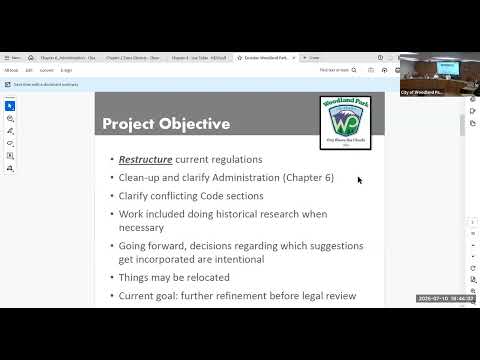
Woodland Park — At a July 10 work session, the Woodland Park Planning Commission reviewed a clean draft of a consolidated Unified Land Development Code and agreed to relabel confusing lot-level "open space" requirements as lot coverage standards, directing staff to share comment tracking, send the draft to the city attorney for legal review and prepare for public outreach in the fall.
The code rewrite is a structural effort to combine multiple zoning chapters into a single, clearer document. Planning staff said the draft reorganizes three former chapters into a unified code and will relocate some provisions (for example, lot-coverage tables) so rules are easier for staff, applicants and the public to find.
Commissioners and staff stressed the change is largely organizational rather than substantive: the metrics behind requirements (for parkland dedication, cluster development open space and coverage ratios) are not being removed, but where those metrics appear in the document will shift so related rules are grouped together.
Discussion and key direction
Commissioners focused on a recurring source of confusion in the current regulations: a 40% open-space requirement that applies in some subdivision and cluster-development contexts versus a separate lot-coverage table intended to limit how much of an individual lot may be built upon. To reduce confusion, the commission endorsed renaming the lot-level provision to a clear lot coverage section (variously described in the meeting as “lot coverage limitations,” “lot coverage standards” or “lot coverage requirements”) and adjusting the draft text so it reads in terms of maximum covered area rather than the inverse wording "open area".
Staff explained the lot-coverage table uses a formula tied to lot size: for example, a 7,500-square-foot lot would allow 35% coverage while an acre would allow 20% coverage, so the allowed percentage declines as lot size increases. Commissioners asked that the revised language make clear the standard applies at the individual lot level and be explicit about what elements count as covered area.
Commission guidance and next steps
The commission asked staff to provide a comment-tracking spreadsheet that shows which commission suggestions were accepted, which were not and why. Staff agreed to provide that file and to continue refining terminology (for example, moving from the term "mobile home" to "manufactured home," and updating references from "family" to "household" to match state law changes).
Staff said the next formal steps are: integrate commission comments from the current review period, send the draft to the city attorney for legal review (staff indicated that review was expected in August), then hold a broader public outreach period once the legal review is complete. Staff estimated a September public unveiling and a 30-day comment period, with subsequent public hearings before the commission and then city council later in the year or early next year.
Other concerns flagged
Commissioners identified several areas that need additional clarification or future study: the precise authorities and appealability of the Board of Adjustment/appeals processes (commissioners said the draft scattered appeal references across multiple sections and made it hard to determine what is appealable); enforcement and penalty procedures (how notices of violation and court summons are used and where monetary penalties are set in the municipal code); parking standards and some engineering specifications tied to subdivision standards; and the interaction between multifamily-use descriptors and conditional-use review.
Historical context and residual edits
Staff summarized the code's history to explain the current disconnects: some provisions adopted in 1998–2001 (including a 40% open-space requirement tied to subdivisions and a separate land-use intensity/lot-coverage table) have been carried forward even as use tables and other sections changed in more recent updates (including a 2020 amendment tied to tiny-home/detached-dwelling issues). That history, staff said, explains why a single policy concept can appear in multiple chapters and why the reorganization seeks to collocate related rules.
Document metrics
Staff reported the current clean draft is roughly 307 pages with 239 reviewer comments captured in the commission review spreadsheet (staff reported about 13% of comments were questions, 16% were freeform comments and roughly 2% were technical edits). Commissioners asked that staff address cross-reference and subsection citation problems throughout the draft so references point to the intended paragraph or subsection rather than a broader chapter.
What was not decided
No formal vote was taken. Commissioners did not adopt final wording at the meeting; rather, the group provided direction to staff to make the terminology and structural changes described above, to share the comment-tracking spreadsheet, and to send the draft for legal review before public release.
Ending
Staff and commissioners said the rewrite is intended to be a living document that will be refined after legal review and public comment. The commission signaled general support for moving the draft forward with the requested clarifications and for scheduling public outreach once the city attorney completes review.