Get Full Government Meeting Transcripts, Videos, & Alerts Forever!
Get email alerts on the Mosquito Control topic
No spam. Unsubscribe anytime.
Maryland entomologist urges neighborhood cleanup, explains county spray rules
Summary
Jean Zastrow of the Maryland Department of Agriculture briefed College Park residents on mosquito biology, disease risks, and control measures, emphasizing source reduction, larviciding options, and how the county’s truck-spray program and exemptions work.
Jean Zastrow, an entomologist with the Maryland Department of Agriculture (MDA) mosquito control program and head of the Anne Arundel County program, told College Park residents on July 9 that the most effective way to reduce biting mosquitoes is to find and eliminate small breeding sites in and near yards.
Zastrow told members of the city meeting that Maryland has about 60 mosquito species in roughly 10 genera, but “only about 10 of these species are of concern for vectoring disease.” She said the department uses an integrated pest management approach that prioritizes larval controls, targeted biological products and insect growth regulators, and limited adult pesticide applications when disease or population thresholds are met.
Why it matters: Mosquito-borne illnesses such as West Nile virus and eastern equine encephalitis circulate in Maryland; control decisions can affect public health and household use of private pest services. Zastrow said community cleanups and coordinated neighborhood action are especially important for Aedes albopictus, the Asian tiger mosquito, which breeds in tiny amounts of water and is closely associated with human habitations.
Zastrow explained control tools and local rules. Larval products used by the MDA are biochemical and insect growth regulators; the state also stocks some permanent water sites with native fish (fathead minnows) under a free permit from the Maryland Department of Natural Resources. For adult mosquito nuisance spraying the program typically applies permethrin via ultra-low-volume (ULV) foggers during evening hours; Zastrow said the droplets and the low label rates the agency uses mean the truck-applied spray is effective for roughly 30 to 40 minutes before dispersing or binding to surfaces.
On exemptions and buffers, Zastrow said individuals who do not want a truck spray applied near their property can contact the office to register an opt-out; the program then creates a 300-foot buffer around that address for standard nuisance applications. She emphasized that exemptions are suspended during disease-response spraying.
Residents pressed for practical steps and local notification. One resident who said she has lived in College Park since 1962 described health concerns and asked how a neighbor’s opt-out increased her risk; Zastrow advised first asking the neighbor to reduce the buffer, and said petitions and community-level requests can be elevated to the secretary of agriculture for review. Residents also asked how they will know when their neighborhood is scheduled: Zastrow said the city typically posts maps and announces treatment nights (and College Park runs a text notification system), and the MDA assigns night-of-week zones where possible but will not treat if weather or staffing conditions make applications ineffective (she cited temperature and wind limits).
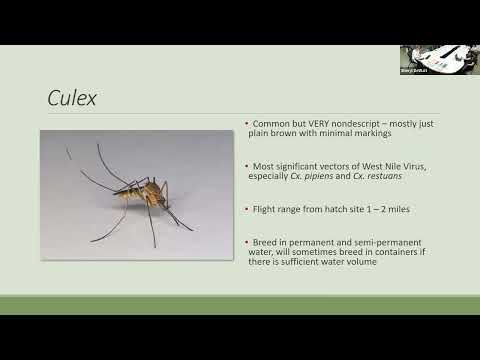
Zastrow reviewed species and disease context: Culex species are the main concern for West Nile virus and can fly one to two miles from larval sites; Anopheles species vectored historic malaria; and Asian tiger mosquitoes (Aedes albopictus), introduced to Maryland in 1987, bite in daytime, breed in containers as small as a teaspoon of water and generally fly about 200 meters from their hatch site. She also noted one locally transmitted malaria case in Maryland in 2023 as context for surveillance.
On the risks of private commercial applications, Zastrow said many for‑hire firms use longer‑residual, broader‑spectrum pesticides and barrier treatments that persist on vegetation for days or weeks, and that applicator training and correct certification (mosquito category certification) matter when hiring a private service. She recommended proven repellents (DEET, picaridin and oil of lemon eucalyptus) and community cleanups, and discouraged reliance on unproven essential oils.
Technical and logistical details cited by Zastrow included: MDA traps and larval dipping to monitor species and disease, sending suspect samples to the Maryland Department of Health for testing, optional fish stocking (fathead minnows) that requires a DNR permit, and guidance that the truck-applied fogging is typically not performed below about 62°F or above about 85°F, and is halted for rain or high winds.
The presentation included a Q&A in which residents asked about how to publicize the talk, the availability of mosquito dunks for container treatment, where to get inspection help, and the environmental effects of spray. Zastrow said most of the material is available on the MDA mosquito control web pages, recommended working with neighbors for community cleanup and outreach, and encouraged residents to call the local MDA office for inspections.
For residents seeking follow-up, Zastrow provided the local MDA office phone number that covers Prince George’s County and central and western Maryland, and she offered to check with agency public information staff about re-using the recorded meeting materials for local outreach.