Get Full Government Meeting Transcripts, Videos, & Alerts Forever!
Get email alerts on the Electric Vehicle Infrastructure topic
No spam. Unsubscribe anytime.
Moab planning commissioners workshop EV-readiness ordinance; staff to refine exceptions and thresholds
Summary
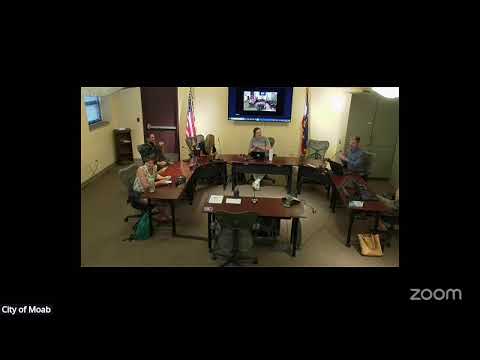
Moab City Planning Commission members and staff revisited a draft electric‑vehicle readiness ordinance July 10, debating unit thresholds, how to treat townhomes versus shared‑parking multifamily projects, and the scope of an exceptions process.
Moab City Planning Commission members and city staff returned July 10 to a draft ordinance aimed at making new multifamily housing ‘‘EV-capable’’ or ‘‘EV-ready’’ as part of the city’s emissions-reduction goals. Planning staff presented draft text, commissioners questioned the threshold that triggers the rules, and staff said it will refine the exception and administrative-review language before a public hearing.
The ordinance draft would apply to multi‑household dwellings and, as currently written, would kick in at three or more dwelling units. The draft sets 10% of spaces as EV-capable and an additional 10% as EV-ready (a combined 20% standard) and contains an exception process for development that cannot meet the standard as written. ‘‘This is how we have it written right now — 10% EV capable and 10% EV ready,’’ said Alexi Lamb, city planning staff, during the workshop.
Commissioners and staff debated three main questions: what unit count should trigger the standard (options discussed included three, five and seven units); whether townhomes with individual garages should be treated the same as apartment-style shared-parking projects; and how exceptions should be reviewed — administratively by staff or by the planning commission as a discretionary process. Planning staff and the city’s building official raised concerns about aligning the ordinance with state code distinctions between the International Residential Code and the International Building Code and with federal accessibility rules such as the Americans with Disabilities Act.
Why it matters: the threshold and exception rules affect small ‘‘missing middle’’ projects that developers say are most likely to face costly electrical upgrades. Commissioners said they want to avoid creating procedural hurdles that slow new housing while still advancing the city’s climate goal. Commissioner Miles Lofton said he favored a lower threshold tied to the city’s land-use code to standardize review; Commissioner Jill Tatton and others said they wanted strong—but defensible—exceptions language to avoid arbitrarily denying requests.
Discussion highlights - Trigger level: Staff noted the municipal land‑use code currently treats three or more units as multi‑household; staff suggested retaining the land‑use threshold for consistency but offered options to raise the trigger to five or seven units to reduce small-project impacts. - Townhomes and ownership: Barry, the city building official, and Alexi Lamb described townhomes as often built and served like single‑family homes (private garages and individual ownership) and therefore potentially less appropriate for a multifamily-triggered standard; commissioners raised the possibility of defining ‘‘shared parking’’ as a separate trigger but noted that ‘‘shared parking’’ is not yet a defined term in the code. - Exception process and review authority: Staff described attorney feedback warning that overly vague administrative exceptions can be legally vulnerable and that discretionary, documented planning-commission findings are more defensible. Staff recommended aligning the exception process with existing discretionary exceptions (as used for landscaping) and building clear findings of fact to support any denials. - Practical effects/costs: Commissioners and staff discussed likely installation costs and power needs. Staff and commissioners noted a 30–50 amp circuit in a new garage is a common step to make a unit ‘‘EV-ready’’ and estimated incremental costs as ranging from a few hundred dollars up to roughly $1,500 depending on site conditions and conduit runs. Commissioner Miles Lofton said two 40‑amp circuits in a garage are useful beyond charging electric vehicles, for tools or secondary appliances.
Direction and next steps - Staff will tidy the draft ordinance, incorporate attorney comments, and return the proposed code in a structure ready for a public hearing. Alexi Lamb said the draft will be adjusted to match existing administrative practice where appropriate and to include a clearer exceptions process. No vote or formal action was taken. - Commissioners asked staff to provide clearer definitions (for example, ‘‘shared parking’’), costs examples, and a recommended trigger option for the commission to consider at the next hearing.
Context and constraints: Commissioners noted technical factors outside city control — state code distinctions between IRC and IBC and ADA obligations — affect when higher standards reasonably apply. Staff flagged that certain small projects may be technically feasible for EV readiness but that mid‑scale ‘‘missing middle’’ projects sometimes require electrical upgrades that create the largest cost and feasibility questions.
Quotations - Alexi Lamb, city planning staff: "This is how we have it written right now — 10% EV capable and 10% EV ready." - Barry, building official: "Townhomes often have private garages…should we consider those developments differently?" (paraphrased during the workshop)
What’s next: staff will revise the draft and bring a public‑hearing version back to the Planning Commission for formal consideration; city council will ultimately decide whether to adopt an ordinance.
Speakers quoted or recorded in the workshop included Alexi Lamb (city planning staff), Corey Shurtleff (city staff), Barry (building official), Miles Lofton (planning commissioner), Jill Tatton (planning commissioner), Carolyn Conant (planning commissioner), Kai Marenfeld (planning commissioner/chair) and Nathan (city attorney), among others.