Get Full Government Meeting Transcripts, Videos, & Alerts Forever!
Get email alerts on the Governance And Administration topic
No spam. Unsubscribe anytime.
OHA trustees vote unanimously to enter executive session after public testimony alleging rushed budget process and improper legal counsel
Summary
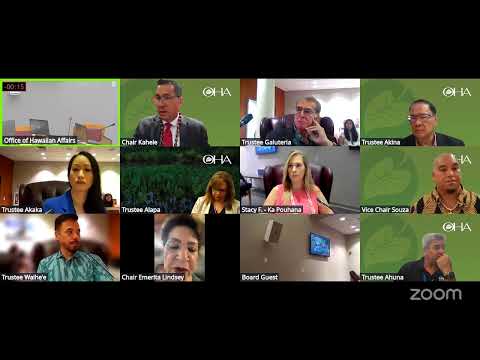
On July 10, 2025, the Office of Hawaiian Affairs Board of Trustees voted 9-0 to go into executive session to consult with attorneys on trustees’ duties after public testimony alleging the biennium budget process and use of external counsel bypassed board approval and limited beneficiary input.
The Office of Hawaiian Affairs Board of Trustees voted 9-0 on July 10, 2025, to enter an executive session pursuant to "HR section 92-5" to consult with attorneys on trustees’ duties related to OHA’s financial affairs, employees and operations, after a public commenter raised concerns about the board’s budget process and use of outside legal counsel.
The testimony came from Jermaine Myers, who identified himself as an OHA beneficiary and a Nanakuli Hawaiian homestead lessee. Myers said beneficiaries lacked adequate time to review the most recent biennium budget and questioned use of legal advice during board discussions. "Beneficiaries did not have sufficient time on this financial matter to give input," Myers told the trustees, and asked, "Why couldn't the executive session wait until after public testimony?" He also cited the Sunshine Law while presenting his remarks.
Myers told trustees the board had worked from four different budget versions and that the last version was posted three days before a June 30 Board/BLT meeting, leaving beneficiaries, he said, with only minutes to respond. He said public testimony was limited to five minutes at 8 a.m. on June 30 and that open session testimony did not begin until about 10:30 a.m., forcing attendees to wait on a weekday for full public comment.
Myers also described a sequence of motions at the June 30 meeting: he said Vice Chair Souza moved to waive or bypass fuller discussion of the biennium budget in committee, Trustee Akaka offered an amended motion described as a stopgap, and Chair Kahele declared Akaka’s amendment unacceptable. Myers further alleged that when Trustee Akaka requested that corporate counsel Everett Ota come to the table to address the amendment, Chair Kahele denied that request and instead brought an attorney to the board table who, Myers said, had not been approved by the full board. "Where a request is made in writing and a legal opinion is rendered by the department of attorney general or any other external legal counsel, such opinion along with a copy of the written request for such an opinion shall be immediately distributed to all board members in written form," Myers said, citing provisions of the OHA bylaws that he said were amended and approved by the full board in April.
The trustees then moved to recess to executive session. The roll call recorded the following votes in favor: Trustee Akaka (aye); Trustee Akina (aye); Trustee Alapa (yes); Trustee Lindsay (aye); Trustee Galloteria (aye); Vice Chair Souza (aye); Trustee Waheae (yes); Chair Kahele (aye). The board secretary announced there were nine yes votes and the board was moving into executive session. The motion’s maker and seconder were not stated on the public transcript.
The board opened the meeting by announcing it would livestream the open session and said it would return to open session and resume livestreaming after completing the executive session. Interim corporation counsel Everett Ota and other OHA executive staff were identified as present at the start of the meeting; no legal conclusions or board decisions from the executive session were recorded in the public portion of the transcript.
Because the transcript records discussion and a formal vote to enter executive session but does not record the substance of the attorney consultation, public details about any legal advice or subsequent board action were not available in the public record provided.