Get Full Government Meeting Transcripts, Videos, & Alerts Forever!
Get email alerts on the Comp Plan Update topic
No spam. Unsubscribe anytime.
Spokane Valley begins comprehensive plan update, flags housing shortfall and wildfire risk
Summary
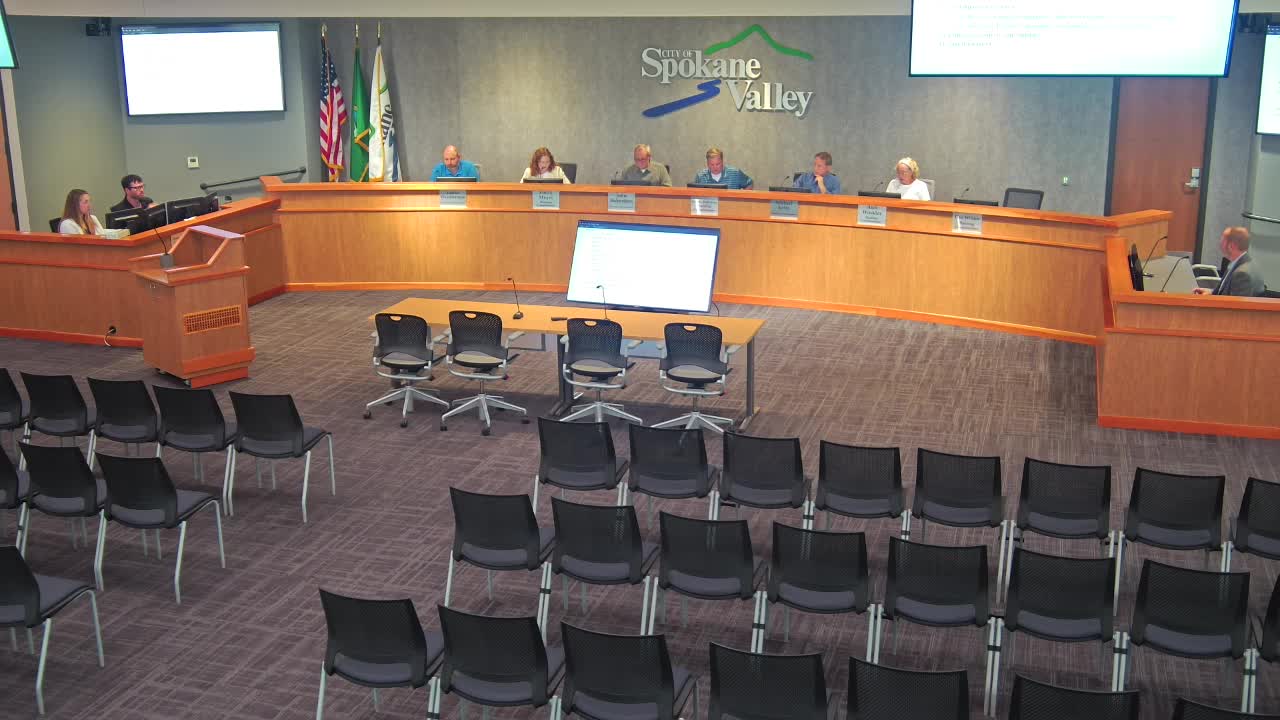
City planning staff told the Spokane Valley Planning Commission on July 10 that the comp plan update will prioritize housing, a new climate element and code changes tied to wildfire risk, while commissioners raised concerns about parking, density and public input.
The Spokane Valley Planning Commission on July 10 opened a yearlong update of the city's comprehensive plan that will add a climate element, address state-mandated housing requirements and include a vulnerability assessment that identifies wildfire and smoke as the city's highest climate risks, city planner Steve Roberge said.
The update will guide future zoning and development code changes and will be paired with a State Environmental Policy Act (SEPA) environmental impact statement, Roberge told commissioners. He said staff and a consultant team will move through an audit-and-analysis phase into policy development this year, with a draft comprehensive plan assembled in January and a planning commission recommendation expected around March; staff said they are targeting adoption in mid-2026 while noting the state has offered an extension of the statutory deadline.
Why it matters: the update responds to recent state law changes and countywide policy shifts that require local governments to plan for specific housing types and income levels, add a climate resiliency element and bring local codes into compliance. Those changes could require higher residential densities, adjustments to critical-area protections and specific mitigation measures to address wildfire and smoke exposure, city staff said.
Roberge outlined the project schedule and major components. The work is organized into phases: an audit/analysis phase that staff said is nearly complete; a policy-development and drafting phase through late 2025; and a plan adoption and code-update phase that will run into early 2026. He said the update will add a climate chapter with two subelements: a greenhouse-gas inventory and policy piece (described as largely analytical and policy-oriented) and a resilience subelement that may lead to code changes.
On housing, Roberge said the city must "plan for certain income levels" and ensure zoning provides locations and capacity for specified housing types, including middle housing and accessory dwelling units, as required by state law. He told commissioners the city's land-capacity analysis showed Spokane Valley currently lacks enough land under existing zoning to meet its allocation of roughly 16,600 homes over the next 20 years.
Commissioner Meyer, citing material from a recent Greater Spokane Incorporated housing summit, said the Spokane County median home price now exceeds $400,000 and said he understood that about 70% of the county population cannot afford that median price. Meyer said the council's takeaway was that jurisdictions need housing "at each level of affordability" so people can move up the housing ladder.
Roberge said staff will present policy options when choices exist and identify where state statute imposes specific mandates. "My goal is to provide to you options where we have options and identify where something has been mandated strictly," he said.
Climate and vulnerability assessment: Roberge presented a vulnerability assessment prepared for the city that draws on maps and data from the Washington Department of Natural Resources. The assessment examined three sectors'0 health and well-being, natural environment and built infrastructure'0 and, according to Roberge, found the highest vulnerabilities tied to wildfire and wildfire smoke, with the largest impacts on public health and on community resources and public services.
Roberge described the vulnerability method as qualitative, using exposure, sensitivity and adaptive-capacity metrics to assign low/medium/high scores. He said the resilience subelement of the climate chapter will focus on actions and may produce regulatory changes, while the greenhouse-gas subelement will result primarily in analysis and policy recommendations rather than extensive code revisions.
Public engagement and materials: staff said the project has launched a comp plan 2026 webpage and a public survey; the planner reported more than 150 responses at the time of the meeting and said staff will be promoting the survey through social media, a farmers market outreach event and other channels. Roberge said background documents from the audit phase will be posted on the project web page as they are finalized.
Commissioner concerns: several commissioners pressed staff on how much genuine influence the planning commission and city council will have over policy outcomes, given state mandates and consultant-driven work. Commissioners raised quality-of-life questions tied to density and parking: some warned that reducing on-site parking without other measures could shift cars into neighborhood streets and harm livability. Commissioners also asked about the interaction between growth, housing density and local climate impacts; Roberge said greenhouse-gas effects will be examined in the climate analysis and through the SEPA alternatives analysis.
Staff acknowledged trade-offs. Roberge said the SEPA environmental impact statement will analyze a no-change alternative, a more extreme alternative and a preferred alternative, and that mitigation measures would be identified through that public-scoped process. He said the city has used a state-provided checklist to identify specific statutory changes that will require code amendments.
Next steps: staff will continue policy conversations on housing, transportation and climate through fall and winter, present draft policy options and return with more detailed materials and code amendment proposals. Roberge encouraged commissioners to participate in outreach events and said the consultant team brings prior local experience, including work on Spokane Valley's 2016 comp plan update.
Votes at a glance - Motion to approve agenda: approved (vote tally not specified). - Motion to approve minutes for 05/22/2025: approved, 6 in favor, 0 opposed (as recorded in the meeting). - Motion to adjourn: approved (ayes recorded).