Get Full Government Meeting Transcripts, Videos, & Alerts Forever!
Get email alerts on the Municipal Budgeting topic
No spam. Unsubscribe anytime.
Conroe council reviews FY2026 budget, directs staff to model pay scenarios after months of hiring freezes
Summary
At a July 10 budget workshop, Conroe city staff presented the proposed fiscal year 2026 operating and CIP budgets and council members pressed for options to raise employee pay — including COLA and step proposals — directing staff to return with modeled scenarios and multi‑year projections.
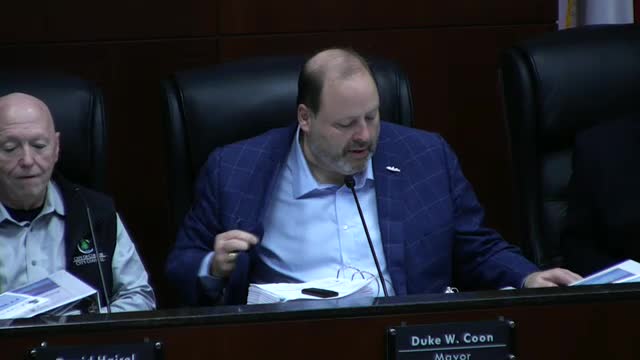
Mayor and council members met July 10 in Conroe for a public budget workshop to review the proposed fiscal year 2026 operating and capital improvement program (CIP) budgets and to press city staff for options to increase employee pay.
Finance staff presented an overview of the proposed FY2026 operating budget and related estimates. Finance director Ms. Gibbs said the city’s total gross revenue proposed for FY2026 is $362,000,007 (presented in the workshop slides) and that the general fund gross revenue budget is $136,000,008 with proposed general fund expenditures of $130,000,006 — a difference the presentation listed as roughly $6,000,002 and an estimated fund balance of about $82,000,005 at year end.
Why it matters: Council members said employee pay is a high priority after three years of hiring freezes and continued recruitment pressure from neighboring jurisdictions. Councilwoman Porter told colleagues she “cannot in good conscience sit here without thinking about employees” and asked staff to produce scenarios for possible compensation increases. Several council members cited local law‑enforcement pay adjustments in surrounding jurisdictions as a retention risk for Conroe.
Discussion highlights - Pay options and costs: Ms. Gibbs walked through staff estimates for pay adjustments. Council and finance staff used a working figure that 1% across all funds is approximately $720,000; a 5% COLA would be roughly $3.6 million and a 6% COLA roughly $4.3 million, figures the city’s finance staff (Michael) provided during the workshop. The council also reviewed a separate step program for civil‑service positions (police and fire) that staff estimated would cost about $1.1 million. Council members asked for scenarios combining steps/merit for civil‑service positions and comparable merit/COLA packages for non‑civil‑service employees so the increases are “as equal as it can be.”
- Equity and structure: Several councilmembers — including Porter and others — emphasized fairness across civil‑service and non‑civil‑service employees. Council discussion repeatedly returned to two options: (a) a uniform COLA across all employees to lift pay bases and top‑out levels, or (b) a combination of steps for civil‑service roles and merit or COLA for other employees. Councilmember Wood summarized the request: “let’s figure the step and let’s just go baseline 2%… then what would a comparable COLA increase be for the non‑civil service employees?”
- Direction to staff: Council directed finance and HR staff to prepare several scenarios and run multi‑year projections showing the budgetary impacts. Staff said they would model combinations (steps for civil service, various COLA levels for all employees, and combined packages) and present the results at a subsequent council meeting as part of a budget update.
Other budget items noted - Reduced benefit costs: Ms. Gibbs said the city’s TMRS contribution rate was projected to fall slightly (cited in the presentation) and that the self‑funded insurance contribution per full‑time employee was proposed to decline from $17,048 to $14,942 for FY2026. Council members credited those savings as partially available to support personnel increases.
- Supplemental requests: The presentation included a list of supplemental departmental requests the finance presentation covered, including one‑time IT and equipment items and modest increases across police, fire and infrastructure operations. Ms. Gibbs noted a proposed general fund reserve set at 230 days (about $82.5 million in the slides) and characterized the proposed budget as having a modest operating surplus prior to any pay decisions.
What the council directed - Staff to return with modeled pay scenarios (COLA and step/merit combinations) and five‑year projections showing impacts to reserves and recurring costs. - HR and finance to include both general‑fund and all‑fund views so council can compare the total fiscal effect.
Ending: Councilmembers emphasized they wanted the analysis to be accurate rather than rushed. Several members said they would support increases if the models showed the city could preserve reserves and maintain long‑term sustainability; staff committed to return with scenarios ahead of the next scheduled budget meeting.