Get Full Government Meeting Transcripts, Videos, & Alerts Forever!
Get email alerts on the Trees Oaks Ordinance topic
No spam. Unsubscribe anytime.
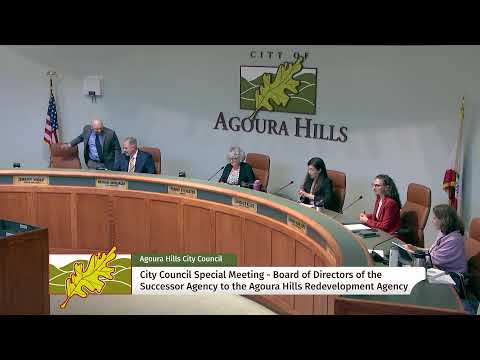
Agoura Hills staff outlines proposed oak tree ordinance rewrite focusing on consistency, incentives and mitigation bank
Summary
City planning staff presented six planning principles to rewrite Agoura Hills’ Oak Tree Ordinance, proposing consolidation of scattered rules, incentives for planting and maintenance, certifications for trimmers, and alternative mitigation options including a city mitigation bank.
City planning staff presented a set of proposed planning principles to guide a rewrite of the Agoura Hills Oak Tree Ordinance, aiming to consolidate conflicting rules, reduce barriers for homeowners, create incentives to plant and maintain trees, and identify alternative mitigation options where on‑site replacement is not feasible.
Principal Planner Robbie Nesivik framed the changes as six issue areas that emerged from the city’s review of existing code and public input. Nesivik said oak tree regulations are currently scattered across five places in the municipal code and include inconsistent mitigation ratios; for example, the zoning ordinance requires a 4:1 mitigation ratio in some cases while Appendix A requires 3:1 for commercial projects. “Oak tree regulations currently live in 5 different locations of the Agoura Hills Municipal Code,” Nesivik said, and staff proposed consolidating those provisions into a single, user‑friendly code section that follows the permit application flow.
Staff’s proposed planning principles include: (1) consolidate and clarify all oak tree regulations in one code location; (2) reframe rules to include incentives for planting and maintaining oak trees (for example parking reductions for canopy in commercial lots and homeowner recognition plaques); (3) provide clear, objective enforcement remedies and consider certification or registration for tree trimming companies to discourage bad actors; (4) explore alternative mitigation strategies such as a mitigation bank on city‑owned property, partnerships with local nurseries, and an oak tree reimbursement program; (5) set clear application requirements and streamline permitting for common pruning; and (6) evaluate community interest in protecting two additional species—California sycamore and Southern California black walnut—if public support and water‑use implications warrant it.
Nesivik and council members discussed enforcement and compliance details: current thresholds require permits for pruning cuts larger than 2 inches, and staff said they are considering raising that threshold to 4–6 inches to reduce costs for homeowners. Staff also explained the current mitigation valuation methodology uses the Council of Tree and Landscape Appraisers (CTLA) method, which can produce disputed tree valuations and expensive enforcement costs. To reduce disputes, staff proposed establishing fixed cost bands tied to local nursery pricing and creating a mitigation bank so homeowners can fund off‑site plantings when on‑site replacements are impossible.
Council members broadly supported an incentive‑first approach. Council member Deborah Klein Lopez, who served on the Land Use and Economic Development Subcommittee that reviewed the item, said incentives will reduce avoidance and illegal removals. Council members asked staff to consider a “safe harbor” for homeowners who hire city‑certified trimmers so enforcement can focus on unlicensed operators, and several members urged that any certification or training be low‑ or no‑cost and flexible (including online options) to encourage participation.
On the question of expanding the list of protected species, staff said Dudek (the city’s consultant) recommended considering the Southern California black walnut and the California sycamore. Staff noted both species are commonly used in urban landscapes, can contribute to canopy cover and have attributes favorable for fire‑wise landscaping; staff also noted higher water needs and the possibility that off‑site mitigation would be required for these species.
Staff outlined next steps: draft the ordinance for LUEDC and planning commission review in September–October, inventory city‑owned property for potential mitigation bank sites, and reach out to local nurseries and nonprofits to develop baseline mitigation costs and potential reimbursement or planting programs.
Ending: No formal action was taken at the meeting; staff will return with a draft ordinance and additional analysis for committee and planning commission review.