Get Full Government Meeting Transcripts, Videos, & Alerts Forever!
Get email alerts on the Water Infrastructure topic
No spam. Unsubscribe anytime.
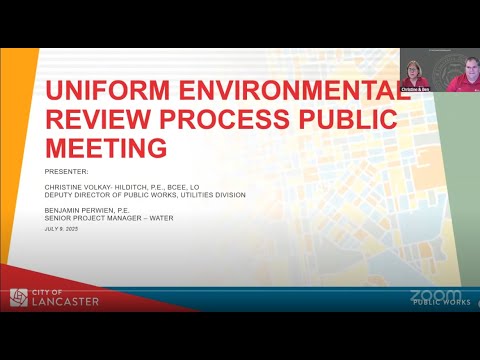
Lancaster City presents environmental review and funding plan for $40–50 million water transmission main
Summary
Lancaster City public works officials outlined an environmental assessment, permit needs, funding status and timeline for phases 2 and 3 of a large-diameter transmission main that the city says will add redundancy to the system serving about 120,000 people.
Lancaster City public works officials on Tuesday presented an environmental assessment and permitting plan for phases 2 and 3 of a large-diameter transmission main, a project the city estimates will cost between $40 million and $50 million.
The project would add a redundant raw-water and finished-water main to replace aging infrastructure installed in 1955 and to extend the redundant main completed in 2022. Chris Hildich, deputy director of public works for Lancaster (Utilities), said the system serves more than 120,000 county residents and that a 2012 leak on the older line — which cost about $200,000 to fix — underlined the need for improved transmission infrastructure. "We needed better infrastructure so that this wouldn't be an issue in the future," Hildich said.
The utilities bureau is preparing an environmental assessment under the National Environmental Policy Act (NEPA) because parts of the project would be in the floodplain and include multiple stream crossings, conditions the Pennsylvania Department of Environmental Protection (PA DEP) said preclude a categorical exclusion. The city hired Arrow Engineering to prepare the environmental assessment narratives required by PA DEP and by PENNVEST, the state lending program for water infrastructure, Hildich said.
According to the presentation, phase 3 is a raw-water main taking water from the Susquehanna River to the Susquehanna treatment plant; phase 2 is a treated-water main from the treatment plant to the Oyster Point Reservoir and an interconnect near Mountville that would allow the distribution network to operate with full redundancy. The route discussed runs through Columbia Borough, West Hempfield, Mountville Borough and East Hempfield.
Officials listed required permits including PA DEP approvals through its Safe Drinking Water program, approvals related to stream crossings that require coordination with the U.S. Army Corps of Engineers, railroad crossing agreements (Norfolk Southern and the Columbia and Reading Railroad), PennDOT highway occupancy permits for work along Columbia Avenue/Route 462, and a National Pollutant Discharge Elimination System permit for earth disturbance and construction stormwater controls.
Hildich said the city applied to the Commonwealth Financing Authority for ARPA funds in 2023 for the full cost of phases 2 and 3 but received $3,132,000 for phase 2. The city plans to apply to PENNVEST for low-interest loan funding, which requires the NEPA environmental review process that prompted the public meeting. "One of the requirements that they have is that they require that any major project have an environmental study under the National Environmental Policy," Hildich said.
The presentation gave a tentative schedule: PENNVEST application in July 2025; completion of required permits by September 2025; PENNVEST funding approval in October 2025; bidding and pipe procurement in October–November 2025; construction start aimed for January 2026; and roughly 15 months of construction with completion around March 2027. Officials said the project budget includes approximately $1,225,000 for design and surveying services.
City staff said permit applications are submitted and currently under review and comment. The presentation emphasized that the project cannot avoid floodplain exposure because the raw-water intake must withdraw from the Susquehanna River and that several stream crossings are necessary to route the mains into the distribution system. Ben Perwin, senior project manager in the water bureau, was identified as a project lead and was cited in the presentation for technical details about stream crossings and routing.
The city posted contact information during the virtual meeting for members of the public seeking more information or to submit comments. Hildich said the environmental narratives will be filed with PA DEP as part of the NEPA process required for PENNVEST consideration.