Get Full Government Meeting Transcripts, Videos, & Alerts Forever!
Get email alerts on the Worker Outreach topic
No spam. Unsubscribe anytime.
Committee backs bill to codify and expand California Workplace Outreach Program
Summary
The committee approved SB 578 to codify the California Workplace Outreach Program into the Labor Code, after testimony showing the program’s reach and effectiveness in educating vulnerable workers and promoting wage-claim activity.
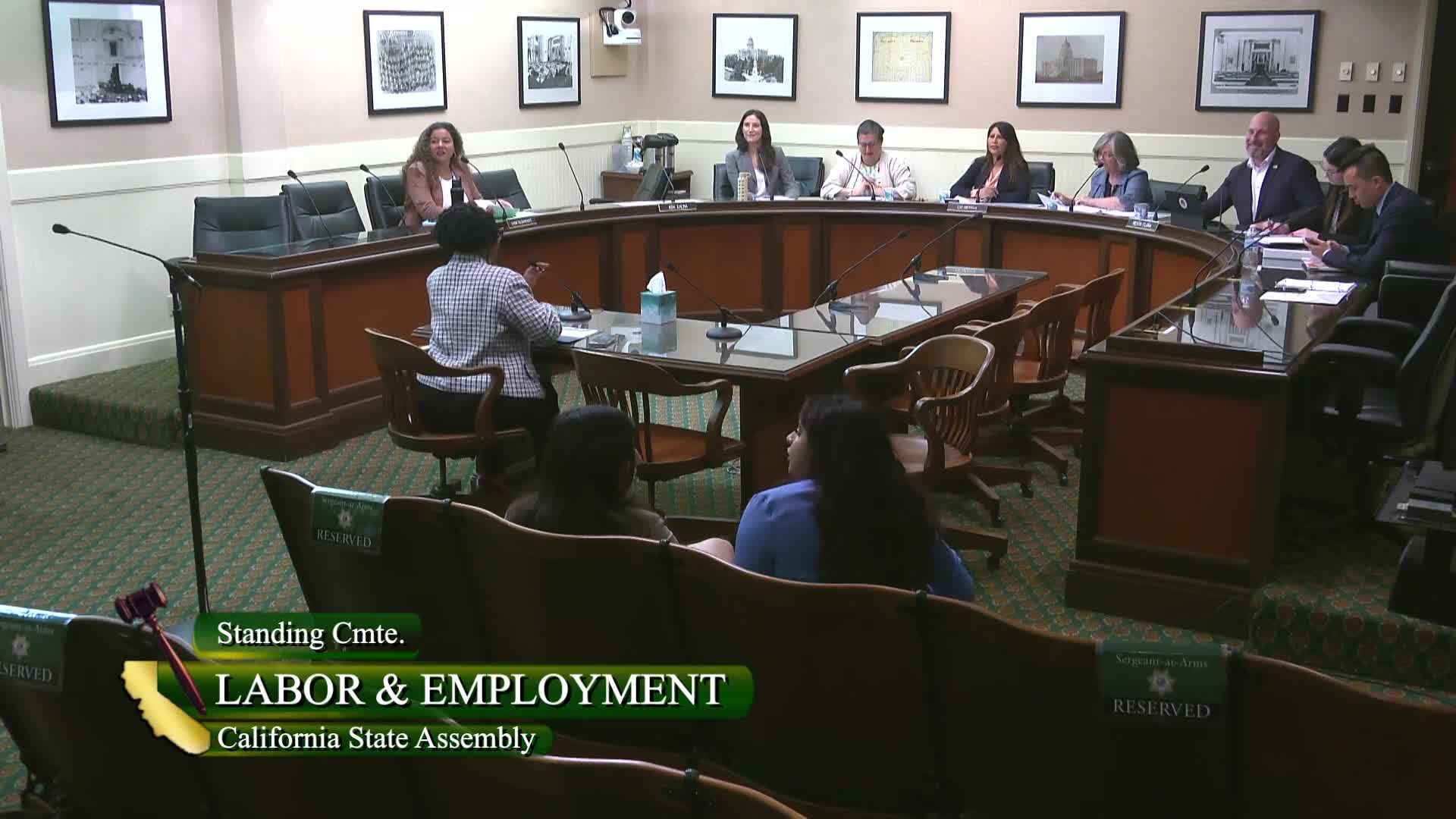
The Assembly Labor and Employment Committee voted to pass SB 578 by Sen. Smallwood-Cuevas, re-referring the bill to the Appropriations Committee. SB 578 would codify the California Workplace Outreach Program (CWAP) in the Labor Code, creating a permanent framework for state funding and partnership with community organizations that provide workplace-rights education.
Sen. Smallwood-Cuevas and researchers from the UC Berkeley Labor Center presented evidence that CWAP — started as a pandemic response — reached nearly 2 million workers across 38 counties and received $25 million in state funding during its iterations. "Workers who've been educated by a trusted messenger organization through CWAP are more likely to be aware of fair payment laws," Pam Egan of the UC Berkeley Labor Center told the committee, summarizing research findings that education through CWAP increases awareness and the likelihood of pursuing claims.
Community-based witnesses described cases in which outreach led to wage-claim filings, inspections and citations. Alexis Tedoro of the Pomona Economic Opportunity Center recounted several worker stories — including domestic workers and day laborers — who used CWAP resources to file wage claims and prompt enforcement actions. Tedoro said the program was especially valuable for immigrant workers who distrust government and rely on trusted local organizations for information and assistance.
Supporters included domestic-violence, labor and worker-advocacy organizations. No opposition witnesses were recorded. Committee members spoke in favor of codifying CWAP as a cost-effective, scalable approach to reaching hard-to-reach workers and to protecting low-wage workers across the state.
The committee moved the bill to Appropriations; proponents urged continued funding and safeguards to ensure community partners can respond quickly to crises such as raids and wildfires.