Get Full Government Meeting Transcripts, Videos, & Alerts Forever!
Get email alerts on the Worker Classification topic
No spam. Unsubscribe anytime.
Committee advances bill offering amnesty, two-paycheck system for construction truck drivers
Summary
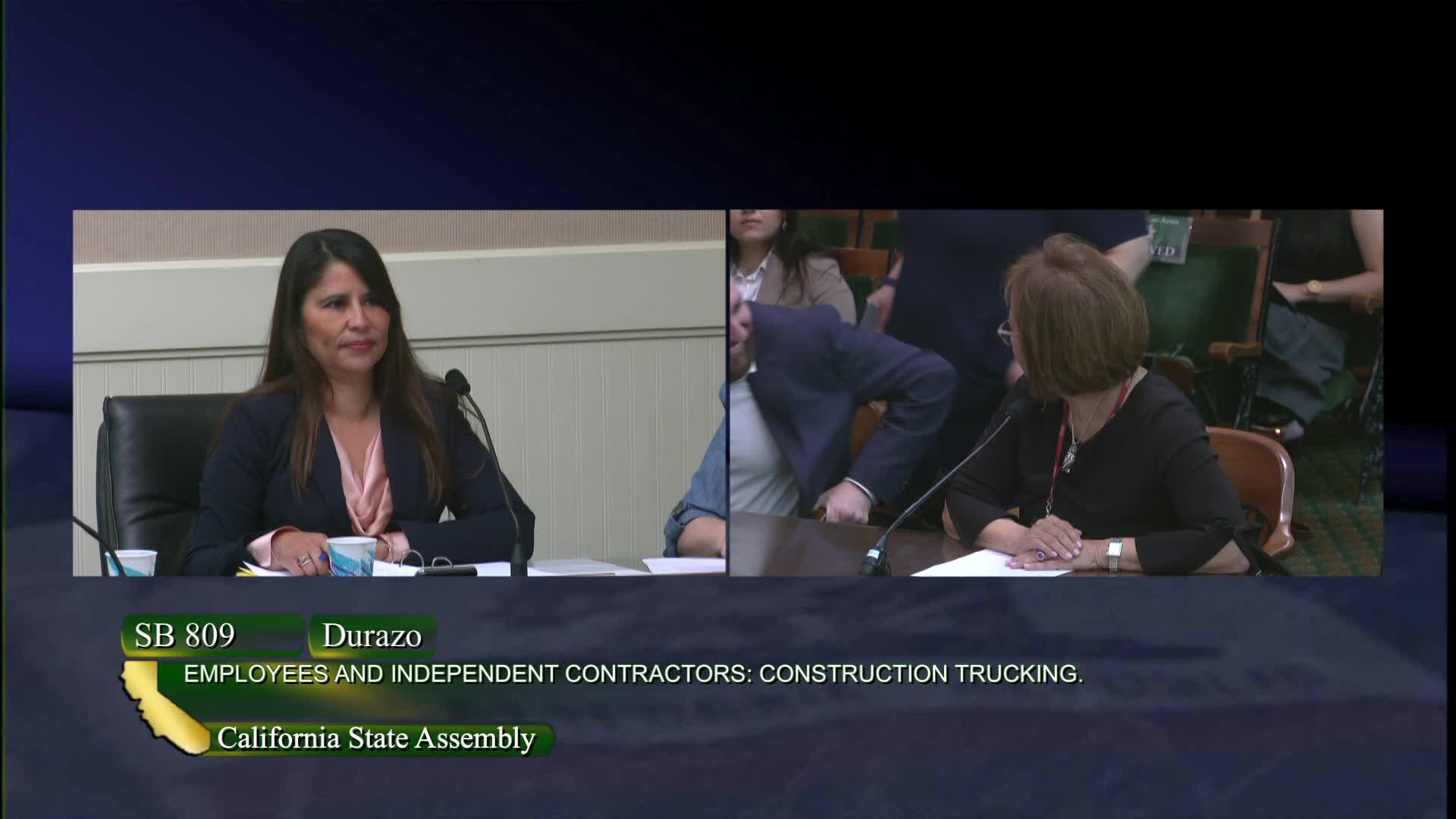
The Labor and Employment Committee passed SB 809, a Durazo-backed bill that offers limited amnesty to construction employers who reclassify misclassified truck drivers and implements a two-check payment system for labor and equipment use.
The Assembly Labor and Employment Committee voted to pass SB 809 by Sen. Durazo and re-referred the bill to the Judiciary Committee. The measure would incentivize construction employers to reclassify misclassified truck drivers as employees by offering conditional amnesty for prior misclassification if employers comply and compensate workers appropriately.
Sen. Durazo said the bill aims to stop widespread misclassification in construction trucking and to implement a two-check system that separates pay for labor from compensation for use of equipment such as trucks. "This guarantees they're compensated fairly for both their time and the expenses related to their trucks, such as fuel and maintenance," the author said in presenting the bill.
Matt Broad (California Teamsters) and Judy Yi (State Building and Construction Trades Council) testified in support, describing the bill as a pathway to compliance with AB 5 while protecting workers' wages and benefits. "If you implement this high road jobs model, the 2 check system ... you can get immunized for liability for misclassification," said Matt Broad in support. Testimony argued the bill balances employer liability relief with worker protections and cited brokers and dispatch systems as drivers of the misclassification problem.
No witnesses testified in opposition. Committee members recorded ayes during the roll call and the bill was read out as passed and referred to Judiciary.
SB 809 proponents said the bill uses an established model that other jurisdictions have employed to transition workers from independent contractors to employees while accounting for equipment-related costs.