Get Full Government Meeting Transcripts, Videos, & Alerts Forever!
Get email alerts on the Cannabis Regulation topic
No spam. Unsubscribe anytime.
Lake County supervisors hear hours of public comment as rewrite of cannabis ordinance advances
Summary
Dozens of residents, farmers and industry representatives urged the Board of Supervisors to refine proposed cannabis zoning, setbacks, hydrology rules and grandfathering — while the board signaled support for higher setbacks, hydrology studies and rescinding a 10-year permit cap.
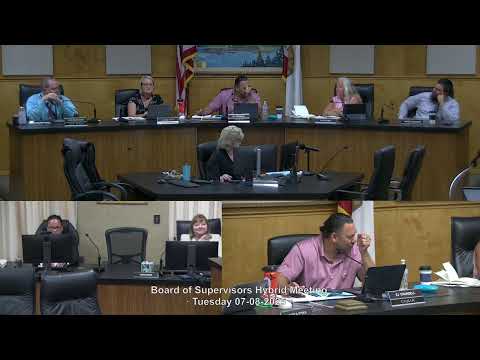
LAKEPORT, Calif. — Lake County supervisors on July 8 heard more than two hours of public comment and a lengthy board discussion on staff recommendations to rewrite the county’s cannabis ordinance, with speakers urging a mix of protections for legacy farms, stricter setbacks and clearer hydrology and enforcement rules.
The hearing gathered growers, ranchers, neighborhood residents and nonprofit advocates who addressed topics including expansion of the county’s Farmland Protection Zone (FPZ), proposed setback distances from residences and public lands, whether homeschools should be treated as protected schools for setback purposes, hydrology and water-use reporting, odor and filtration standards for greenhouses, bonding for enforcement, grandfathering of existing operations and the permit term length.
Speakers described divergent local impacts. Jim Comstock and Marshall Comstock, who identified their family’s multi-generation ranch on Grange Road, said cannabis cultivation is a “lifeline” that helps keep their property in agricultural production and warned that FPZ changes could exclude legacy farms. Local cultivators and task force participants, including Jennifer Smith, urged alignment with state policy and cautioned against “eleventh hour” additional exclusion zones such as homeschools. Several others, including residents Bill Wilson and Joni Henderson, said odor and health issues from nearby greenhouses have materially affected their quality of life; Henderson urged a 1,000-foot homeschool setback where an affidavit is on file with the state.
Speakers raised legal and procedural concerns. A public commenter (Autumn Carsey) and others alleged potential conflicts of interest surrounding Planning Commissioner Monica Rosenthal’s prior advocacy; other speakers, including a representative of the Blitt County Community Action Project, said county counsel previously advised the planning commission that Rosenthal was not conflicted. Double Eagle Property Owners Association and Camp Indian Meadows asked the county to recognize restrictive covenants and improve the county’s public-facing exclusion maps or intake processes so property owners and buyers are better informed.
Several cultivators and industry advocates (e.g., Louis Lincoln, equity retail license holder) urged the board not to add “added hurdles” beyond state requirements, argued for recognizing cannabis as an agricultural crop, and pressed for protections and a fair renewal path for existing legal operations. Multiple speakers asked that nonconforming legal farms be grandfathered at permit renewal.
On enforcement, speakers and staff discussed annual compliance monitoring site visits, complaint-driven follow-up (including photographic evidence of alleged water hauling), the county’s use of fines and revocation as enforcement tools, and a proposed $5,000 bond for enforcement actions (the county noted $5,000 is consistent with many code enforcement clean-up costs, while some board members suggested a higher amount could be considered). Staff said annual compliance monitoring visits are being conducted for every permitted cannabis site.
Board members responded with a mix of positions but notable common ground. Supervisors and staff signaled support for: increasing setbacks from off-site residences (Supervisor Sabatier proposed 500 feet as a baseline; others suggested 500 feet as a starting point and discussed up to 1,000 feet in some contexts), clarifying the definition of “public lands” so only developed public park facilities are treated the same way as parks, requiring hydrology studies for projects that draw substantial water, refining the revocation process to emphasize compliance-first remedies (fines, remediation) before revocation, and rescinding the existing 10-year permit expiration so longstanding compliant operations would not face a fixed sunset. The board also discussed options to limit maximum canopy (some supervisors floated ranges such as 20–80 acres) to prevent operators from aggregating undevelopable acreage to expand canopy, and suggested considering restrictions on greenhouse placement in high fire-risk areas and scenic corridor setbacks.
Directives and next steps from the board: staff will incorporate the board’s direction as they draft the ordinance and take it to the Agricultural Advisory Committee and Planning Commission for further vetting before returning to the board for final action. Supervisors suggested the board is not ready to reopen the Water Board Notice of Applicability deadline until pending applications are processed; several supervisors said they prefer to finish the rewrite before deciding whether to accept additional applications. Staff also noted the county could explore administrative options — such as a hearing officer for appeals — to streamline workload for land-use appeals.
Why it matters: The county’s rewrite aims to balance agricultural diversification, protection of legacy farms and neighbors’ public-safety and nuisance concerns while aligning local rules with state cannabis law. Any final ordinance will affect current permittees, pending applications and future applicants and could shape water use, local agriculture and rural land use in Lake County for years.
Ending: The board did not take final action; direction to staff was to draft changes reflecting the board’s input and preserve further review by advisory bodies before the board returns to adopt an ordinance. Public commenters and supervisors said they expect continued engagement as the draft proceeds through agricultural advisory and planning channels.