Get Full Government Meeting Transcripts, Videos, & Alerts Forever!
Get email alerts on the Land Use topic
No spam. Unsubscribe anytime.
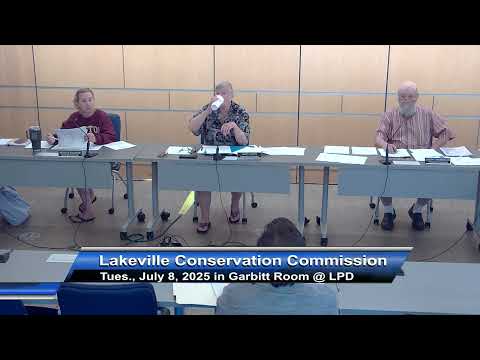
Commission orders peer review, vernal-pool inquiry and plan revisions for proposed house at 19 Captain’s Way after neighbor concerns
Summary
The Town of Lakeville Conservation Commission continued review of a proposed house at 19 Captain’s Way on July 8 and directed staff to obtain a wetland-line peer review, research vernal-pool certification, and require revised plans and stronger erosion and drainage controls.
The Lakeville Conservation Commission on July 8 continued review of a proposed single-family house at 19 Captain’s Way after lengthy public comment and detailed questions from commissioners about wetland delineation, flooding, and wildlife habitat.
The proposal includes a house and septic system sited close to a flagged wetland; commission staff said the wetland line as flagged currently passes near or through the proposed building footprint so that a 25-foot “no touch” zone runs through the middle of the house. The applicant’s representative said the plan complies with Title 5, Board of Health regulations and the Wetlands Protection Act as submitted and noted the septic location and layout. The applicant’s team also confirmed a wetland scientist, identified in the record as Steve Schmiel, performed soil auger testing when he surveyed the property earlier in spring 2025.
Commissioners and several residents raised multiple concerns: whether the flagged wetland line is accurate, the potential for flooding and high groundwater near the back of the house, the proximity of septic components to the interpreted high groundwater, and potential impacts to wildlife from a possible vernal pool on the site. One neighbor, Keith Archer of 18 Anaconda Drive, described recurring seasonal flooding near the shared boundary and said water had come nearly up to the street during a large spring event.
Commissioners requested several follow-ups before the commission can proceed: peer review of the wetland-line delineation (quotes to be obtained), research on whether the potentially wet area can be certified as a vernal pool and the timing for that process, provision of revised construction and erosion-control plans (including roof-drain recharge, an infiltration trench where appropriate, and stronger erosion protections such as a 10-inch silt sock plus silt fence or equivalent), and a site visit by commission members (Niles and at least one other commissioner). The applicant said they were amenable to adding roof drains, jute mesh or sod for slope stabilization, split-rail limit-of-work fencing with signage, and other measures requested by the commission.
Commissioners also instructed staff to locate and distribute the minutes of an earlier commission meeting that the commission referenced as establishing a 25-foot “no touch” policy around wetlands; members said they want to confirm the existence and wording of that policy before deciding how to apply it to this lot. Several commissioners expressed a policy preference against approving new construction with a 25-foot no-touch zone bisecting a house and said that, in their experience, the commission had not approved such cases in roughly two decades.
The commission voted to continue the item to July 22, 2025, and to pursue the peer review quotes and vernal-pool research in the interim. The motion approved a package of follow-up items: obtain the prior meeting minutes showing the no-touch policy, solicit peer-review quotes for the wetland-line delineation, research vernal-pool certification and timing, require revised plans showing enhanced drainage and erosion controls (including roof drains and possible infiltration measures), obtain updated erosion-control details, and schedule a joint site visit with staff and commissioners. The applicant was advised that if the commission remains uncomfortable after those steps, the commission may deny the project; conversely, the applicant may respond with design adjustments. The vote to continue carried on an aye vote.
The commission also heard from neighbors who urged caution about building on the lot, noting tight site constraints, adjacent wetlands, and concerns about precedent if the commission were to allow construction within close proximity to sensitive resource areas.