Get Full Government Meeting Transcripts, Videos, & Alerts Forever!
Get email alerts on the Community Planning topic
No spam. Unsubscribe anytime.
Monterey County staff outline Moss Landing Community Plan timeline, flag battery storage and sea-level issues
Summary
County staff gave a status report on the long-running Moss Landing Community Plan update, outlined a fall 2025 revised draft and draft EIR release, and flagged key outstanding policy topics including battery energy storage safety, shoreline adaptation and coordination with the California Coastal Commission.
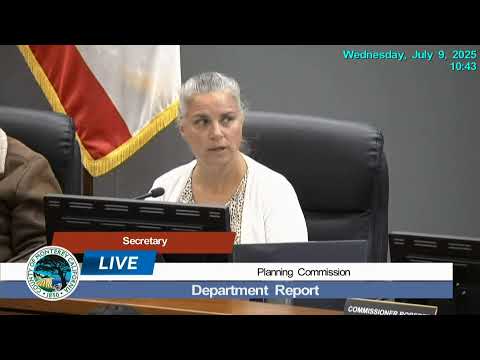
Monterey County planning staff presented a status update July 9 on the Moss Landing Community Plan (GPZ090005), reiterating a multi-year effort to revise the 1982 North County coastal land use plan chapter and identifying battery energy storage, climate change adaptation, and industrial land-use questions as key outstanding policy issues.
Principal planner Sarah Weichel told the Planning Commission the county seeks to release a revised draft of the community plan and the draft environmental impact report in fall 2025, with Planning Commission review and recommendation targeted for winter 2025–26 and Board of Supervisors consideration in spring 2026. She said the EIR will analyze anticipated buildout relative to existing on-the-ground conditions and will include program- and project-level analysis for two projects: the proposed Monterey Bay Aquarium Research Institute (MBARI) marine research campus on the island and a Moss Landing Road improvement project.
Why it matters: Moss Landing includes harbor, industrial, natural, and residential areas and faces interrelated challenges — sea-level rise, climate resilience, and large-scale energy-storage facilities at the power plant site — that require coordinated policies. Staff emphasized the plan update aims to retain the 2009 community committee vision while resolving technical and regulatory matters before finalizing policy language.
Key policy issues and process: Staff identified battery energy storage systems (BESS) as the most recent challenge, citing the January 2020 fire and later incidents at the Moss Landing Power Plant that have raised fire-safety and environmental concerns. County staff said they will work with the Department of Emergency Management, the Environmental Health Bureau, the California Coastal Commission, North County Fire Protection District, and first responders to develop plan policies and minimum application requirements for BESS, using available science and state and federal regulations as a baseline. The county also received a grant from the California Coastal Commission to support a shoreline and harbor adaptation plan, which staff said will follow adoption of the community plan in a phased approach.
Staff also described concurrent transportation planning, including a Moss Landing Road improvement project and a Highway 1/Elkhorn Slough resilience study conducted by the Transportation Agency for Monterey County. The draft plan released in December 2024 retains the moderate-growth scenario originally recommended by the 2009 community plan committee; staff said revisions in fall 2025 will focus on changes that do not alter the plan's overall vision but will provide a more stable project description for the draft EIR.
Commission discussion: Commissioners asked about Coastal Commission comments suggesting potential reclassification of heavy industrial sites. Staff said county planners plan to meet Coastal Commission staff to discuss those comments but are not planning a wholesale conversion of industrial land at this stage. Commissioner Gomez asked whether draft county policy will account for pending state legislation and CPUC actions related to battery storage; staff said they are monitoring bills such as AB 303 and will convene an internal staff team to develop countywide and Moss Landing-specific policy guidance informed by ongoing soil and air testing and input from scientific experts.
Outcome: The Planning Commission received the status report; staff noted the plan remains iterative and that public engagement and additional technical work will continue before formal hearings and recommendations.
Provenance: Staff presentation, commissioner questions, and staff responses occurred during the Moss Landing Community Plan agenda item and associated public discussion.