Get Full Government Meeting Transcripts, Videos, & Alerts Forever!
Get email alerts on the Housing Policy topic
No spam. Unsubscribe anytime.
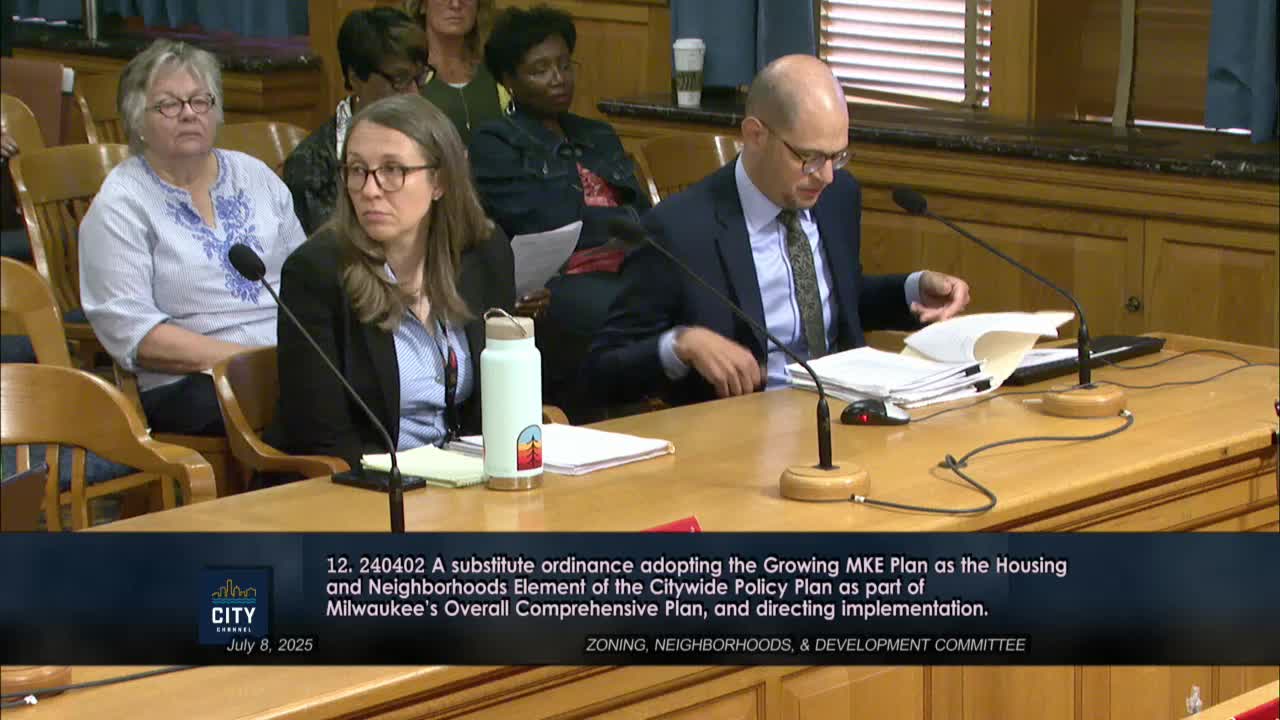
Zoning committee advances revised "housing element" update after months of debate
Summary
Milwaukee committee approved a substitute to a long-debated update to the city's comprehensive plan housing chapter after months of public engagement, sending the document to full council for final consideration.
A Milwaukee Common Council committee on Monday voted to forward a substantially revised housing element ' an update to the citywide policy plan ' to the full council after months of public meetings and revisions. Committee members adopted Substitute A, which incorporates changes made after public feedback and replaces an earlier draft often referred to as "Growing MKE."
The substitute narrows some earlier, more expansive recommendations and emphasizes a mix of tools intended to expand housing options while protecting existing single-family homeownership where city leaders and neighborhood groups pressed for limits. "This has become quite personal," Alderwoman Zamarripa, a sponsor, said in the committee hearing, urging colleagues to move the plan forward so implementation steps can begin.
Why it matters: The housing element is intended to guide future zoning updates, public investments and implementation programs to address a citywide shortage of housing and rising rents. The committee's version recommends changes the Department of City Development (DCD) says would increase the range of housing types available ' such as accessory dwelling units, fee-simple attached townhomes, and cottage courts ' but it removes earlier recommendations that would have allowed duplexes and triplexes across single-family zones as a matter of right. DCD staff told the committee those prior recommendations were removed after council and neighborhood feedback.
What the substitute does: The text adopted by the committee: - Adds the Anti-Displacement and Collective Affordable Housing plans into the comprehensive plan so that their recommendations are elevated for future policy and budget decisions. - Recommends allowing accessory dwelling units (ADUs) in residential districts, with details to be worked out in separate zoning legislation. Committee debate focused on whether ADUs should be permitted as a matter of right or require special use review and on owner-occupancy requirements. - Preserves single-family homeownership as a priority by recommending townhomes on separate lots and cottage courts as potential options in some neighborhoods instead of removing single-family protections across the board. - Calls for targeted code changes to remove mathematical barriers (minimum lot-area-per-unit rules) that DCD says now prevent some forms of housing on small lots, while adding clearer design standards and neighborhood planning requirements.
Public reaction and next steps: The hearing drew long public testimony for and against the substitute, from neighborhood groups, housing advocates and developers. Supporters said the substitute is the product of extensive public engagement and will help diversify housing options; opponents worried it would weaken aldermanic input and accelerate changes to neighborhood character. DCD staff and plan sponsors said specific zoning changes and implementation programs will come back to the council as separate, public legislative files.
The committee accepted Substitute A and recommended it for council consideration; the council will hold a further vote before the housing element becomes city policy. The move forward does not itself change zoning or budgets; it sets the policy framework the administration and council intend to use when crafting future legislation and programs.