Get Full Government Meeting Transcripts, Videos, & Alerts Forever!
Get email alerts on the Natural Channel Design topic
No spam. Unsubscribe anytime.
LDEQ presents natural channel design methods and Rosgen classification at ARBC meeting
Summary
Louisiana Department of Environmental Quality watershed staff presented natural channel design principles, Rosgen stream classification and bankfull concepts to the ARBC. LDEQ said it is pursuing a pilot watershed project in the Hammond area to test nature-based channel restoration for water-quality improvements.
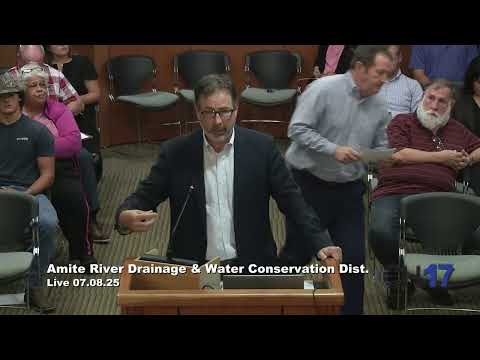
Chuck Berger of the Louisiana Department of Environmental Quality—s watershed planning and engineering section gave a technical presentation July 8 on fluvial geomorphology, Rosgen stream classification and natural-channel design principles.
Berger reviewed how rivers gather, store and move water, sediment and woody debris; he explained the Rosgen classification system (dimension, pattern, profile and bed material), the concept of bankfull stage (channel-forming flows that often occur with a 1- to 2-year recurrence) and tools such as the Bank Erosion Hazard Index (BEHI) used to estimate sediment contributions from channel banks.
Berger said natural-channel design and watershed planning can be used as an alternative or complement to traditional point- and nonpoint-source controls for water-quality impairments. He described international and out-of-state examples, cited a Houston-area project with measurable vegetation recovery, and credited fluvial geomorphologists such as Dave Rosgen and Luna Leopold.
LDEQ staff told the ARBC they are pursuing a pilot project in the Hammond area to demonstrate nature-based approaches to address water-quality impairments and river instability. Berger said LDEQ believes this approach could be the first of its kind in Louisiana for the department—s watershed initiative; funding and local partnerships remain under development.
Commissioners and staff discussed how natural-channel design aims to restore dynamic equilibrium and reduce ongoing maintenance needs compared with heavily engineered, straightened channels. Berger cautioned that restoration work requires field measurements (riffle-to-riffle slopes, sediment sampling) and multidisciplinary teams and that projects can require monitoring and minor adjustments after implementation.