Get Full Government Meeting Transcripts, Videos, & Alerts Forever!
Get email alerts on the Housing Affordability topic
No spam. Unsubscribe anytime.
Bountiful council reviews state housing-affordability data, discusses local tools including ADUs and accessory-structure changes
Summary
At a July 8 work session the Bountiful City Council reviewed data from a University of Utah/Gardner Institute briefing on statewide housing affordability trends and discussed local responses including the general plan update, accessory dwelling units, and a proposed change to accessory-structure height on the regular meeting agenda.
Bountiful City Council held a work session on July 8, 2025, to review statewide housing-affordability data presented to the governor and to discuss what the city might do locally. City Manager Gary Hill summarized charts from the Kemp C. Gardner Policy Institute and the University of Utah showing long-term increases in home size, declines in household size, sharply rising construction costs since 2020 and that, statewide, the median sales price reached 6.4 times median household income in 2023.
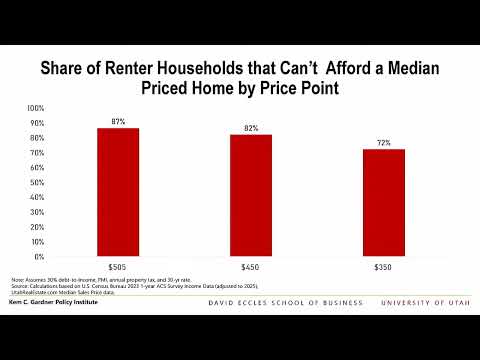
The discussion matters locally because Bountiful’s median home price is about $535,000, and Hill said the income needed to afford a median-priced home in the city in 2024 was roughly $160,000 annually. Hill highlighted a chart showing that 87% of renters cannot afford a $505,000 home and said the share unable to buy a median home in Bountiful would be closer to 90%.
The council and staff framed the data as complex and multi‑factorial. Hill said he disagreed with a presenter’s claim that zoning alone determines house size: "I don't agree with that. I think consumer choice has a lot more to do with it than zoning does," he said. Councilmembers discussed a mix of local tools — including accessory dwelling units (ADUs), modest increases in allowed accessory-structure height to make second-story living space feasible, and the general plan update — while acknowledging limits on what a largely built-out city can do.
Mayor (name not specified) said affordability matters for public-safety staff and teachers, adding, "I want our police officers to be able to live here." Councilmember Beth (name not specified) and other councilmembers urged that decisions be driven by data rather than anecdotes. Councilmembers and staff also described the Utah League of Cities and Towns' interim land-use discussions and the governor’s new Build Council as state-level venues where research and potential legislative proposals are being hashed out.
Staff described one example Steve Waltrip, a former legislator now working on statewide housing, highlighted in which a Weber County development mixed smaller homes into a larger project and initially used deed restrictions to target buyers such as teachers and first responders; councilors said that mixed-development approach may be part of a toolbox for producing more moderate-priced homes in some jurisdictions.
On local process, planning staff member Francisco (last name not specified) told the council the general-plan update draft would be made available for public review the following week and that a 30-day comment period would follow before the plan goes to the planning commission; staff estimated the planning commission and city council could act on the update in the fall, depending on how long the planning commission takes.
The council noted a regular-meeting agenda item (item 10) coming after the work session: a planning-commission recommendation to increase permitted accessory-structure height paired with greater building setbacks, a change intended to allow second-floor living space above detached garages. Council discussion emphasized the tradeoffs — allowing more usable accessory space vs. neighbor concerns about taller buildings.
Speakers also discussed broader barriers that affect housing supply in greenfield communities — chiefly infrastructure costs such as new water or sewer systems that can run into tens of millions of dollars — and said state resources and financing approaches are part of conversations at the league and the governor’s office.
No formal council votes were taken at the work session. The discussion closed with staff and council agreeing to continue the general-plan process, publish the draft for public comment, and review the accessory-structure and other zoning proposals as part of the regular meeting agenda and subsequent planning commission hearings.