Get Full Government Meeting Transcripts, Videos, & Alerts Forever!
Get email alerts on the Domestic Violence topic
No spam. Unsubscribe anytime.
1 Place tells council domestic violence is a public-safety crisis; urges coordinated response
Summary
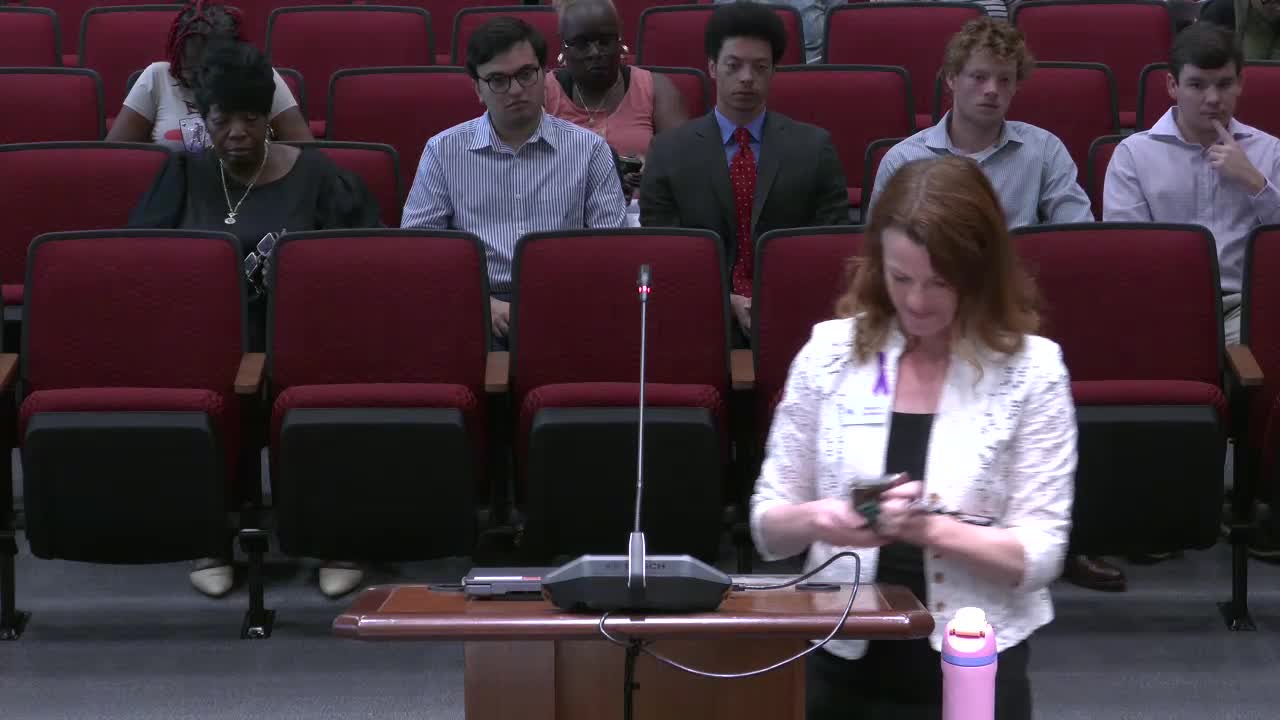
Rebecca McWilliams, executive director of 1 Place Metro Alabama Family Justice Center, told the Birmingham City Council that domestic violence in Birmingham and Jefferson County has reached “a public health and public safety crisis” and urged a coordinated community response to help survivors and hold offenders accountable.
Rebecca McWilliams, executive director of 1 Place Metro Alabama Family Justice Center, told the Birmingham City Council that domestic violence in Birmingham and Jefferson County has reached “a public health and public safety crisis” and urged a coordinated community response to help survivors and hold offenders accountable.
McWilliams said agencies that work together under one roof at 1 Place help survivors navigate the justice and support systems, but stressed the scale of the problem: Birmingham-area law enforcement and courts collectively handle thousands of domestic-violence calls each year and the city is seeing hundreds of strangulation cases that are the strongest predictors of future homicide.
Why it matters: Council members heard detail-level statistics and program descriptions that illustrate how domestic violence reaches beyond private households into criminal justice and public-safety workloads. The presentation framed domestic violence as both an immediate lifesafety threat and a driver of broader community violence, and it included program and policy items the council and partner agencies could further support.
McWilliams told the council that the city’s three largest reporting districts—Birmingham Police Department, Hoover and the Jefferson County Sheriff—record about 12,000–14,000 domestic-violence related calls for service annually; Birmingham Municipal Court receives roughly 65–70 misdemeanor domestic-violence cases per month; and the Birmingham division of the district attorney’s office prosecutes about 400 domestic-violence felonies a year. As of the morning of her presentation she said 723 petitions for protection from abuse had been filed in Jefferson County this year.
McWilliams emphasized strangulation as an urgent indicator of danger: she said Birmingham Police responded to nearly 400 strangulation cases in the last 18 months and that responding officers report seeing seven to 10 strangulation incidents a week. “Strangulation is the largest indicator of a victim eventually being killed by their abuser,” she said.
The presentation included several recommendations and ongoing efforts: 1 Place performs lethality or danger assessments with clients, provides on-site advocacy and navigation, operates Camp Hope for children exposed to domestic violence, and participates in a high-risk team with prosecutors and analysts to identify offenders who pose elevated risk. McWilliams said the program is working with judges, law enforcement and prosecutors on process changes such as better documentation and medical exams after suspected strangulation, improved service of protection orders and protocols for relinquishing firearms in high-risk cases.
Council members and staff described complementary efforts already under way. McWilliams said Jefferson County District Attorney Danny Carr has prioritized domestic violence prosecution and shared a 2021 finding that 74% of known homicide offenders had a prior history of domestic violence. She also described local judicial and court reforms: a revamp of the batterers-intervention program led by a presiding judge and monthly offender-focused groups that include researchers and service providers to study how to reduce recidivism.
Councilors asked about upstream prevention and services for perpetrators. McWilliams described limited resources for offender-focused intervention and said Camp Hope and other childhood interventions try to reduce future perpetration, but that the city and partners need more programs aimed at people who perpetrate violence. She said 1 Place’s current annual budget is about $1.1 million, with roughly $600,000 from private philanthropy and a portion of federal funds that are at risk; she said 1 Place receives little or no steady city or county funding.
The presentation closed with a request that agencies continue to coordinate on system-level changes—real-time documentation protocols, prioritized service of protection orders for high-risk victims, and improved processes for temporarily removing firearms from people who pose an immediate risk.
Councilor reaction and follow-up: Council members voiced support for the center’s work and discussed possible local policy responses, including expanded funding for services, improved data sharing and partnering with restorative-justice practitioners and community organizations. Several council members volunteered to share local contacts and to assist with outreach and program ideas.
Ending: The council did not take formal action during the presentation but asked staff to continue coordination with 1 Place and other criminal-justice partners; McWilliams said she would return with partners as work on shared protocols continues.