Get Full Government Meeting Transcripts, Videos, & Alerts Forever!
Get email alerts on the Transportation Thoroughfare Plan topic
No spam. Unsubscribe anytime.
Consultants brief commissioners on updated thoroughfare plan; two options presented, court urged to pick level of technical depth
Summary
Friese & Nichols and county staff presented a proposed update to Kaufman County's 2016 thoroughfare plan, offering a lighter update using regional COG data or a deeper, county-tailored modeling approach; commissioners discussed outreach and funding implications and asked staff to consider next steps.
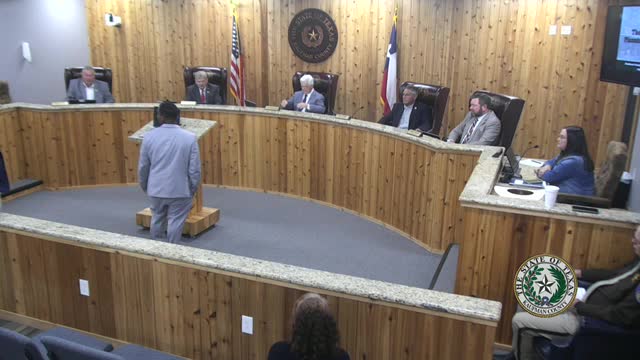
Friese & Nichols and county staff briefed Kaufman County Commissioners Court on plans to update the county's 2016 thoroughfare plan and presented two alternative approaches: a more limited update using North Central Texas Council of Governments (NCTCOG) datasets, and a deeper, county-specific travel-demand modeling effort that would "dust off" a Kaufman subarea model and refine demographic forecasts.
The consulting team described the thoroughfare plan as a "living policy document" meant to guide right-of-way preservation, align county road plans with municipal plans, and help prioritize capital projects. Eddie Haas, presented as Transportation Planning Manager with Friese & Nichols, outlined the two options: Option 1 would rely largely on COG-supplied demographics and regional modeling; Option 2 would include a deeper demographic and vested-development analysis tailored to Kaufman County and support additional scenario testing.
Consultants noted tradeoffs: Option 2 would cost more but would produce a model that allows scenario testing (for example, evaluating the transportation effects of large proposed developments or changes to regional projects) and could produce more refined forecasts for county planning and grant applications. They cited examples from nearby counties where deeper modeling materially changed growth forecasts.
Public-engagement approaches discussed included two town-hall meetings plus online outreach using interactive mapping and surveys (the consultants cited response rates of several hundred in comparable county studies). Commissioners raised practical concerns about turnout for in-person meetings and the value of online tools to broaden participation. Staff also noted rising construction costs since 2016, which affects budgeting for future roadway projects.
No formal decision was recorded at the workshop; consultants said they would provide a written scope and cost estimates (the consultants'handout aligned with the deeper Option 2 scope), and the court asked staff to review the options and return with a recommended scope and potential funding sources.
Why it matters: An updated thoroughfare plan sets long-range priorities for county roadway investments, helps preserve right-of-way, informs coordination with cities and TxDOT, and can affect capital programming and bond planning.
Next steps: Staff and consultants will refine a scope and cost estimate for the court; commissioners will determine the desired level of modeling and public engagement before a contract or work authorization is approved.