Get Full Government Meeting Transcripts, Videos, & Alerts Forever!
Get email alerts on the Cooling Centers And Heat Response topic
No spam. Unsubscribe anytime.
New Castle County officials stress nonprofit-led cooling centers, county steps in only for emergencies
Summary
At a July 8 Public Safety Committee meeting, New Castle County emergency management outlined coordination with nonprofits, the University of Delaware and state agencies on cooling centers as heat days rise; libraries can serve as emergency cooling sites but the county said regular operations remain nonprofit-led.
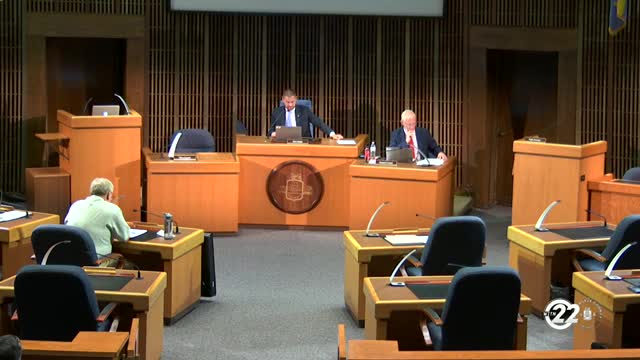
NEW CASTLE COUNTY, Del. — New Castle County emergency management told the county’s Public Safety Committee on July 8 that cooling centers across the county are run primarily by nonprofits and that the county will formally open public facilities, including libraries, only when nonprofit capacity is exceeded or an emergency is declared.
The presentation by Chris Hodgen, coordinator for New Castle County Emergency Management, described a multi-agency task force that meets weekly through much of the year and daily during heat waves, and outlined efforts to coordinate sites, transportation and data so residents without air conditioning can find relief.
Hodgen said the county has documented a warming trend and is adapting operations. “The average annual temperature in New Castle County has risen over 3 degrees in the twentieth century,” Hodgen said, and he cited forecasts showing more frequent days that exceed 95 degrees. He said nonprofit groups such as Friendship House currently lead cooling-site activations and that the county’s role is primarily coordination, logistics and stepping in when nonprofits are overrun.
Why it matters: County staff and council members said the combination of an urban heat island in Wilmington and socioeconomic factors — older homes without central air, neighborhood tree canopy deficits and limited transportation — leave some residents especially vulnerable during heat waves.
Hodgen described a three-tier framework the county and state partners are developing to clarify what different cooling sites should provide. Tier 1 sites (examples: libraries, malls) would offer a place to get out of the heat for short periods; Tier 2 would add basic supplies such as water and a dedicated private area; Tier 3 would be full-service sites run by nonprofits offering cots, snacks and social-service referrals. He said the Delaware Health and Social Services (DHSS) is drafting statewide guidance that local partners will use to finalize those tiers.
Hodgen also described operational tools the task force uses: a live shared spreadsheet where partners update hours and walk-in counts; heat outlooks from the University of Delaware that distill National Weather Service data into an experimental HeatRisk product that factors temperature, humidity and socioeconomic vulnerability; and the new Census heat-vulnerability data layers the county is using to identify underserved neighborhoods.
Friendship House, which Hodgen said activated for a recent Code Orange (extreme heat) period, reported seasonal activity levels the presentation summarized: 27 Code Purple (winter sheltering) events serving 246 people, and 14 Code Orange events serving 62 people last year. Hodgen said typical state service centers recorded 5–10 walk-ins per site during recent heat events.
Council members raised operational concerns. Councilman Hollins thanked emergency management for clarifying what the county technically designates as a cooling center. Councilman Cartier suggested expanding outreach to neighborhood community centers. Councilman Carter noted many libraries lack backup generators and that transportation south of the canal remains limited; Hodgen confirmed the county has three portable generators available but prefers sites with full power for longer activations and acknowledged the need for better transit options.
In public comment, Rob Bullock, president of the Route 9 Community Alliance Coalition, asked whether buses with air conditioning could be used as temporary cooling sites during extended blackouts. Hodgen replied that mass power outages would be treated as emergency situations and that the county has plans with the Delaware Emergency Management Agency, DelDOT and DART for evacuations and for transporting people with limited mobility; he added the county can also request the American Red Cross to staff a temporary reception center (for example, at a firehouse) without a formal state declaration in some cases.
No formal motions or votes on policy were taken. Hodgen said the county’s next steps are to expand the cooling-center task force to underserved areas (including parts of the Route 9 corridor), continue coordination with nonprofits, pursue transportation partnerships (transit vouchers or ride-share discounts) and incorporate DHSS model guidance when it is released. He invited council members to join weekly task-force calls held Wednesdays at 11 a.m.
The presentation and subsequent discussion made clear the current operating model relies on nonprofit partners for routine cooling services and that county activation of public facilities typically requires either nonprofit requests or an escalation to an emergency declaration.
—