Get Full Government Meeting Transcripts, Videos, & Alerts Forever!
Get email alerts on the State Legislative Program topic
No spam. Unsubscribe anytime.
Leesburg council trims, adds items to 2026 legislative program after staff recommendations
Summary
At a July 7 work session, Leesburg town council directed staff to add several priorities — including a historic-district real estate disclosure, invasive-plant responsibility and campaign finance reform — remove multiple long-standing items and pursue an updated sales-tax distribution statement for future advocacy with state legislators.
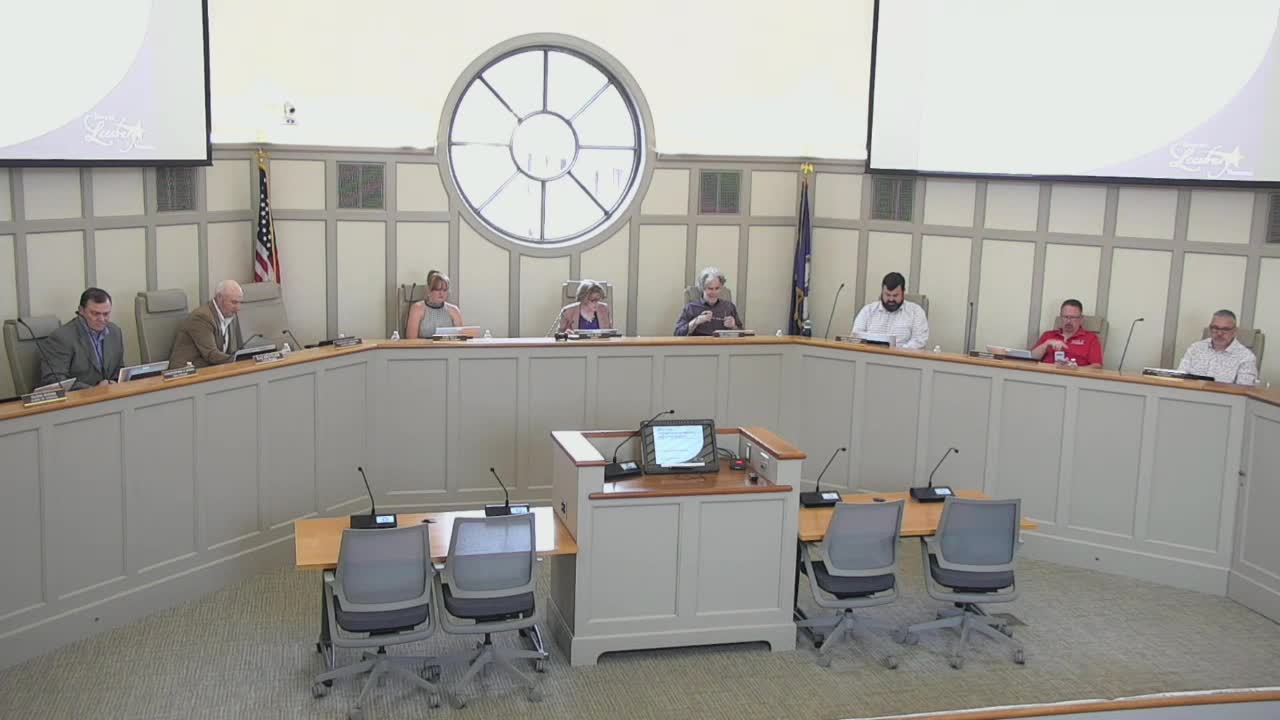
Leesburg town council members on July 7 weighed a staff-drafted 2026 legislative program and agreed to add several new policy positions while removing other items that staff said have not attracted sponsorship in Richmond.
Keith (town staff) presented the draft and told councilmembers the document is built from last year—s program and updated with department suggestions. He said the program contains two categories: general "position statements" that signal the council—s stance to local legislators and narrower "legislative priorities" that request specific bills or sponsors. "The first one we—ll propose to you is adding a real estate disclosure requirement," Keith said, describing staff—s recommendation that state enabling language be amended so Leesburg could require sellers to disclose when a home lies in a regulated historic district.
The council moved through the list item by item and, where the transcript records the outcome, the body adopted additions and deletions by the informal "are there four people?" consent checks the council used during the session. Council members asked staff to continue local outreach and to refine language before a formal adoption resolution is prepared.
Why it matters: the program provides Leesburg—s delegation and lobbying contacts an early signal about what the town expects in the 2026 General Assembly session, which staff reminded council begins Jan. 14 and will include the state budget. The mix of high-level positions and possible legislative asks affects what ideas local legislators will consider drafting during the summer and fall.
Most of the council discussion focused on which items to keep, add or remove and how feasible statewide adoption is. Vice Mayor Hifsimena Johnson asked whether the town should bring a long list of 80-plus items to Richmond or narrow to a top set of priorities; staff recommended focusing on a small number of strong priorities if council expects legislators to draft bill language. Councilmember Cummings said large budget asks have succeeded for some localities but are not routinely successful in the region.
Actions taken and staff direction
- Add: real estate disclosure for properties in regulated historic districts (added to the draft legislative program). Several council members said they supported the proposal but also urged local outreach to the Realtors Association before pushing a statewide change. Councilmember Steinberg said retailers and realtors previously opposed similar disclosures.
- Add: statutory responsibility for invasive plants (added). Council discussion clarified that the state code contains an enumerated list of invasive species; the proposed change would create a statutory path that makes remediation costs the responsibility of the property owner whose plants spread to neighbors. The mayor gave a local example of an elderly resident who paid about $1,700 to remove invasive plants encroaching from an adjacent lot.
- Add: campaign finance reform (added). Council confirmed an existing position statement should remain in the program.
- Do not add: a statewide prohibition on sales of gas leaf blowers (did not move forward). The Environmental Advisory Commission had recommended the position, and some council members said landscapers are already shifting to electric equipment, but the item failed to secure the council—s consent at this session.
- Do not add: a broad clean-and-renewable-energy position (did not move forward at this meeting).
- Regional Greenhouse Gas Initiative (RGGI): council supported a position for Virginia to rejoin RGGI (added to the draft).
- Add: support to ease transfer of VDOT revenue-sharing funds between local projects (added). Staff said this would reduce state paperwork when towns need to move VDOT-allocated dollars from one eligible revenue-sharing project to another.
- Deletions approved: glass recycling (removed from the town—s legislative program after staff said private-sector markets in Northern Virginia are forming and the item has not attracted local sponsors), the English ivy prohibition (removed), a municipal utility "force majeure" exemption (removed), and a $20 million ask for Liberty Street parking-lot remediation (removed). In several cases staff recommended deletion because items had not been sponsored in Richmond in recent years.
- Deletion not approved: expansion of automobile emissions inspection requirements did not gain enough support to be removed from the list.
Other items discussed
Council asked staff to leave a smaller, prioritized set of items for active pursuit in Richmond and to use the longer list as a "menu" for legislators seeking local ideas. The town will keep a $480,000 regional air-traffic-control trailer request (described by staff as a reduced ask compared with a prior $20 million remediation request) in the draft program for consideration.
Next steps and formal adoption
Staff told council that after members finalize edits, the town will prepare a formal resolution for adoption and then circulate the program to local legislators and regional partners, including the Virginia Municipal League (VML) and the Virginia Association of Counties (VACO). "Once you all finish discussing the program and you get to a point ... we'll have a resolution for you for you to have that formally adopted and then we'll shop that around with all of our local legislators," Keith said. Council gave direction on specific additions and deletions and asked staff to refine language and pursue local stakeholder outreach where relevant.
Ending
Councilmembers also asked staff to track which items are likely multi-year efforts (for example, a sales-tax distribution reform) and to coordinate with VML or other regional organizations on larger, statewide reforms before asking a single legislator to carry a complex bill.