Get Full Government Meeting Transcripts, Videos, & Alerts Forever!
Get email alerts on the Early Childhood Education topic
No spam. Unsubscribe anytime.
IBO: 3‑K enrollment edges up while contracted capacity falls, raising fill‑rate questions
Summary
At a Community Board 2 Schools & Education Committee meeting, the New York City Independent Budget Office presented a report showing modest 3‑K enrollment gains alongside declines in contracted capacity for 3‑K and pre‑K, and highlighted new outreach and state funding included in the 2025 executive plan.
The New York City Independent Budget Office told the Community Board 2 Schools & Education Committee that enrollment in 3‑K rose slightly while contracted capacity for both 3‑K and pre‑K fell, driving higher overall fill rates mostly because seats were reduced rather than many more children taking seats.
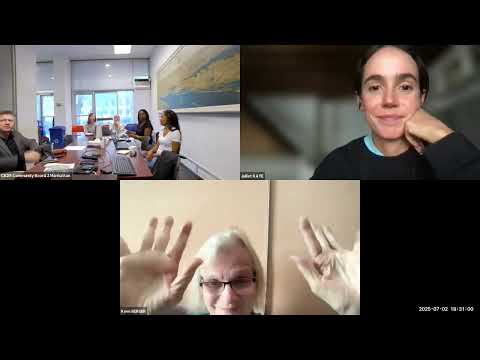
“So I’m Julia Conrad. I’m the assistant director for the education team at the New York City independent budget office,” Julia Conrad said as she opened the presentation and described IBO’s analysis of enrollment, capacity and fill rates for the 2022–23 and 2023–24 school years.
IBO presented three headline findings: 3‑K enrollment rose by about 1.6% year‑over‑year while contracted capacity for 3‑K fell by roughly 2%; pre‑K showed declines in both enrollment and capacity; and fill rate — enrollment divided by contracted seats — rose for both programs largely because capacity contracted. IBO reported fill rates of about 80.9% for 3‑K and 78.6% for pre‑K in the 2023–24 school year.
IBO staff also outlined recent budget changes affecting early childhood programs. Conrad and Emma Gossett, IBO’s budget analyst on early childhood education, said federal stimulus dollars paid for much of the initial expansion, those temporary funds have been replaced by city and state dollars over time, and the 2025 executive plan included new state and city items. Conrad summarized components in the 2025 executive plan: an added $25 million for extended‑day expansion, $20 million for supporting family offers, $55 million for special education expansion, and a $5 million outreach allocation within the Department of Education for 2026.
“In the April 2025 executive plan, they added $5,000,000 in outreach within the DOE for 1 year for 2026 only,” Conrad said, noting the administration also earmarked outreach dollars to other agencies for one‑time efforts.
Committee members asked about the scope and likely effectiveness of outreach as well as how seat types and geography affect demand. IBO emphasized that seat type (half‑day, full‑day/extended, Head Start) and the program’s location matter for whether families will accept offers; IBO flagged a mismatch between where seats exist and where families want them. Emma Gossett noted that seat types such as extended‑day/year and Head Start are typically targeted to low‑income families and differ from half‑day seats, which are increasingly a small share of the portfolio.
Conrad said IBO will follow up with district‑level analysis and could provide the committee with the underlying slides and data. She told the committee that IBO’s next steps include more detailed looks at demand, offers, and geographic patterns of seats and applications.
Committee members and IBO staff agreed to continue the discussion: IBO will send updated slides and follow up on specific questions about outreach spending and district‑level trends, and the committee said it would use the district analysis to inform local outreach and advocacy.
The presentation drew on IBO’s recent report “Utilization up, capacity down: a look at 3‑K and pre‑K trends in New York City,” and IBO staff indicated a more detailed district‑by‑district appendix is available on request.