Get Full Government Meeting Transcripts, Videos, & Alerts Forever!
Get email alerts on the Health Workforce topic
No spam. Unsubscribe anytime.
Menopause Equity Act advances after debate; author agrees to amendments on continuing-education requirement
Summary
AB 432, the Menopause Equity Act, would expand physician training on menopause and perimenopause and passed the Business, Professions & Economic Development Committee after the author agreed to pursue incentive-based amendments.
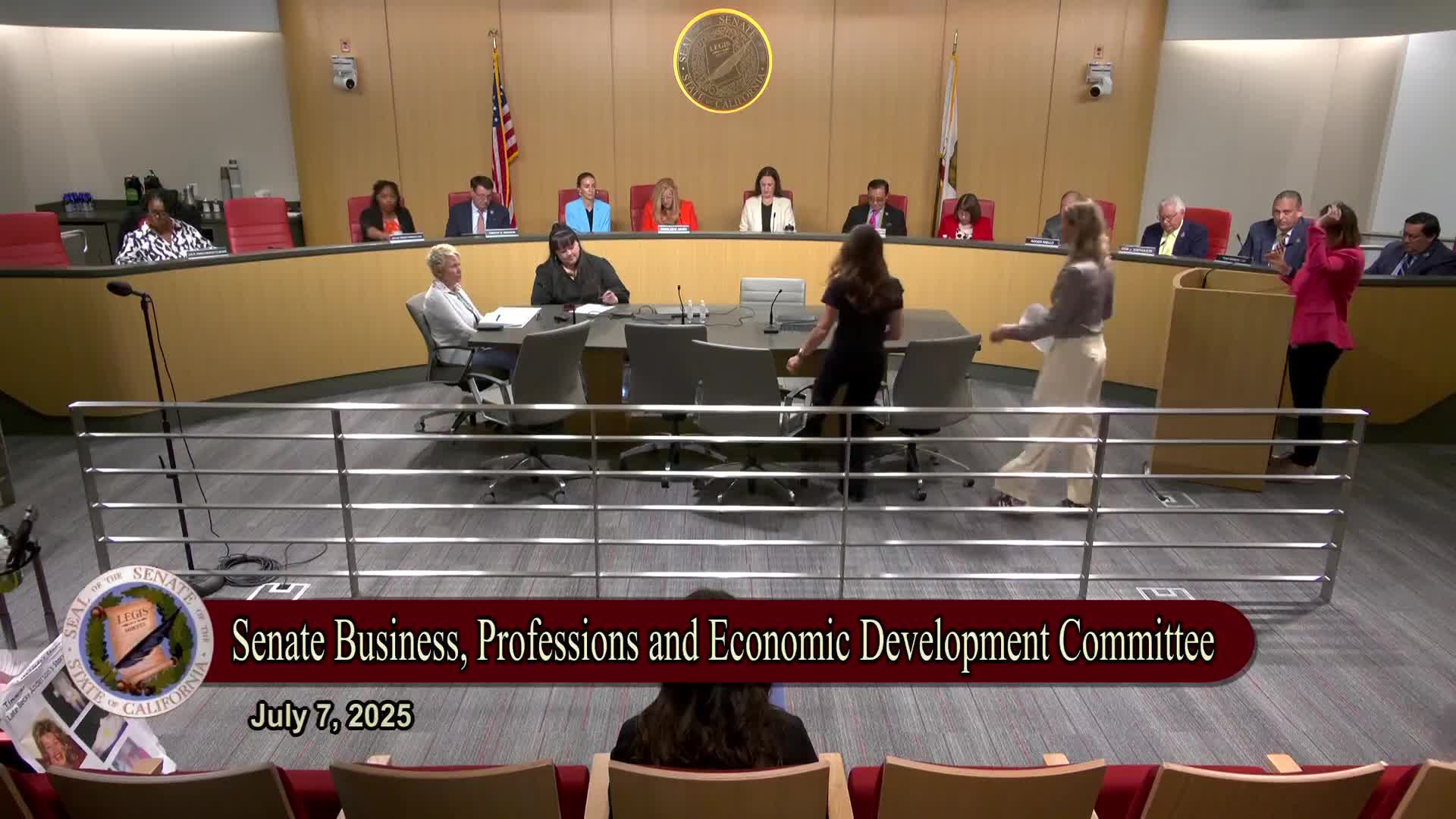
Assemblymember Rebecca Bauer-Kahan presented AB 432, the Menopause Equity Act, proposing continuing-education requirements and incentives to improve clinician recognition and treatment of perimenopause and menopause. The author said her experience with delayed diagnosis motivated the bill and that many clinicians lack training: “Most women like me won't be able to diagnose what is happening in their body when it isn't one of the main symptoms,” she told the committee.
Scientists and clinicians testified in support. Emily Jacobs (director, Women’s Brain Health Initiative, UCSB) said menopause affects multiple organ systems and argued physicians need updated training because ‘‘menopause is not just an endocrine transition, it's a neurological transition.’’ Dr. Judy Mikasich, an OB-GYN and certified menopause practitioner, said effective treatments exist but are underprovided and that ‘‘73 percent of women do not receive treatment.’’ Supporters framed the bill as filling a persistent training gap and as a women's-caucus priority.
Medical associations including the California Medical Association, Medical Board staff and specialty societies asked for narrower or incentive-based approaches rather than a broad, mandatory continuing-medical-education (CME) requirement, citing enforcement and scope concerns. The author and committee discussed an alternative incentive structure under which physicians would receive additional CME credit if they complete approved menopause training; witnesses said that would address concerns about mandatory, across-the-board CME requirements for physicians who rarely see midlife patients.
The chair and the author said they had negotiated amendments with stakeholders and planned to pursue an incentive-based approach and additional clarifications in subsequent committees. The committee voted to pass AB 432 to Senate Health; committee leaders noted the vote would be conditioned on forthcoming amendments to narrow the CME mandate and add flexibility for professional societies to offer approved courses.
Why it matters: AB 432 seeks to broaden clinical knowledge of menopause across specialties, potentially affecting care for millions of people in midlife and older age; medical groups and licensure authorities asked for narrow, implementable language and incentives rather than a sweeping mandate.