Get Full Government Meeting Transcripts, Videos, & Alerts Forever!
Get email alerts on the Long Term Care topic
No spam. Unsubscribe anytime.
Committee advances bill to codify nursing-home services, visitation and billing protections
Summary
The Senate Committee on Health, Hospitals and Human Services voted to forward bill 36-0003, as amended, which would add Chapter 76 to Title 19 of the Virgin Islands Code to define services nursing homes and assisted-living facilities must provide and to set visitation and billing protections.
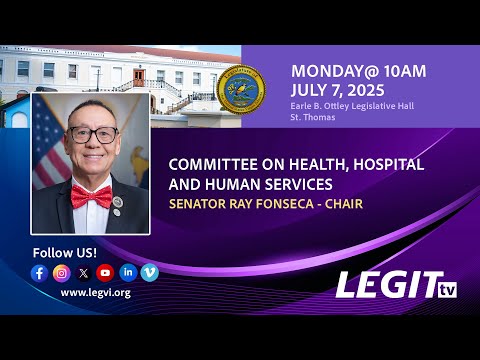
The Senate Committee on Health, Hospitals and Human Services voted to forward bill 36-0003, as amended, to the Committee on Rules and Judiciary after testimony from the Attorney General’s Office, the Department of Human Services (DHS), AARP and others and a recorded committee vote of 5 in favor, 0 opposed, 2 excused.
The measure, sponsored by Senator Angel L. Boulkes Jr., would add a new Chapter 76 to Title 19 of the Virgin Islands Code to specify services nursing homes and assisted-living facilities must provide, limit financial charges, guarantee visitation rights and codify resident protections. Senator Angel L. Boulkes Jr., the bill sponsor, said the legislation “strengthens the standard of care, transparency, and dignity for our most vulnerable residents” and that the measure “aligns and reinforces these protections under the Virgin Islands code to ensure that they are respected, enforced, and consistently applied here at the local level.”
Why it matters
The committee and testifiers framed the bill as an effort to bring territorial practice into alignment with federal nursing-home standards enforced by the Centers for Medicare and Medicaid Services (CMS) and to create local enforcement and reporting mechanisms. Testimony described gaps in capacity and certification: the territory currently lacks multiple CMS-certified nursing homes, and DHS operates two homes for the aged (Herbert Grigg on St. Croix and Queen Louise on St. Thomas) that are not CMS-certified, limiting the territory’s ability to bill Medicaid for long-term care at scale.
What the bill and amendments do
The bill text read into the record describes requirements for hygiene, nutrition, mobility assistance, communication supports, and protections against billing for services covered by Medicare or Medicaid. Sponsor Boulkes told the committee an amendment (filed as amendment 36-406 in the hearing) designates the Virgin Islands Department of Human Services as the territorial oversight agency, requires each facility to submit a written compliance plan within 90 days and to meet full service obligations within 12 months, and directs DHS to publish a reference guide on reimbursable services. Boulkes said the amendment also gives DHS authority to enforce penalties to be established by regulation.
What testifiers told the committee
- Attorney General Gordon Ray said the Department of Justice supports the bill in principle but recommended clearly naming the territorial agency that will conduct on-site surveys and receive reports. “I would recommend that the Virgin Islands Department of Health be memorialized as the government of the Virgin Islands agency charged with oversight,” he said, while noting he would also support DHS if the committee chose that route. He urged creation of a reporting mechanism to collect complaints and violations.
- Troy Shuster, State Director for AARP in the Virgin Islands, testified in strong support and urged amendments to align the bill with Medicaid waiver and state plan approaches, to define small-home and community-based models, to establish staffing and licensing standards, and to require state plan amendments or waivers to unlock federal funding.
- Tayshia Phillips Dorset, Assistant Commissioner, Department of Human Services, testified DHS “fully endorses this legislation” and outlined key bill provisions, including a prohibition on excluding applicants based on income, requirements that facilities not charge for services covered by Medicaid or Medicare, and protections for residents to designate representatives using valid legal documentation. DHS recommended amendments to add adults with disabilities to covered populations, to prohibit conditioning admission on prepayment for services covered by public programs, to require written itemized disclosure for noncovered services, and to phase implementation with compliance plans and technical assistance.
Clarifying operational and budget details from the hearing
- DHS and facility staff provided operational figures: Herbert Grigg currently has 22 residents (capacity 25); Queen Louise has 14 residents (capacity 16). DHS reported waiting lists of about 25 on St. Croix and 20 on St. Thomas. (Statement attributed to DHS staff Kishma Vincent and Anna Velez Martinez.)
- Planned FEMA-funded rebuilds were described as providing roughly 60 beds on St. Croix (Herbert Grigg rebuild, estimate cited by DHS) and roughly 44 beds on St. Thomas (Queen Louise rebuild); committee members and testifiers said even those increases would not meet projected demand.
- Staffing and CMS standards: DHS staff said current nurse-to-resident ratios at the facilities are about 1:10 and that CMS expectations for higher standards would require improving to roughly 1:7 and meeting minimum direct-care hours. DHS cited a CMS-aligned standard of 3.48 hours of direct nursing care per resident per day, with at least 0.55 hours provided by registered nurses and about 2.45 hours by nurse aides (figures provided in testimony by DHS assistant administrator Kishma Vincent).
- Current and potential revenues: DHS testimony estimated a typical Medicaid daily rate in similar settings between about $320 and $340 per day. DHS and facility staff said current collections at the homes are limited (one figure cited: about $126,000 a year in current receipts) and that a fuller revenue picture if billing successfully to Medicaid could be substantially higher (a rough estimate of about $1 million per year was discussed in testimony).
Committee discussion and directions
Committee members pressed DHS and other witnesses on oversight responsibilities (Department of Health’s certificate-of-need process vs. DHS operational oversight), staffing needs, timelines for the FEMA rebuild projects, and how the territory would secure CMS certification. DHS said the Queen Louise FEMA buildout must be completed by 2028 and Herbert Grigg’s by 2032 under current FEMA planning; ODR had issued an RFP for Herbert Grigg construction during the rebuild sequence described by DHS.
Formal action
The committee considered and adopted an amendment that explicitly barred conditioning admission on prepayment for services covered by Medicaid or other public assistance programs, phased compliance timelines (compliance plan within 90 days; full compliance within 12 months), and other transparency and enforcement items described above. Senator Marvin Blyden moved the committee to vote to forward bill 36-0003 as amended to the Committee on Rules and Judiciary; the motion passed and was recorded as favorable. The clerk announced 5 present, 2 absent; committee members recorded present earlier in the hearing were Senators Hubert L. Fredericks; Marvin Blyden; Ray Fonseca (chair); Alma Francis Heiliger; and Milton E. Potter. Senators Kenneth L. Gittens and Kurt A. Veil were recorded as excused/absent.
Next steps and outlook
The bill will be considered by the Committee on Rules and Judiciary with the amendments adopted in committee. Sponsor Boulkes and DHS said they will continue to work with the Attorney General’s Office, AARP and other stakeholders to refine implementation details, reporting mechanisms and funding plans. Several testifiers and senators said federal alignment and CMS certification will be necessary to secure Medicaid reimbursement and to scale capacity.
Ending
Committee members and witnesses emphasized the need to balance codified resident protections with realistic funding, staffing and construction timelines. The measure moves next to the Committee on Rules and Judiciary for further amendment and review.