Get Full Government Meeting Transcripts, Videos, & Alerts Forever!
Get email alerts on the Board Decisions topic
No spam. Unsubscribe anytime.
Queen Anne's County Board of Education approves five policies, curriculum renewals, contracts and purchases
Summary
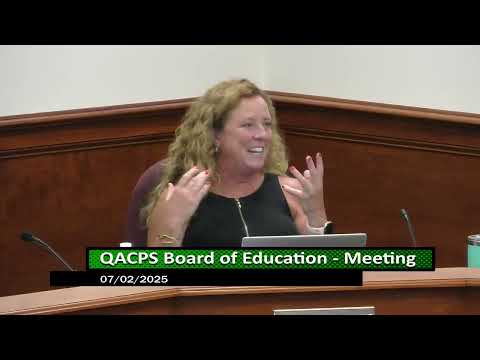
The Queen Anne's County Board of Education on July 2 approved a package of policies, curriculum renewals, contracts and capital purchases, the board said during its open session.
The Queen Anne's County Board of Education on July 2 approved a package of policies, curriculum renewals, contracts and capital purchases, the board said during its open session.
The board voted to approve the human resources report and five board policies; unanimously approved one-year and multiyear instructional purchases and renewals for elementary and secondary programs; authorized a $1.2 million consortium food-service contract and approved a centralized surveillance server purchase for district camera storage. Board members recorded the approvals by voice vote during the meeting; no roll-call tallies were provided in the transcript.
The policy approvals included a rewritten homeless-students policy to align with McKinney-Vento guidance, amendments to the district policy on administering medication to students, updates to home-and-hospital teaching, a new student-registered-offender policy reflecting April 2024 state updates, and a new student-telehealth policy cited to the Maryland Education Article §4-143.
Board members also approved several curriculum and instructional purchases brought by district supervisors: - A one-year renewal of the elementary social studies program My World Interactive (Savvas) with a stated fiscal impact of $96,423.80 charged to the FY26 operating budget. - Licenses and materials for reading intervention programs (HMH Reading Interventions Code and Read180) with a fiscal impact of $59,665.73 from the FY26 operating budget. - A one-year purchase of i-Ready/MyPath math individualized pathways for middle school with a fiscal impact of $80,195.00 from the FY26 operating budget. - An eight‑year adoption of Experience Chemistry (Savvas) for high school chemistry classes totaling $53,508.80 (budgeted in the operating budget).
The board approved continuing to piggyback on the Maryland Shore Educational Food Service Consortium contract (Sysco and related vendors), which the board described as covering most food-service purchasing for the district; the administration presented a $1,200,000 fiscal impact figure tied to the food-service operating budget. The board approved a centralized surveillance camera server (5.67 TB usable storage) to provide a minimum 30-day redundant retention for district buildings; that purchase was presented with a fiscal impact of $72,641.00 from FY25 local CIP funds. The board also approved a contract with AlphaBEST Education Inc. to continue before- and after-school care at several elementary sites; the administration reported no fiscal impact to the district (parent-paid program).
Several presenters explained budget placement and rationale. For example, the administration said the social-studies renewal was a one-year extension to allow piloting of alternatives next year; reading- and math-intervention purchases were described as recurring annual needs tied to fluctuating student counts and state literacy requirements; the chemistry adoption noted cost savings due to existing classroom supplies and semesterized course licensing. The surveillance-server purchase was presented as a one-time capital buy to centralize district video storage and provide redundancy for individual school servers.
Votes at a glance (as recorded in the meeting transcript): - Human resources report — Motion made and seconded; voice vote "Aye"; outcome: approved. (Transcript reference: motion at 1982.74–1990.60.) - Policies: Policy 502 (Administering medication to students); Policy 513 (Education of homeless students — McKinney‑Vento update); Policy 516 (Home and hospital teaching); Policy 535 (Student registered offenders; reflects April 2024 state update); Policy 536 (Student telehealth; Maryland Education Article §4‑143) — Motion made and seconded at 2254.39–2272.03; voice vote "Aye"; outcome: approved. (See provenance below.) - Elementary social studies renewal (Savvas My World Interactive) — Motion made and seconded at 2463.30–2477.72; fiscal impact $96,423.80, FY26 operating budget; outcome: approved. - Reading-intervention materials (HMH Code and Read180) — Motion made and seconded at 2665.17–2687.69; fiscal impact $59,665.73, FY26 operating budget; outcome: approved. - i-Ready/MyPath math licenses (middle school) — Motion made and seconded at 3012.35–3024.28; fiscal impact $80,195.00, FY26 operating budget; outcome: approved. - Experience Chemistry (Savvas) adoption for high school chemistry — Motion made and seconded at 3248.10–3263.09; fiscal impact $53,508.80, FY25 operating budget; outcome: approved. - Maryland Shore Educational Food Service Consortium contract (Sysco vendor purchasing through consortium piggyback) — Motion made and seconded at 3477.47–3490.08; fiscal impact cited as $1,200,000, food-service operating budget; outcome: approved. - Centralized surveillance camera server (5.67 TB usable; Parable MES via UMD consortium agreement 972016) — Motion made and seconded at 3652.47–3676.69; fiscal impact $72,641.00, FY25 local CIP funds; outcome: approved. - AlphaBEST Education Inc. contract for before/after-care services — Motion made and seconded at 3880.03–3891.33; fiscal impact: none to district (parent-paid); outcome: approved.
What the board did not record in the open-session transcript were roll-call tallies (yeas/nays) by individual member; approvals were captured by voice vote. Several presenters noted these purchases and policy changes were budgeted in FY26 operating or FY25 CIP funds and that some items (curriculum renewals) were one‑year extensions to allow further piloting or multi‑year proposals next year.
Provenance: see transcript excerpts below for the first and last recorded lines related to the items above.
Ending: The board closed the open meeting after approving the motions and set its next regular meeting for August 6 at 6 p.m., per the meeting agenda.