Shawnee County district attorney seeks pay increases, highlights successful convictions and software upgrade
Loading...
Summary
District Attorney Keggae requested budget increases focused on staff retention and infrastructure, citing a wage gap with peer offices and the ongoing implementation of Axon Justice digital evidence software; DA also listed multiple recent guilty verdicts as evidence of office performance.
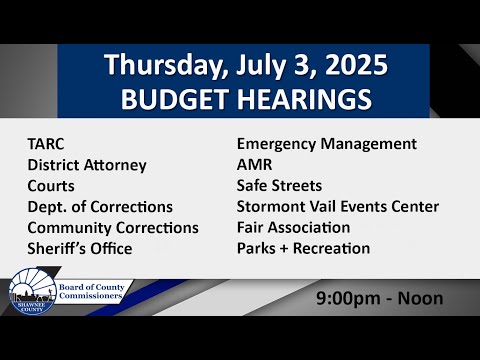
District Attorney Keggae briefed the Board of Commissioners on July 3 about the Shawnee County DA office’s 2026 budget request, emphasizing staff retention and technology modernization to handle growing digital evidence demands.
Keggae said the office faces a pay gap: junior prosecutors earn roughly 18.2% less than peers in nearby prosecution offices, while senior attorneys lag about 9.3%. Legal assistants, he said, are about 24% below comparative positions. He asked the county to help address those market gaps to retain talent and avoid losing attorneys to other offices or private practice.
Keggae also highlighted ongoing implementation of Axon Justice evidence‑management software. He said the office entered a 10‑year subscription with average annual costs “around” $100,000, and that implementation has been “substantially integrated” but has experienced infrastructure or bandwidth issues that IT is working to resolve. Commissioners noted a subscription line item of $175,000 in the budget packet; Keggae said accountant reclassifications and a one‑time reset of how contractual items are recorded produced apparent shifts in line items compared with previous years.
To illustrate workload pressures, Keggae described caseload management challenges and the need for adequate staffing to file charges and avoid backlogs. He cited prior caseload guidance (no more than 150 cases per prosecutor in 2002) and said today’s increased digital evidence makes that standard harder to meet. He told commissioners the COVID backlog has been largely cleared but vacancies cause local bottlenecks and could prevent timely filings.
Keggae also reviewed recent trial results, naming multiple defendants and noting guilty verdicts in a series of major‑felony trials since he last appeared before the commissioners. (Transcript anonymized some offense details.) He said these trial outcomes reflect strong prosecutorial performance.
Commissioners asked about openings; Keggae said the office currently had two attorney openings and expected additional new‑hire offers for interns taking the bar. He described one senior and one starting position open, and said the office had used an internal accountant to reclassify expenses previously charged to diversion funds into standard budget lines.
On the diversion fund, Keggae said the office had historically used diversion dollars to support community donations (e.g., Life House Child Advocacy Center, YWCA, Boys & Girls Club), break‑room furnishings and limited courtroom renovations. He said the office no longer uses diversion funds for some operating expenses after consultation with the county counselor’s office and now budgets those expenses in the general fund.
Commissioners probed whether the Axon Justice rollout would save personnel hours as promised; Keggae said he had eliminated positions in prior requests anticipating efficiency gains and that the software should ultimately reduce duplicative work once infrastructure issues are resolved.
Provenance: Transcript blocks beginning at 3182.255 (topicintro) through 4616.3403 (topicfinish).