Get Full Government Meeting Transcripts, Videos, & Alerts Forever!
Get email alerts on the Committee Actions Health Policy topic
No spam. Unsubscribe anytime.
Senate Health committee advances package of public‑health, behavioral‑health and consumer‑protection bills
Summary
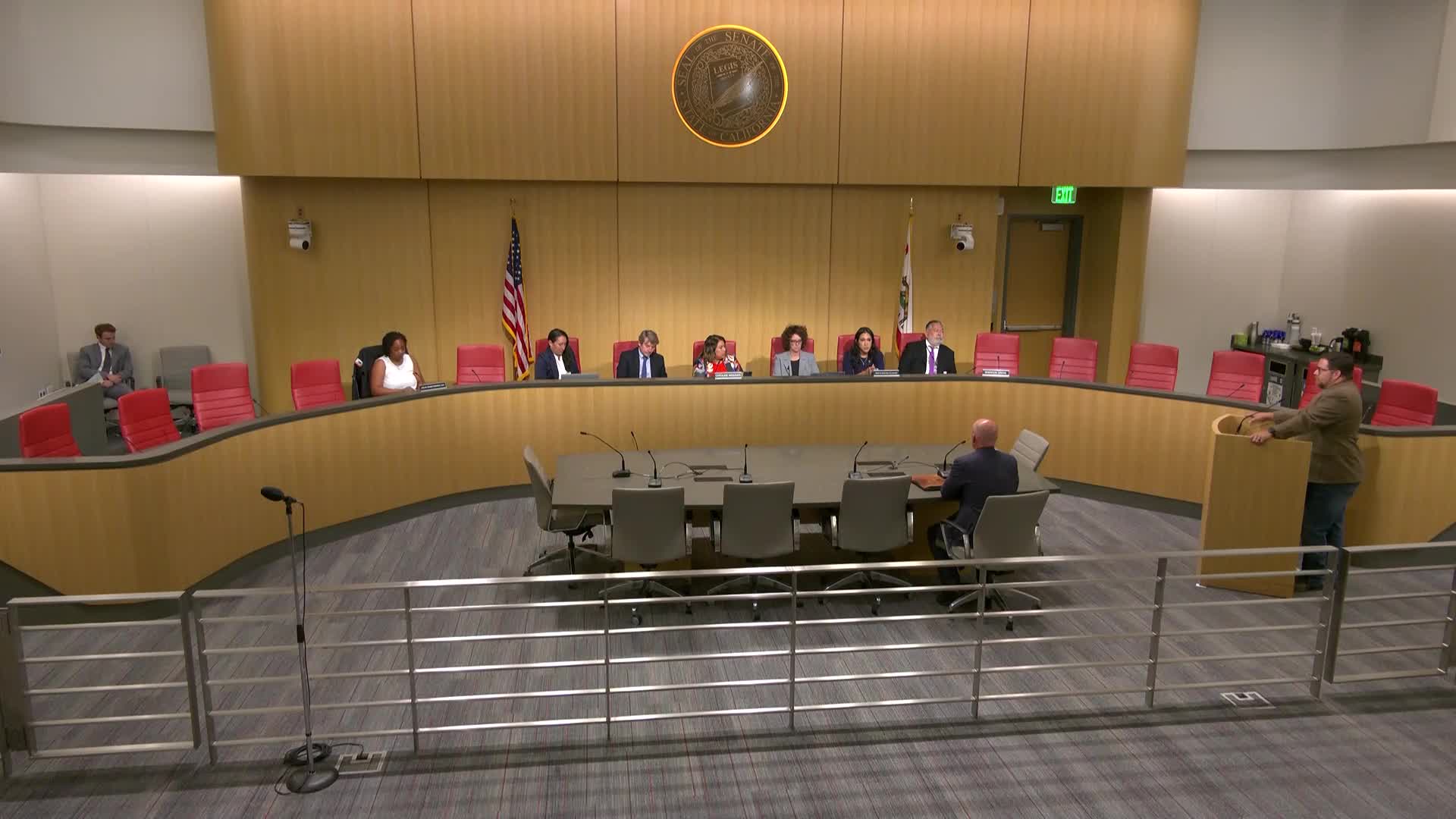
The California Senate Committee on Health on Oct. 27 advanced a slate of bills covering youth sports safety, emergency psychiatric holds, substance‑use treatment rules, language access and other health matters, sending most measures to follow‑up committees for fiscal or policy review.
The California Senate Committee on Health on Oct. 27 advanced a slate of bills covering youth sports safety, emergency psychiatric holds, substance‑use treatment rules, language access and other health matters, sending most measures to follow‑up committees for fiscal or policy review.
The measures included bills to expand AED and emergency‑response planning in youth sports, authorize emergency‑room physicians to place patients on 5150 holds in designated circumstances, update supervision rules for radiologic contrast administration, expand coverage of HEPA air purifiers for wildfire‑affected enrollees, strengthen enforcement of the state’s flavored‑tobacco ban, expand a transgender wellness fund, and several bills addressing oral health, language access and administrative streamlining for health providers. Several bills generated substantive testimony from authors, health‑care professionals, advocacy groups and county officials and drew formal opposition or requests for amendment.
Why it matters: The committee’s actions move a group of policy proposals forward that touch everyday public health (fluoride varnish, AED access), urgent care logistics (5150 holds, SUD treatment flow), and statewide program design (language access, insurance supervision rules). Multiple witnesses told senators the bills are intended to reduce delays in care, improve safety or protect vulnerable populations; several advocacy groups countered that some proposals risk expanding involuntary treatment, creating new mandates on plans or creating administrative gaps that need amendment.
Major items advanced
AB 310 (youth sports AEDs and emergency plans) — The committee accepted amendments and moved the bill. The measure builds on the 2023 Nevaeh Youth Sports Safety Act by requiring youth sports organizations to adopt written emergency‑response plans that identify AED locations, require routine maintenance/testing of AEDs and require coach recertification on CPR/AED on a two‑year cycle. Witnesses included representatives of the Save a Life Foundation and sports organizations; supporters stressed sudden cardiac arrest as a leading cause of death among student athletes and the importance of accessible AEDs. The committee accepted the author’s amendments that retain a phased timeline for compliance.
AB 416 (authority to place 5150 holds for behavioral crises) — The committee advanced a contentious bill that would explicitly authorize emergency‑room (ER) physicians to be designated under county policy to place patients on Welfare and Institutions Code §5150 holds when clinically indicated. Supporters, including emergency‑medicine physicians, said ERs face long delays when no designated professional is available to place a hold and that designation would reduce time patients spend in emergency departments while awaiting transfer to LPS‑designated facilities. Opponents, including peer‑run organizations and some county behavioral‑health directors, argued the change risks expanding involuntary commitments without the community linkages and training that crisis response teams provide; they urged investment in crisis response and voluntary alternatives. The bill’s text and testimony referenced county variation in designation practices and that some counties already designate ER physicians; the committee discussion focused on training standards and safeguards for counties with limited community resources.
AB 1037 (substance‑use disorder modernization) — The committee moved a broad set of updates intended to align statute with current clinical practices for substance‑use disorder (SUD) treatment. Provisions include removing statutory barriers that require individuals to be sober for a set period before admission to some programs, clarifying access to medications for addiction treatment and updating state code to reflect naloxone’s over‑the‑counter status. County behavioral‑health directors and addiction medicine leaders supported the bill as a way to reduce bottlenecks; law‑enforcement and some stakeholder letters raised concerns about specific statutory language (for example, changes originally proposed for paraphernalia/test equipment were withdrawn in later amendments). Committee members asked for continued negotiation on operational details; authors said they would work with stakeholders.
AB 1267 (consolidated licensing/certification for co‑located SUD programs) — Advanced with amendments: the bill would allow a single consolidated license/certification and unified fiscal/programmatic audit process for substance‑use disorder programs that are co‑located and function as a continuum of care, reducing duplicate audits and site visits while retaining unannounced compliance oversight. Providers testified that duplicative licensing visits consume staff time and slow expansion of services; sponsors amended the bill to exclude areas zoned exclusively for residential use.
Other measures moved or discussed
- AB 460 (radiology supervision): modernizes supervision rules to allow remote real‑time audio/video supervision of technologists administering contrast, while requiring on‑site personnel with appropriate licensure to respond to adverse events. Sponsor: California Radiological Society. - AB 573 (tobacco retail enforcement fees): increases annual tobacco‑retailer licensing fees to fund more CDTFA inspections and commissions a study of enforcement coordination; sponsors cited retailer noncompliance with flavored‑tobacco bans and gaps in inspection coverage. - AB 546 (air purifiers): would require certain health plans to cover HEPA purifiers for pregnant enrollees and people with asthma/COPD after a wildfire event; insurers expressed concern about a precedent for appliance coverage and scope/eligibility definitions. - AB 1487 (transgender, gender‑nonconforming, intersex and Two‑Spirit Wellness and Equity Fund): renames and expands the fund, adds Two‑Spirit representation and broadens eligible programs (workforce training, resettlement, diversion and TAY outreach); supporters noted ongoing threats to services and the fund’s role in sustaining community infrastructure; opponents raised fiscal‑oversight concerns about past grantee auditing in rare instances and questioned expansion timing. - AB 350 (Respecting Fluoride for Kids Act): would require Medi‑Cal and commercial plans to cover topical fluoride varnish for children up to 21 and establish Medi‑Cal reimbursement policy for fluoride varnish delivered in public‑health settings; the measure drew brief opposition from groups opposed to fluoride in water but broad health‑care support otherwise. - AB 843 and AB 1242 (language access): measures to align state law and agency practice with federal language‑access protections, designate language‑access oversight in Health and Human Services, and require human review of machine/AI translations. Sponsors emphasized large LEP populations and gaps in interpreter access; community advocates testified in strong support. - AB 1041 (credentialing): a proposal to standardize credentialing forms and set timelines to reduce delays in independent physicians’ credentialing by plans; sponsors described a proposed 90‑day review target and a standardized form process developed with stakeholders.
Votes at a glance (committee actions and next steps)
- Multiple bills were carried forward by the committee and referred to the next appropriate policy or fiscal committee (commonly Appropriations or Judiciary). Specific committee referrals and motions were recorded in the hearing transcript. Where the transcript recorded a final committee roll call during the hearing, the committee clerk announced the bill as “out” or referred and recorded the roll. (Detailed committee roll‑call tallies are recorded in the committee transcript and the Secretary’s roll call.)
What remains: Several items drew ongoing negotiations on technical fixes, training standards and eligibility definitions. Committee members and supporters asked authors to continue working with counties, behavioral‑health directors, insurers and provider groups to resolve operational questions before floor votes or appropriations hearings.
Ending: The committee recessed after completing the scheduled agenda and advanced multiple measures for further committee consideration. The hearing included extended public and organizational testimony and several requests to continue refining language on training, oversight and eligibility.