Get Full Government Meeting Transcripts, Videos, & Alerts Forever!
Get email alerts on the Corrections Behavioral Health topic
No spam. Unsubscribe anytime.
Shawnee County corrections seeks dozens of staff and $3.3 million to open behavioral health unit
Summary
County Department of Corrections asked commissioners for staffing and operating funds to open a behavioral health unit in its jail annex, including 30 specialized correctional specialists and new maintenance and transport positions; total personnel costs for new positions estimated at about $3.29 million.
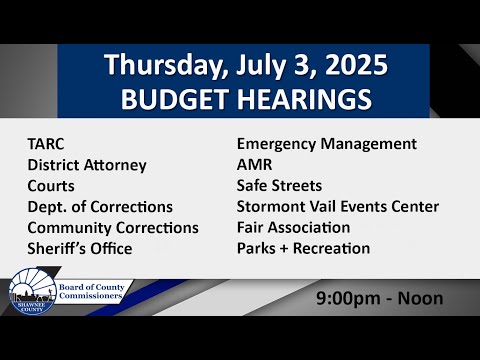
Shawnee County Department of Corrections Director Brian Cole told commissioners on July 3 that the department’s 2026 budget centers on opening a new behavioral health unit to house people with serious mental illness and provide targeted programming.
Cole said the department is requesting funding primarily to hire 30 correctional specialists dedicated to the behavioral health unit, plus three additional program/classification/transportation positions and three maintenance positions. The new posts would work 12‑hour shifts and require specialized training in crisis intervention techniques and mental‑health first aid. Cole said the department may scale the number of hires if full staffing proves infeasible and that some existing posts would be reallocated rather than eliminated.
The line‑item increases drive a roughly 14–17% increase for the detention budget, according to materials Cole referenced. County staff later confirmed that the combined 36 new positions (including benefits) for the behavioral health effort total about $3,286,830 per year, a substantial portion of the requested increase. Community corrections requested roughly $216,000 in county match funds (about $229,000 with benefits) to maintain state grant matches and wage adjustments.
Cole said the jail’s behavioral health unit is tentatively scheduled to open in April 2026; he cautioned vendor lead times for cell construction could push that 30 to 60 days. He described the unit as a consolidation of dedicated beds (about 40–60 capacity depending on configuration) for people needing suicide watch, competency restoration, or other intensive mental‑health programming. Staff and commissioners discussed that the unit would not immediately remove other safety posts and that some suicide‑watch beds will still be required elsewhere if totals exceed the new unit’s bed count.
Cole said the county has pursued outside funding to offset staffing and capital costs. He identified ongoing discussions with the Kansas Department for Aging and Disabilities about programming dollars and noted county staff were pursuing a potential $2 million grant expected to be known by October that might cover HVAC or other capital needs. Cole said he and others had also discussed potential state assistance for staffing with Department of Corrections leadership, but no commitments were reported.
Commissioners asked about hiring feasibility for 30 specialized correctional specialists given current statewide shortages; Cole said the department is already recruiting and has candidates in process and intends to phase hiring and training so new staff can attend the county academy before the opening. He also said the department expects to transition some existing staff into the behavioral unit, collapse or consolidate some posts elsewhere, and use academy training and in‑house certification to make the staffing plan realistic.
Other budget items tied to the detention request include a maintenance supervisor and two maintenance staff to support the enlarged facility footprint, an additional transport position, and modest increases for food service and off‑site medical transports. Cole said CIP requests also include a security upgrade ($75,000), an inmate transport vehicle (potentially purchasable this year to avoid a 2026 request), and a $55,000 fire‑detection upgrade in an inmate workshop area.
Cole stressed the project’s scale and fiscal impact and said county staff would work with audit/finance to scale hiring as needed. He said if mid‑process analysis suggests the department cannot responsibly fund 30 new correctional specialists, they would return to commissioners to propose a reduction (for example, cutting 10 positions) rather than proceed with an unsustainable plan.
Provenance: Transcript blocks beginning at 5366.275 (topicintro) through 6573.635 (topicfinish).