Get Full Government Meeting Transcripts, Videos, & Alerts Forever!
Get email alerts on the Landscape Maintenance Districts topic
No spam. Unsubscribe anytime.
City of Oxnard staff recommends policy to manage underfunded landscape maintenance districts
Summary
Anthony Miller, special districts manager in the City of Oxnard Public Works Division, presented a staff recommendation that the City Council adopt a resolution establishing a maintenance and funding policy for the city’s landscape maintenance districts (LMDs).
Anthony Miller, special districts manager in the City of Oxnard Public Works Division, presented a staff recommendation that the City Council adopt a resolution establishing a maintenance and funding policy for the city’s landscape maintenance districts (LMDs).
Miller said the policy is intended to clarify funding practices and set procedures for districts that were formed before Proposition 218 (1996) and therefore have maximum, fixed assessment rates that do not automatically inflate with rising costs. “LMDs exist to provide a direct and special benefit to those who choose to purchase property within its boundaries,” Miller said. He told the council the proposal draws on feedback from the Public Works and Transportation Committee and from public comment during committee hearings.
The proposed policy would: define when fund balances may be used; describe reserve types the city may hold for LMDs; set operating reserve guidance (a floor of 16.6% and a ceiling of 47.4% of budgeted expenses for fully funded districts); establish project reserves for identified capital items; and specify a hierarchy of staff actions when an underfunded or deficient district cannot meet maintenance needs within its capped maximum rate.
Staff told the council that many Oxnard LMDs were created under the Landscape and Lighting Act of 1972 (Streets and Highways Code) before Proposition 218 limited the council’s ability to increase assessments without a property-owner ballot. Because some pre-1996 districts do not include an automatic inflation adjustment, Miller said rising operating costs for landscape services and utilities have produced “substantial swings in maintenance quality” in districts where costs now exceed the districts’ assessment capacity.
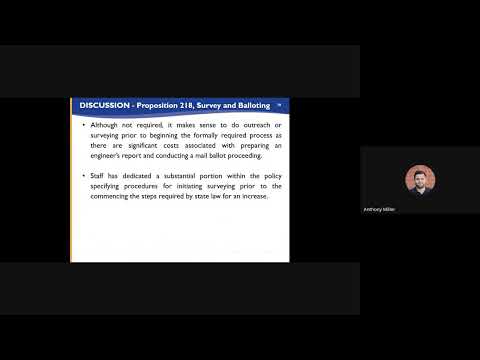
To limit the cost of pursuing assessment changes, the policy recommends conducting outreach and surveying prior to preparing an engineer’s report or initiating a formal Proposition 218 assessment mail-ballot proceeding. Policy section 5, “Survey and Balloting,” outlines when staff should initiate surveying, how balloting should be funded, what steps to follow if a district cannot fund maintenance, and options if a ballot is not pursued or if a ballot fails.
The policy would also distinguish reserve categories allowed under the Streets and Highways Code, including operating reserves (explicitly referenced to Streets and Highways Code section 22569 in staff materials) and project reserves (described with reference to Streets and Highways Code section 22660). Staff described project reserves as funds set aside for any improvement that will incur an expense “greater than can conveniently be raised from a single annual assessment” and that such an assessment may be levied and collected in installments over a period not to exceed five fiscal years.
Staff proposed clear classifications for districts: “underfunded” districts that cannot fund both reserves and maintenance activities, and “deficient” districts that are projected to end the fiscal year with a fund balance deficit. The policy includes a prescriptive priority list of staff actions if a district falls into one of these categories; staff said the list was drafted to reflect the committee’s direction while retaining flexibility to follow future, more-specific City Council direction.
Miller noted that staff provided tables and a map in the staff report identifying districts at risk: table 1 shows how the highest assessed rates translate to monthly-equivalent payments, table 2 lists districts classified as underfunded or deficient, and attachment 3 is a map of those districts. Miller said the information is intended to illustrate scope and scale, not to set a specific ideal assessment amount.
Financial impact: Miller stated there is no direct financial impact from adopting the policy. The presentation concluded with staff asking if the council had questions. The transcript does not record a subsequent motion, vote or formal council action on the resolution in the provided segments.