Get Full Government Meeting Transcripts, Videos, & Alerts Forever!
Get email alerts on the Historic Preservation Survey topic
No spam. Unsubscribe anytime.
Historic Preservation Office presents final Downtown Austin survey, recommends multiple potential districts
Summary
The Historic Preservation Office briefed the Historic Landmark Commission on a final Downtown Austin Historic Resource Survey documenting nearly 2,000 resources, recommending potential local historic districts and next steps including periodic updates and targeted outreach to underrepresented areas.
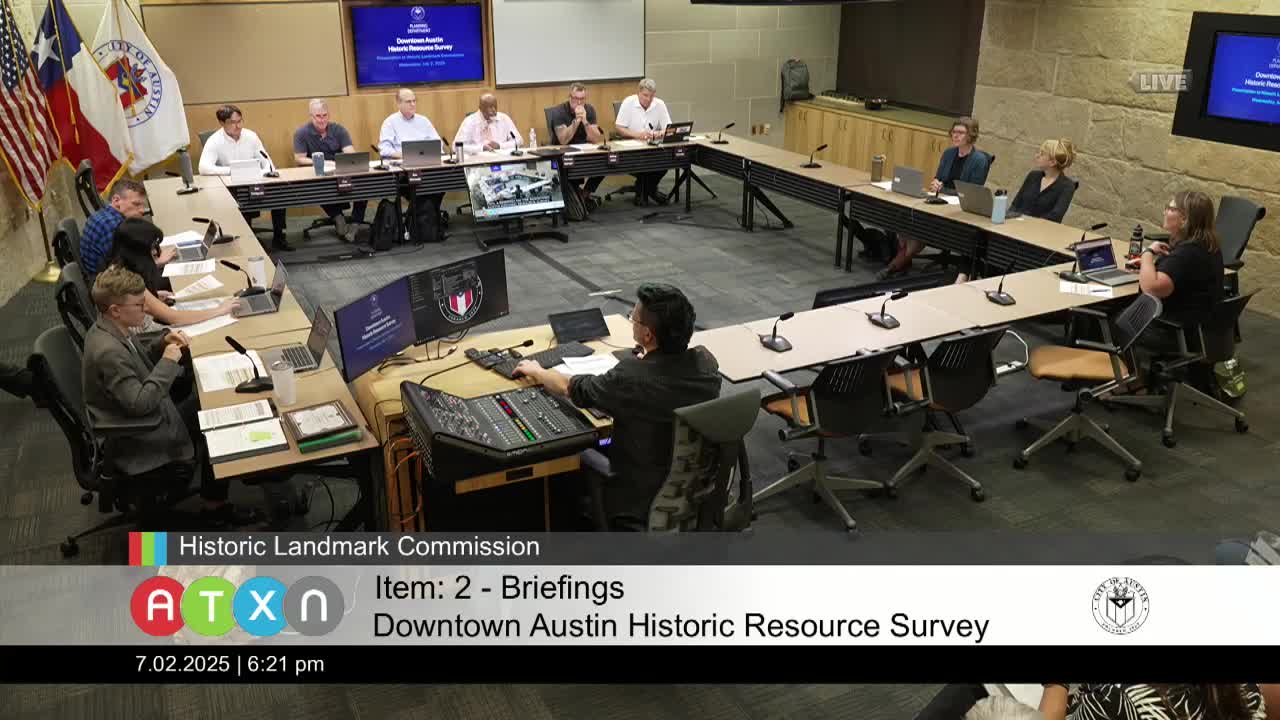
The City of Austin Historic Preservation Office presented the final Downtown Austin Historic Resource Survey to the Historic Landmark Commission on July 2, saying the work documents nearly 2,000 resources across roughly 1,500 parcels and produces recommended boundaries for potential local historic districts.
The survey covers properties at least 50 years old within a downtown boundary roughly bounded by MLK/Enfield, MoPac, I-35 and Lady Bird Lake; staff said it will guide future designations, demolition reviews and local and National Register nominations.
Kim McKnight, division manager for the Historic Preservation Office, told commissioners the downtown effort is the first comprehensive update since 1984 and is intended as a foundational planning tool. “You cannot protect things if you don’t know what they are and where they are,” McKnight said, describing the fieldwork, photographic documentation and development of historic contexts that underpin eligibility recommendations.
The survey recommends numerous potential local historic district boundaries and finds a large share of surveyed resources eligible for some form of designation: staff noted that many resources are eligible for local landmarking or National Register listing and that substantial portions of downtown already sit in eligible or listed districts.
Commissioners and staff emphasized that the survey itself does not impose zoning or tax changes. McKnight said local designation would add a local zoning overlay and could make properties eligible for local tax relief tied to following design standards; National Register listing would not change local zoning but could make properties eligible for rehabilitation tax credits.
Staff said next steps include department acceptance of the final survey, use of the findings in demolition and zoning reviews, outreach to property owners and neighborhoods, and a prioritization process for further survey work in areas of high development pressure. Funding partners such as the Heritage Tourism Division helped underwrite the project, and staff said they hope to update other areas — East Austin was noted as a candidate — on a roughly 10-year cycle.
Commissioners praised the survey for identifying underrepresented areas and for providing a roadmap to pursue local districts where contiguous concentrations of eligible resources exist.
The department will publish the final survey materials and use them in hearings and staff recommendations going forward. The briefing represented an informational acceptance; no formal zoning action resulted from the presentation.