Get Full Government Meeting Transcripts, Videos, & Alerts Forever!
Get email alerts on the Un Security Council Pakistan Presidency topic
No spam. Unsubscribe anytime.
Pakistan, as Security Council president for July, unveils program of work and schedules debates on Palestine and UN–OIC cooperation
Summary
Pakistan, serving as president of the United Nations Security Council for July, presented a program of work adopted earlier the same morning that schedules two signature high-level events, periodic mandated briefings on country situations and thematic files, and a series of subsidiary-body meetings.
Pakistan, serving as president of the United Nations Security Council for July, presented a program of work adopted earlier the same morning that schedules two signature high-level events, periodic mandated briefings on country situations and thematic files, and a series of subsidiary-body meetings.
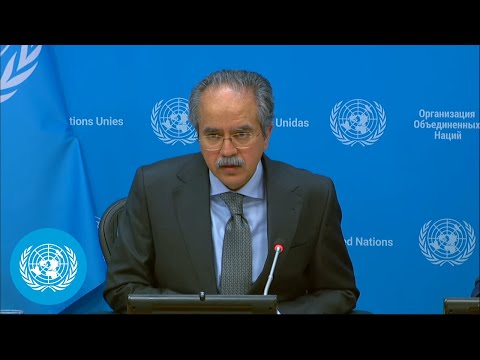
Ambassador (Permanent Representative of Pakistan; President of the Security Council) told reporters the program “includes a full schedule of periodic and mandated briefings and other meetings across a broad range of regional and thematic issues.” He said Pakistan will convene two signature events: a high‑level open debate on “promoting international peace and security through multilateralism and peaceful settlement of disputes,” scheduled for July 22 and expected to be chaired by the deputy prime minister and foreign minister of Pakistan, senator Mohammad Isakdar, with the secretary‑general expected to brief the council; and a briefing on cooperation between the United Nations and regional and subregional organizations that will include the Organization of Islamic Cooperation (OIC), scheduled for July 24.
The program also lists a quarterly open debate on the Middle East, including the Palestinian question, scheduled for July 23; Pakistan said it is considering elevating that meeting to ministerial level. The ambassador said that discussion would “reaffirm the council’s responsibility to protect civilians, uphold international humanitarian law, and push for an immediate ceasefire,” and to explore longer‑term political steps consistent with U.N. resolutions.
Council members will also receive mandated briefings and situational updates on a range of country files, the ambassador said, naming Colombia, Haiti, Cyprus, Sudan, the International Criminal Court (ICC) matters, and monthly updates on Syria and Yemen; he noted consultations on Lebanon in the context of “resolution 1701.” He said the council is prepared to convene additional meetings if developments on the ground require timely engagement.
On working methods, Pakistan said it will prioritize transparency and inclusivity, maintain regular informal consultations and briefings, keep Fridays largely open for subsidiary‑body meetings, and support catch‑up work after delays in agreeing chairs for subsidiary bodies. Pakistan will serve as chair or co‑chair of some subsidiary bodies, including the 1988 Taliban sanctions committee and informal working groups on sanctions and documentation, the ambassador said.
During a question‑and‑answer session, the ambassador confirmed that the program document adopted that morning is intended to yield outcomes where possible. He also said a draft Security Council text jointly tabled by Pakistan, China and Russia on the Middle East — described in the briefing as seeking to address the cessation of hostilities — “is on the table” and remains under discussion; he said there was no timeline for a vote and that members were working to find language that could attract broad support, including from permanent members.
Reporters asked about specific country situations. On Haiti, the ambassador said discussions are ongoing and referred to the secretary‑general’s recommendations set out in a February letter; he said council members have been holding intense discussions and that the matter remains under consideration. On the U.N. mandate on children in armed conflict, he said mandates and criteria should be applied “uniformly, universally, and without selectivity” to strengthen those instruments.
Asked in his national capacity about nonproliferation and Iran’s relationship with the Non‑Proliferation Treaty (NPT), the ambassador said Pakistan’s view is that there remains space for dialogue and that parties’ rights under the NPT should be respected; he said recent attacks on nuclear sites have complicated discussions but that a return to diplomacy remains preferable. On Kashmir, he noted the matter remains on the Security Council’s agenda with historical resolutions calling for a plebiscite and said the council and permanent members bear responsibility for implementing outstanding measures.
The press briefing concluded after an extended question period in which journalists raised other topics including Ukraine and Afghanistan; the ambassador said the council remains “the master of its own procedure” and can add items if developments require it.
The press counselor at the Pakistan Mission, Amanit, opened the briefing and introduced the ambassador. No formal vote or timetable for action on the Middle East draft resolution was announced during the briefing.