Get Full Government Meeting Transcripts, Videos, & Alerts Forever!
Get email alerts on the Energy Storage topic
No spam. Unsubscribe anytime.
Residents raise safety, setback concerns as DTE representative urges balanced local ordinance on battery storage
Summary
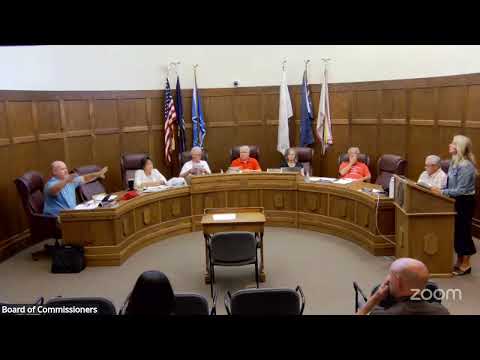
Public comment at a Gratiot County Board meeting focused on proposed local rules for battery energy storage systems; residents raised environmental and safety concerns while a DTE contractor argued strict limits could push developers to state siting.
Public comment at a Gratiot County Board of Commissioners meeting focused on battery energy storage systems and the county ordinance being drafted to regulate them, with residents raising safety and environmental concerns and a contractor for DTE urging measured rules to preserve local control.
Speakers at the microphone described worries about contamination from failed systems reaching farm tiles, ditches and lakes, the adequacy of setbacks and landscape screening, and the ability of local soils and wildlife to support planned vegetation buffers. A DTE-affiliated speaker sought to counter those concerns by citing modern safety standards and permitting requirements and warning that overly restrictive local rules could push applications to the Michigan Public Service Commission (MPSC).
The exchange was part of the meeting’s public-comment period and did not include a formal vote or ordinance action. Board members and staff said the planning commission is drafting an ordinance and that additional technical information will be gathered before any final local rules are adopted.
A DTE representative, speaking as a contractor working with DTE Direct, described differences between past incidents and current systems and cited national safety standards. The representative said Moss Landing was “a repurposed warehouse, not a purpose built facility,” and asserted that modern battery energy storage systems are designed and tested to contain failures. He said, “There is no evidence from the EPA, CDC, or NIOSH showing that battery storage events like Moss Landing result in long term community health issues, toxic fallout, or airborne nanoparticles affecting miles of homes.” He also cited UL 9540 and UL 9540A testing and NFPA guidance and described permitting and third-party testing as part of the regulatory process.
Multiple residents pushed back, citing local farming practices and water runoff as risks. One resident said: “I farm. I know exactly how stuff gets into farm tiles, and then it ends up in a ditch,” and asked whether developers would accept long-term financial responsibility for cleanup and harm. Residents raised specific concerns about setbacks and screening: they questioned whether 100-foot or 150-foot setbacks were sufficient, proposed three-row plantings that suit local soils, and said deer browsing can kill newly planted screening if species and soils are not matched.
The DTE contractor said company permits and conditional use applications include decommissioning and liability provisions and that some developers would consider state siting if local rules are judged unworkable. The contractor noted state siting could allow different standards, including sound limits cited in state-level discussions — “55 dBA sound limit at the dwelling” and setbacks “as close as 50 feet from the property line,” he said — and characterized the result as a potential loss of local control for siting decisions.
Speakers referenced several local planning and screening issues: whether drain tiles could be rerouted as part of siting mitigation, how many acres a storage facility actually needs (developers spoke of projects needing roughly 12–20 acres depending on size), and whether strict setbacks (for example, 600 feet) would leave insufficient acreage on many parcels. Commenters also invoked prior wind and solar projects in Gratiot County to argue both that farming can continue around energy infrastructure and that past projects have sometimes required company follow-up to repair farm tile damage.
No formal action was taken. Board members said staff would gather additional technical responses to questions raised during public comment, including the feasibility of rerouting drain tile and the specifics behind setback calculations, and that the planning commission’s draft ordinance would be refined with input from residents and developers.
The discussion occurred during the public-comment period and centered on planning commission draft language; the county did not adopt or reject any ordinance at the meeting.