Get Full Government Meeting Transcripts, Videos, & Alerts Forever!
Get email alerts on the Health And Human Services topic
No spam. Unsubscribe anytime.
Meeker County Health & Human Services details MNChoices assessments, waiver programs and staffing pressures
Summary
Health & Human Services presented a status report on MNChoices assessments, elderly waivers, the new CFSS program and staffing/provider shortages; commissioners and staff discussed funding mechanics, random‑moment time study revenue and local service gaps.
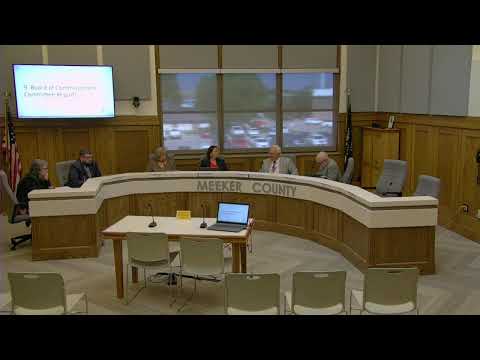
Health & Human Services staff briefed the Meeker County Board of Commissioners on July 1 about MNChoices assessments, elder waiver and alternative care programs, and staffing and provider availability in the county.
Melissa Stonelake, supervisor for MNChoices and the over‑65 waivers, said Meeker County performs comprehensive MNChoices assessments — an initial assessment can take more than a dozen hours — and that the program is intended to identify person‑centered services to keep people in their homes rather than in facilities. Stonelake reported 2024 revenue from MNChoices of $581,593 and explained the state/federal share (about 45% state, 55% federal under the current cost allocation). She said the county currently staffs four full‑time assessors plus two half‑time positions (roughly five FTEs) and that many case managers are required to be certified assessors.
Stonelake described the way the MNChoices funding allocation is tied to the random‑moment time study (RMTS): staff receive intermittent electronic “hits” asking what they are doing at a particular moment; coding responses generate reimbursement for time spent on eligible activities. She noted the RMTS is the principal mechanism that determines MNChoices allocation and that staffing availability and honest, timely completion of RMTS hits materially affect revenue. As the board discussed, a pending state budget change under consideration could change the state share or move to a flat rate; HHS staff said federal rules and CMS oversight create additional uncertainty.
Board members pressed on a range of operational issues: how often RMTS “hits” arrive (random; staff have 24 hours to respond), oversight of responses (records in the county documentation system can be checked), and how potential changes to state funding rules might affect county budgets. Tina Schenk, HHS director, and Andrew Lettson, county administrator, said they are tracking state and federal developments and would coordinate with regional partners and MNChoices administrators on any necessary adjustments.
Sizable gaps in local long‑term care capacity were also discussed. Stonelake said Meeker County has roughly 100 elderly waiver clients currently and about 20 Alternative Care (AC) clients; local skilled nursing and assisted living capacity contracted after COVID, and some residents now must receive care out of county. Commissioners and staff noted programs such as caregiver supports, senior companions and potential intergenerational or volunteer models to address socialization and nonclinical needs, but they cautioned that provider recruitment remains a limiting factor in rural service delivery.
The presentation concluded with a request for continued monitoring of MNChoices allocations and staff capacity; commissioners thanked HHS staff and asked for periodic updates as federal/state budget decisions become clearer.