Get Full Government Meeting Transcripts, Videos, & Alerts Forever!
Get email alerts on the Local Taxation topic
No spam. Unsubscribe anytime.
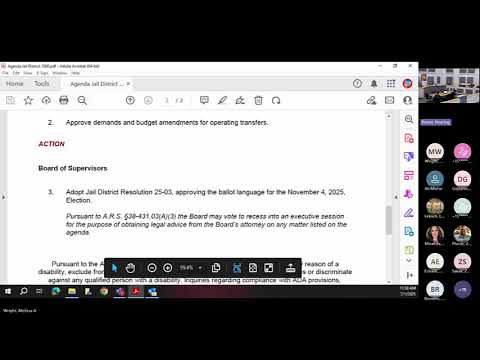
Cochise County Jail District adopts ballot language for half-cent sales tax to finance jail construction
Summary
The Cochise County Jail District board voted 3-0 to approve ballot language for a proposed half-cent (0.5%) sales tax to fund construction and financing of county jail facilities; the tax would begin July 1, 2026, and end when related debt is repaid or on July 1, 2043.
The Cochise County Jail District Board of Directors voted 3-0 to adopt Resolution No. 25-03 approving ballot language for a proposed excise (sales) tax that would raise up to one-half of one percent to fund construction and financing of county jail facilities.
County Administrator Laura Gilman read the ballot language to the board after the panel returned from an executive session: “Shall the Cochise County, Arizona Jail District be authorized to levy an excise tax (sales tax) of up to a half cent, or one-half of one percent (0.50%), on most business transactions starting 07/01/2026? This tax would only pay for the construction and financing of county jail facilities. The jail district will end the tax on the earlier of 90 days after the jail district debt secured by such tax is fully repaid or 07/01/2043.” The motion to approve the resolution passed unanimously.
Why it matters: The ballot language sets the terms the public will vote on in the November 4, 2025, election and specifies both the permitted use of the revenue—construction and financing of jail facilities—and a hard end date tied to repayment of debt or July 1, 2043. The board said the timeline and language were time-sensitive for filing with the elections office.
Public comments and executive session: Two members of the public raised concerns before the board approved the resolution. Radford Hyde said he was “almost aghast” that the ballot language was not attached to the posted agenda and asked why the public could not review the draft before it was discussed in executive session. Tricia Jeradette told the board she had “no basis for forming any kind of comment” because the draft language was not posted.
Board members and county attorneys defended the use of an executive session for finalizing the draft. County Attorney Zuko explained that the board may recess to executive session to receive privileged legal advice: “The board has a right, like any private party that has an attorney, to have an open discussion with your attorney to bounce ideas around … that allows you to speak openly and freely with us before you make up your minds about the decision.” Gilman told the board the draft had been reviewed by counsel, including bond counsel, and that tight statutory timelines required submitting final language to the elections office by the next day.
Key dates and details: The board stated the election would be held Nov. 4, 2025; the proposed tax would begin July 1, 2026; and the tax would end 90 days after the related jail district debt is repaid or on July 1, 2043, whichever occurs first. The board also announced a public hearing on the continued establishment of the jail district scheduled for Aug. 5 at 10 a.m.
Procedure and outcome: The item was discussed in executive session for legal review before the public vote; no official action occurred during executive session. After returning to open session and reviewing the language, the board approved Resolution No. 25-03 adopting the ballot language. The vote was recorded as 3-0 in favor.
Background: Board members said they worked with bond counsel and county attorneys at a prior meeting to draft and refine language. The resolution’s prefatory “whereas” clauses summarize the board’s statutory authority and the chain of events leading to the ballot measure.
What remains: The county will file the approved ballot language with the elections office under the statutory filing timeline. Members of the public who raised concerns were invited to submit comments by email and to attend the scheduled public hearing on Aug. 5.