Get Full Government Meeting Transcripts, Videos, & Alerts Forever!
Get email alerts on the Public Safety topic
No spam. Unsubscribe anytime.
Cherokee County Fire and Emergency Services reports steady response times, highlights staffing and SPLOST funding needs
Summary
Chief Randy Wenner presented the 2024 annual report to the Cherokee County Board of Commissioners, noting maintained national accreditation, a $70.3 million FY2024 budget driven by personnel costs, rising call volumes and plans for quick-response vehicles and station investments funded in part by SPLOST.
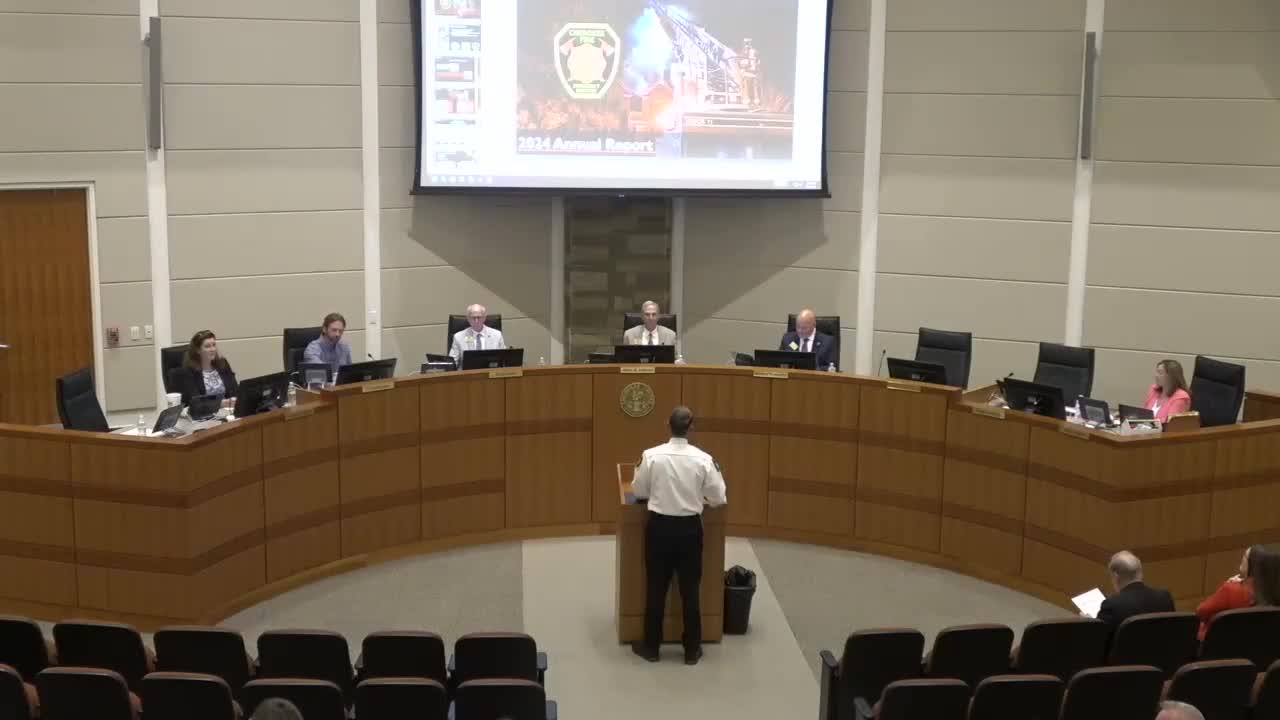
Chief Randy Wenner presented Cherokee County Fire and Emergency Services’ 2024 annual report to the Cherokee County Board of Commissioners on July 1, saying the department has maintained national accreditation and is addressing rising call volumes and budget pressures.
Wenner told the board the department “is very proud of our accreditation status,” noting the department is among 23 internationally and one of 14 in Georgia to reach that level. He said the combined Fire and EMS FY2024 budget was $70,300,000 and that personnel costs made up roughly 82 percent of that total.
The report framed several operational pressures: a growing call volume that outpaces population growth, nearly 17,000 ambulance transports in 2024 and average response time of 6 minutes, 39 seconds while the 90th-percentile response time has been increasing. “Our response times are creeping up,” Wenner said, and the department is identifying investments to address that trend.
Why it matters: rising call volume and an aging, growing population are increasing demand for EMS and fire services. Commissioners and staff discussed capacity, equipment wear and capital needs that would require both operating and one-time capital funding.
Wenner outlined several strategies and programs the department is pursuing: community paramedicine, a rapid-response QRV (quick response vehicle) pilot to add depth in high-demand territories, the county’s paramedic school accreditation and expanded training pipelines that yield college credit for recruits. He said QRVs are smaller pickup-style units that can be staffed and deployed to handle lower-acuity calls so heavy apparatus like a $2 million ladder truck is preserved for incidents that require it.
On staffing, Wenner said the department’s field operations staff would reach about 462 positions after the August recruit class, and noted the system now operates 16 Advanced Life Support transport units. He also highlighted a paramedic SWAT medic program—paramedics embedded with sheriff’s deputies on high-acuity tactical calls—and local recruitment success via public relations and the Citizen Fire Academy.
Wenner reviewed SPLOST spending for Fire and EMS: the department spent about $6.5 million from prior SPLOST cycles and expects to use SPLOST 2024 allocations (the county’s allotment shown as $37 million) plus impact-fee revenue to support station rebuilds and remodels; he said about $2 million in county-collected impact fees have been set aside, with an additional $2 million collected in the City of Canton earmarked for downtown Station 16 work.
Commissioners asked operational questions that Wenner answered in detail, including whether QRVs would be cross-staffed or dedicated. Wenner said the department’s preference is to staff QRVs. Commissioner Carter and others praised the department’s training and accreditation work; Chairman John Johnson said the county is “enormously proud of Cherokee Fire.”
Wenner also discussed logistics, health and safety initiatives, and employee retention: the department has a three-pronged health program (physical performance standards, annual medical physicals with cancer screenings, and mental health resources), and it honored retirees during the presentation. He credited the department’s IT and logistics staff with maintaining operations through events such as a 2024 CrowdStrike cybersecurity incident.
Ending: Wenner closed by thanking staff and said he welcomed questions; commissioners offered applause and thanks for the department’s service.