Get Full Government Meeting Transcripts, Videos, & Alerts Forever!
Get email alerts on the Road Validation topic
No spam. Unsubscribe anytime.
Valley County commissioners discuss road validation process, public access and safety concerns
Summary
At a June 30 workshop the Valley County Board of Commissioners reviewed a plan to validate historic and disputed roads, focusing on public access, safety audits, weed mitigation and who will pay for maintenance and upgrades.
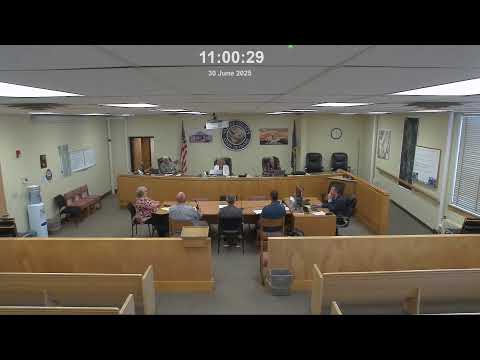
Valley County commissioners held a workshop at 10:15 a.m. on June 30 to discuss a proposed process for future road validations, a step county staff say is necessary to clarify which historic routes are public and which are private and to set expectations for maintenance, safety and public access.
Commissioners and county staff described the county's current validation work as an effort to update the official road map required under Idaho road law and to resolve disputes where gates or signage have led the public to believe historic routes are private. Staff said several routes identified by the parks and recreation division and others will be checked, researched and potentially validated or vacated after historical review and interdepartmental coordination.
Officials said the process will include three main steps: compiling a prioritized list of candidate routes, conducting historical research to establish whether each route qualifies as a public road, and assigning a project lead to coordinate required reviews and any follow-up work. County staff warned the work can generate downstream maintenance obligations, require safety or signage upgrades and sometimes prompt negotiations with adjacent private landowners.
Discussion emphasized public-safety reviews and engineering oversight as distinct from the historical research that establishes whether a road is public. Staff proposed a formal engineering review for hazards such as roadside obstructions, steep scarps that could threaten a roadway, drainage issues, and road curvature. Staff also raised noxious-weeds control as an operational concern for routes that have not been actively used or monitored.
County staff referenced a recent research contract and database compiled by a historical researcher (identified in the meeting as Amaya) that collects records from outside sources and county archives. Commissioners said they expect that researcher to contact county staff in early July to take direction on the next set of priority validations.
Old Council Road was cited repeatedly as the example that prompted the current effort. Presenters said historical research showed portions of Old Council Road were built with county funds in the early 1900s and that part of the route remains gated; staff described a pending petition and an upcoming public hearing to consider a partial realignment of that roadway.
Road department staff warned that validating a road can create new maintenance responsibilities such as installing and later maintaining cattle guards, signage or other measures. Staff said the county currently has no standing project budget for those specialty items and recommended the county identify whether maintenance tasks will be handled by the road department, contracted out, or covered by developers when a given route becomes part of a development project.
Parks and recreation staff said many of the candidate routes are recreation access corridors and recommended the department lead those projects where recreation access is the driver. Planning and zoning staff were identified as the lead when validations are prompted by development proposals.
Commissioners and staff also discussed interagency coordination: involving weeds control, wildfire mitigation, and road engineers so sites can be inspected and hazards addressed before a road is opened to broader public use. Participants repeatedly emphasized that validation itself is distinct from physical improvements; validation confirms legal status, while upgrades, signage, and hazard mitigation are separate implementation steps often requiring additional budget or contractor work.
Next steps identified at the workshop included: assembling the list of candidate roads compiled earlier by parks and recreation, directing the contracted historical researcher to proceed with the prioritized list, assigning project leads for individual routes, and preparing for public hearings where petitions exist (Old Council Road was specifically named). Staff also said they will identify funding lines for anticipated one-off costs (signage, cattle guards, contractor installation) and bring any necessary budget requests back to the commission.
Participants flagged two recurring concerns: (1) liability and safety risks on routes that have not been actively monitored for years, including noxious weeds such as leafy spurge in the West Mountain Road area; and (2) the need to set clear standards and public messaging (for example signage indicating recommended vehicle type or maintenance level) so the traveling public understands a route's condition and intended use.
No formal motions or votes occurred at the workshop. Staff said they will return with the prioritized list and recommendations on project leads, budget impacts and contract scopes before any validation decisions are presented at a public hearing.
The discussion closed with staff and commissioners agreeing to remain engaged as the research and field reviews proceed and to coordinate across departments before validating and opening any route to broader public use.