
Board hears extended public hearing and trustee discussion on Petaluma Accelerated Charter School Spanish program
Get AI-powered insights, summaries, and transcripts
Subscribe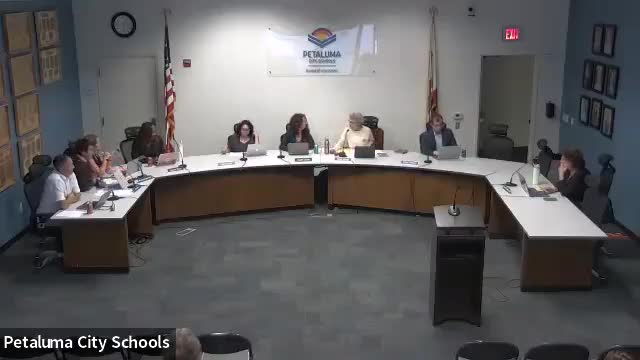
Summary
Parents, teachers and district staff debated whether to keep, modify or suspend the Spanish language requirement in the Petaluma Accelerated Charter School (PACS) program. Speakers urged caution, proposed alternatives including college-level or online options, and trustees agreed to study scheduling, staffing and equity before a final decision.
The Petaluma City Schools Board of Education held a lengthy public hearing and discussion on Tuesday on the future of world language instruction at the Petaluma Accelerated Charter School (PACS), with parents, staff and district administrators urging changes to how Spanish is offered and asking the board for more time to develop a plan.
Parents and staff who addressed the board said the current Spanish program has not delivered consistent outcomes and that the school should not ask students to enroll in a course they do not trust. "School starts August 13, and the clock is ticking," said Susie Starkey German (commenter), urging the district and PACS leadership to clarify teacher assignments and provide transparent outcomes before families make elective choices. "If the current Spanish teacher is returning next year, most rising eighth graders will opt out if given the option," she said.
Sarah Sharp, a parent and bilingual resource specialist at McDowell and McNair elementary schools, told trustees that world language is "a core academic subject" and urged the board to preserve or strengthen access to Spanish, saying language learning supports cognitive flexibility and long-term opportunity. "We should be uplifting the value of Spanish language development, and expanding, not limiting access to world language classes," Sharp said.
Other parents said the program has been inconsistent and recommended stopgap or alternative delivery models. Ted Sprague, an incoming PACS parent, said eliminating Spanish because of a single staff failure would be "the wrong solution" and urged the board and district to address root causes, not simply remove the course. Another parent suggested partnering with Santa Rosa Junior College (SRJC) to allow qualified seventh- and eighth-graders to take SRJC Spanish I for college credit as a temporary option, while district staff pointed at Edgenuity and other online providers as possible interim solutions.
District staff and PACS leaders outlined operational constraints. Jason (district staff) and PACS scheduling staff explained that PACS students take eight classes per day rather than the six commonly used at comprehensive junior highs; that structure compresses afternoon elective minutes and makes it difficult to expand Spanish without eliminating another elective or restructuring the school day. One PACS staff member explained that the program historically relied on a shared or full-time Spanish teacher; "until 2022 we employed a full-time Spanish teacher" split between sites, the district said, and recent staffing changes left no .4 FTE position available for PACS.
Trustees and staff reviewed student outcome numbers shared in the meeting: in the most recent graduating cohort 21 PACS students matriculated to high school; 16 enrolled in Spanish I and five in Spanish II. Earlier cohorts showed varying rates: 2023–24, 14 students total (11 Spanish I, 3 Spanish II); 2022–23, 19 students (9 Spanish I, 10 Spanish II). PACS staff noted those annual cohorts and the program's frequent teacher turnover — "six teachers in 10 years" was cited — as part of the context for low continuity.
Possible short- and medium-term approaches were discussed but not decided. Options considered included: - Keeping Spanish in the charter but piloting an alternative delivery model this fall (for example, Edgenuity or SRJC enrollment for qualified students) and directing staff to strengthen hiring and schedule design; - Making Spanish optional and allowing students to choose music or a student-success period instead (several PACS schedule mock-ups showed this could be done without adding FTEs by scheduling the electives at the same time); - Temporarily removing Spanish from the PACS fall schedule while the district and PACS develop a structural change to lengthen elective minutes and secure a reliable instructor.
Board members repeatedly said they wanted more data and a firm implementation plan before taking final action. One trustee read a district communication noting the policy language is "intentionally broad" and that staff plan to "focus on creating the implementation plan" during 2025–26; full implementation and more detailed guidance for off-campus lunch, extracurriculars and handbooks were described as likely to follow in 2026–27. Trustees asked for schedule comparisons with other middle schools, historical minutes and staffing data, potential budget implications, and additional details on partnerships with SRJC or online providers.
No final vote on the PACS charter or program change occurred at the June 24 meeting. Trustees indicated the PACS amendment (a formal charter amendment request to change the curriculum wording) would appear on the board agenda for a vote at a subsequent meeting; staff committed to supply scheduling breakdowns, historical rosters and a range of feasible implementation options.
The discussion closed with a request from PACS staff to provide the board with the school's prior schedules and a district pledge to convene a study session or to provide a detailed staff report to help trustees weigh staffing, budget and equity tradeoffs before any charter amendment is finalized.
Community members who spoke included parents from McKinley and PACS, a bilingual resource specialist, and several staff who helped draft PACS schedules. The board emphasized next steps: collect the data discussed, consider a study session, and bring a clear implementation option to the board for a decision before the school year begins or at the scheduled charter-review meeting.