Get Full Government Meeting Transcripts, Videos, & Alerts Forever!
Get email alerts on the Mitchell Field Rezoning topic
No spam. Unsubscribe anytime.
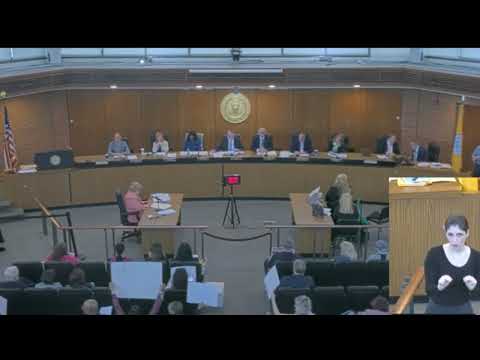
Hempstead board adopts new Mitchell Field zoning despite broad public opposition
Summary
The Town of Hempstead board voted to adopt a new Mitchell Field Integrated Resort District zoning code and accept the FEIS finding statement after a continuation of a public hearing that began May 27, 2025.
The Town of Hempstead board voted to adopt a new Mitchell Field Integrated Resort District zoning code and to accept the final environmental impact statement finding (FEIS) after a continuation of a public hearing that began May 27, 2025. The measures passed by recorded voice vote, with Supervisor Don Clavin and the council members present voting aye.
The zoning change replaces an older MFM code on the parcel commonly known as the Nassau Coliseum and adjacent Marriott property and establishes the MF‑IRD (Mitchell Field Integrated Resort District), the town attorney said during the hearing. Adopting the FEIS finding statement and the new zoning does not approve any specific site plan; it creates a code under which future conceptual master plans and site plans could be submitted for public review and board approval.
The adoption followed more than three hours of public comments at the continuation hearing. Hundreds of county residents, many from Garden City, Uniondale, East Meadow and surrounding communities, spoke almost unanimously against allowing gambling at the site. Speakers cited traffic, public safety, water resources, proximity to schools and hospitals, and experience from other casino communities as reasons to reject rezoning for gaming.
Daniel Baker, attorney for the applicant, told the board that Las Vegas Sands is no longer pursuing a state gaming license for the site but said Sands remains committed to seeing meaningful development at the Coliseum parcel. “Sands is no longer pursuing a gaming license through the state solicitation process,” Baker said, adding that the FEIS studied alternatives both with and without gaming and that adopting the findings would allow redevelopment options to move forward.
Residents gave detailed remarks. Marie Murphy, a Garden City resident, said: “Say no to the casino and the rezoning of the Nassau Coliseum site that includes any type of gambling.” Christine Mulaney of Garden City warned of traffic and other harms and said, “20,000 daily gamblers would create a traffic nightmare.” Multiple speakers highlighted the site’s proximity to Hofstra University, Nassau Community College, Kellenberg Memorial High School and Memorial Sloan Kettering and urged alternatives such as medical research facilities, affordable housing, STEM and cultural venues.
Several speakers urged the board to seek broader community input before changing zoning. “Ask for their input. They’re willing to provide you the information,” Kathy Wysaki said, summarizing a common theme: residents asked for a public survey or planning process focused on alternative uses.
Town counsel and outside counsel emphasized that the board was only adopting a zoning code and the FEIS finding; any specific project would later require a conceptual master plan, additional public hearings and site plan approvals. Outside counsel explained the “fail safe” that future conceptual master plans and site plans would be subject to public notice and further board discretion.
Votes and motions recorded at the meeting show the board approved the FEIS finding statement and the MF‑IRD zoning. The board’s adoption of the new code does not authorize construction or any specific development without subsequent approvals under the new code.
Speakers at the hearing included residents, town officials and attorneys. Many residents urged the board to reject gaming and proposed a range of alternative uses—medical and research campuses, clean-energy hubs, sports and cultural facilities, senior and workforce housing, and digital media or biotech uses—cited by multiple commenters as options that would bring jobs without the harms they associate with casinos.
The town clerk announced a short recess after the public comment period before the board moved to the motions. The first motion recorded was to accept and adopt the FEIS finding statement for the proposed MF‑IRD; the second motion was to adopt the MF‑IRD zoning. Both motions were seconded and recorded as adopted.
The board and staff repeatedly stressed that adopting the code is a zoning action, not an approval of any particular project. Future proposals that rely on the new code will be subject to additional public hearings and approvals.