Get Full Government Meeting Transcripts, Videos, & Alerts Forever!
Get email alerts on the Police Chief Reappointment topic
No spam. Unsubscribe anytime.
Fire and Police Commission reappoints Chief Jeffrey Norman amid public opposition over facial recognition and RNC policing
Summary
The Milwaukee Fire and Police Commission on June 26, 2025, voted to reappoint Chief Jeffrey Norman to a second four‑year term as chief of the Milwaukee Police Department, effective Nov. 15, 2025, at an annual salary of $243,000.
The Milwaukee Fire and Police Commission on June 26, 2025, voted to reappoint Chief Jeffrey Norman to a second four‑year term as chief of the Milwaukee Police Department, effective Nov. 15, 2025, at an annual salary of $243,000.
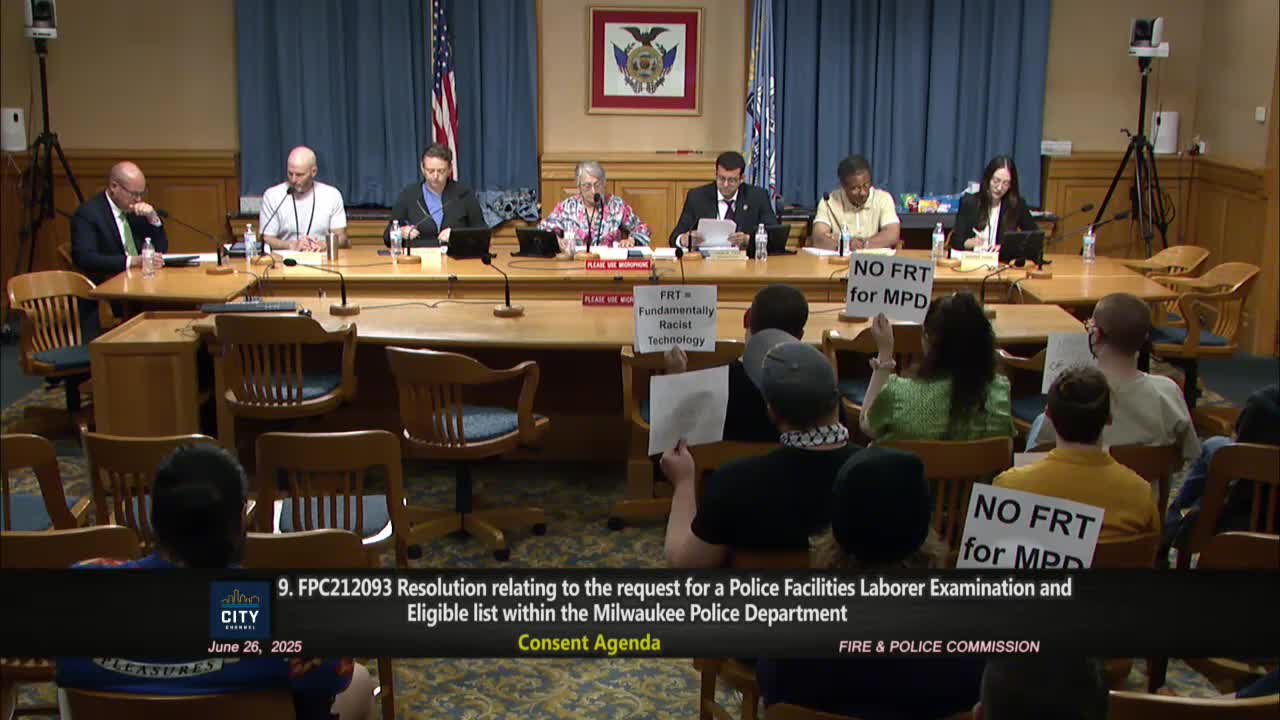
The vote followed an extended public comment period in which multiple residents and community activists urged the commission to reject Norman’s reappointment, citing a lack of trust in his leadership, the department’s pursuit of facial recognition technology (FRT), and police actions during the Republican National Convention (RNC) events last year that preceded the killing of Sam Sharp Jr.
Nut graf: The vote capped a contentious public process. Commissioners held two community meetings about the reappointment earlier in June and took public testimony at the June 26 meeting. Public speakers repeatedly connected concerns about surveillance technology and lack of accountability to Norman’s fitness for another term, while several commissioners and one alderman publicly supported Norman’s leadership and culture changes within the department.
Public concerns and quotes
Multiple speakers representing the Milwaukee Alliance and other community groups urged commissioners to block the reappointment. Ron Jansen told the commission, “I don’t believe the chief has earned that trust.” Alan Chavoia said the city had been failed by law enforcement leadership and argued, “We lost Sam because of that.”
Diego (Dio) Garcia, who identified himself as representing the Milwaukee Alliance, said simply: “Hell no to FRT,” and urged the commission not to reappoint Norman. Heba Mohammed said the group collected about 630 petition signatures at a recent Equal Rights Commission meeting and that the total had climbed to about 740 since then, and asked the FPC to press Norman on FRT and to require he appear in person to answer questions.
Other public speakers raised related issues: Kayla Patterson, an MPS graduate, said “there’s nothing about this technology that’s going to make the youth of Milwaukee feel any more safe.” Olivia McClain warned against selling mugshots to a private company, saying, “Do not allow the MPD to sell our mugshots to Biometrica in exchange for facial recognition technology.” Marty Wall raised broader concerns about traffic enforcement and policing priorities under the chief’s leadership.
Chief Norman and supporters
Chief Jeffrey Norman, appearing virtually, apologized for not attending in person and said he understood the concerns raised: “There’s a lot more work to do, and I am willing to continue to engage,” he told commissioners, adding that the department must keep working to build trust across different community groups.
Alderman Nik Kovac (appearing as Alderman Chambers in the public comment record) and several commissioners spoke in favor of Norman’s reappointment, citing departmental reforms and cultural change. Commissioner Burgos, citing decades of law‑enforcement experience, commended Norman’s management and said the department is moving toward “constitutional policing.” Commissioner Ramey said Norman has shown commitment to community engagement and culture change.
Commission debate and procedure
Commissioner JoAnna Fung criticized the timing and optics of the FPC’s two community meetings—both held the same day and coinciding with a large protest day—and said the schedule made it harder for dissenting residents to attend. Fung said she would prefer Chief Norman to be present in person before a final vote.
Commissioner Horowitz moved to reappoint Norman; Commissioner Spence seconded. Commissioner Fung then moved to place a temporary hold on the reappointment so the chief could appear in person; that motion failed on a roll call vote, which the record shows failed with 3 ayes and 5 noes.
Final vote and outcome
After debate, commissioners took a roll‑call vote on the reappointment resolution (FPC file FPC‑212060). Commissioners recorded on the roll call as voting aye included Burgos, Evans, Fung, Borowicz, Ramey, Snyder, Spence and the chair. The motion carried; Chief Norman was reappointed and said he would continue engagement efforts with the community.
What the record shows — and what it does not
Speakers at the meeting repeatedly tied their objections to the department’s pursuit of facial recognition technology and to accountability concerns arising from the RNC‑era policing and the killing of Sam Sharp Jr. Commissioners and the chief said they were committed to continuing community engagement, but the meeting record does not show the commission placing new conditions on the reappointment or adopting a binding oversight action regarding FRT.
Next steps
Norman’s new term begins Nov. 15, 2025. The FPC and community groups discussed additional meetings and ongoing oversight, but no specific follow‑up deadline or binding requirement was recorded in the motion before the commission at the June 26 meeting.
Ending: The reappointment concluded the most contentious item on the FPC’s June 26 agenda; the commission proceeded to routine promotions, appointments and departmental communications after the vote.