Get Full Government Meeting Transcripts, Videos, & Alerts Forever!
Get email alerts on the Public Safety Curfew topic
No spam. Unsubscribe anytime.
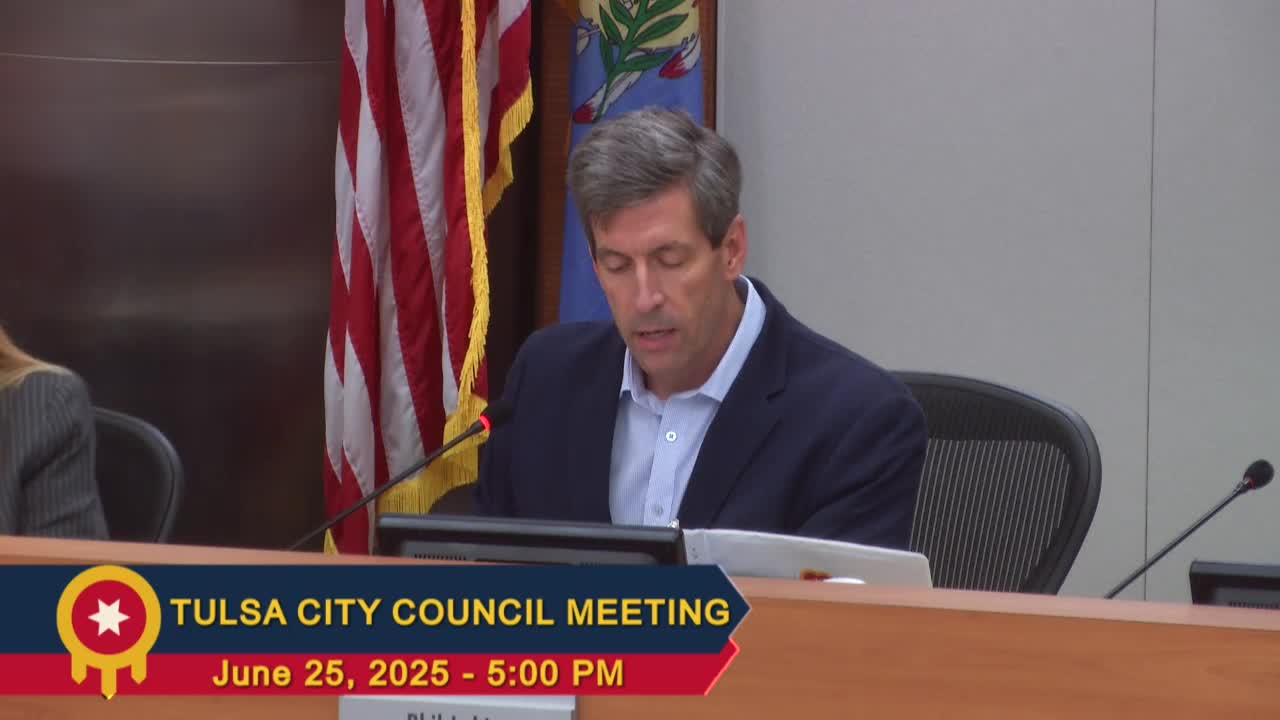
Tulsa council approves emergency downtown juvenile curfew after heated debate; policy narrowed to Thu–Sat, sunsets Oct. 22
Summary
The Tulsa City Council approved an emergency ordinance late Wednesday establishing a temporary curfew for minors in a defined downtown area, voting to adopt the measure after amending it to run only on Thursdays, Fridays and Saturdays from 9 p.m. to 6 a.m. and to sunset Oct. 22, 2025.
The Tulsa City Council approved an emergency ordinance late Wednesday establishing a temporary curfew for minors in a defined downtown area, voting to adopt the measure after amending it to run only on Thursdays, Fridays and Saturdays from 9 p.m. to 6 a.m. and to sunset Oct. 22, 2025.
Supporters — including downtown business owners and the Downtown Tulsa Partnership — said the measure is a short-term public-safety tool intended to reduce large, unruly gatherings and blunt a recent surge of violent incidents. "This action is about creating temporary measures," Brian Kurtz, chief executive officer of the Downtown Tulsa Partnership, told the council. "Perfection is the enemy of progress, and this is not a perfect solution."
Opponents — including youth-service providers, parents and community organizers — said the ordinance risks criminalizing children, disproportionately increasing police contact with Black and brown youth, and would worsen long-term problems unless paired with community programs. "We demand that you invest in our children and not criminalize them," Michelle Lara, executive director of a local community organization, told the council, urging the city to use federal grant funds for prevention programs instead of expanding enforcement.
Why it mattered
Council members framed the vote as an emergency response to repeated nights of large crowds, fights and at least one fatal shooting near downtown. Business owners told the council foot traffic and late-night sales have fallen and that employees and patrons have reported feeling unsafe. "We have to take action quick because the longer we delay action, the longer we wait to find the perfect answer, the more issues that we're going to have," Elliot Nelson, founder and CEO of McGalli's Group, said.
At the same time, public testimony emphasized that enforcement alone will not solve structural drivers of violence. Several speakers asked the council to ensure alternatives — increased youth programming, diversion, a municipal alternative court and better-funded violence-intervention work — accompany any enforcement steps. "This curfew will not stop gun violence because it is a systemic issue," Michelle Lara said, noting the city has received federal grant funding aimed at violence reduction.
Council action and vote
The council first voted to waive charter and procedural rules so the ordinance could be considered and take effect on an emergency basis. After taking public comment from a mix of business owners and community members (12 speakers on item 6a), council members amended the proposed ordinance. The final motion narrowed the downtown curfew hours to 9 p.m.–6 a.m. on Thursdays, Fridays and Saturdays only, kept the emergency clause, and set the sunset date at Oct. 22, 2025.
On the final roll call for the amended ordinance, the votes were: Councilor Doctor Wright — Yes; Councilor Lakin — Yes; Councilor Bush — Yes; Councilor Hall Harper — Yes; Councilor Archie — Yes; Councilor Dutton — No; Councilor Gilbert — Yes; Councilor Bengal — Yes. The ordinance passed 7–1. With the emergency clause, the curfew can take effect immediately if signed by the mayor.
Enforcement, oversight and next steps
Tulsa Police Department representatives told the council the narrower, time-limited curfew gives officers a clearer, more enforceable standard and said their preference is to disperse crowds rather than issue citations. A department official said body-worn cameras are active for patrol contacts and described multiple channels for filing complaints, including contacting internal affairs and the city's Department of Resilience and Equity.
Several council members said they want short review intervals and data tracking to check for unintended consequences, including increased youth arrests or displacement of problems to other neighborhoods. Councilor Archie and others urged that the pilot be limited in scope and duration so the city can adapt based on real-time data. Youth-service providers asked the council for funding and direct coordination with community organizations to provide alternatives and diversion rather than rely solely on fines or court involvement.
Votes at a glance (other council actions taken that evening)
- Minutes (Items 1a & 1b): Approved by unanimous roll call (8–0). - Mayor’s items 4B–4T (multiple special events and travel donations): Approved with emergency clause on certain items; council accepted public comment earlier on those mayor’s items. Recorded vote: unanimous where noted. - Rezoning (Item 5a, Z78-15): Approved (unanimous roll call). - Ordinances second reading (Item 7a–7e): Approved, with the emergency clause on item 7e (unanimous roll call). - Council travel donation (Item 8b): Approved.
The council signaled intent to monitor the curfew closely, collect data, and revisit or amend the ordinance as needed. Several council members and community speakers announced follow-up meetings and community listening sessions to pursue nonpunitive responses and youth programming.
Ending
Council members and community leaders said the measure is a temporary, imperfect step intended to reduce immediate risk while other interventions are developed. Several speakers urged the city to use the curfew’s implementation window to expand diversion, youth services and violence-intervention programs so the city can evaluate whether the curfew decreases harm without producing disproportionate enforcement impacts.