Get Full Government Meeting Transcripts, Videos, & Alerts Forever!
Get email alerts on the Gaza Humanitarian Crisis topic
No spam. Unsubscribe anytime.
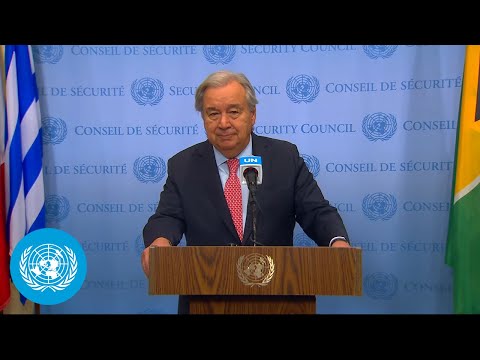
UN secretary-general urges immediate Gaza ceasefire and a ‘surge’ of humanitarian aid
Summary
United Nations Secretary-General urged an immediate ceasefire in Gaza, called for the unconditional release of hostages and demanded full, sustained humanitarian access after describing a humanitarian crisis and blocked aid deliveries.
United Nations Secretary-General said before departing for Seville that it is "time to find the political courage for a ceasefire in Gaza," and called for an immediate, unconditional end to fighting and a rapid, large-scale increase in humanitarian assistance.
The secretary-general described what he called a "humanitarian crisis of horrific proportions," saying families in Gaza have been repeatedly displaced and are now confined to "less than 1 fifths of Gaza's lands" and that "bombs are falling on tents, on families, on those with nowhere left to run." He said the occupying power "is required by international law to agree to and to facilitate humanitarian relief," and said recent deliveries remain far too small: "A trickle of aid is not enough. What is needed now is a surge. The trickle must become an ocean."
The secretary-general demanded "the immediate and unconditional release of all hostages, and full, safe, and sustained humanitarian access," and said distribution problems must be fixed. He said a previously used plan grounded in humanitarian principles — "humanity, impartiality, neutrality, and independence" — should be allowed to operate again, that "we have the supplies. We have the experience," and that such a plan had worked during the last ceasefire.
He warned that any effort that channels civilians into "militarized zones is inherently unsafe," saying, "It's killing people." The secretary-general also said that healthcare capacity has been overwhelmed: "Doctors are forced to choose who gets the last vial for of medicine or the last ventilator. Aid workers themselves are starving. This cannot be normalized." He noted that "a handful of medical supplies finally crossed into Gaza earlier this week," but said that underscored the scale of the need.
In response to a question about allegations by the Gaza Humanitarian Foundation that the United Nations had engaged in a campaign of misinformation about killings near food distribution sites, the secretary-general replied, "We didn't invent the images everybody has seen." He also said that when violations of international law occur, "there must be accountability." When asked whether member states should sanction Israel to ensure compliance with international law, he said the existence of multiple alleged violations means there must be accountability, without prescribing specific measures.
The secretary-general closed his remarks by framing the longer-term solution as political: he said the only sustainable path to restoring hope is "paving the way to the 2 state solution," and urged member states to "uphold UN Charter" commitments and to enable humanitarian operations as required by international humanitarian law.
Less critical details: the remarks were delivered before the secretary-general's departure to Seville for the Financing for Development conference, which he said he was co-hosting with Spain.