Get email alerts on the Public Engagement Planning topic
No spam. Unsubscribe anytime.
Council adopts code changes to expand mailed notice radius and require developer‑led community meetings for large projects
Summary
Cathedral City adopted a zoning code amendment to expand mailed public‑hearing notification from 300 feet to 500 feet (750 feet for projects of five acres or greater) and to require developer‑led outreach meetings for larger discretionary proposals.
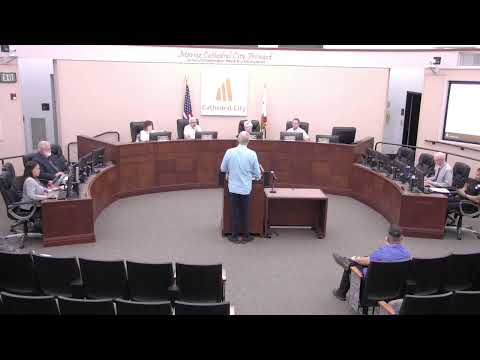
The City Council on June 25 adopted an ordinance amending Cathedral City Municipal Code to expand mailed notification requirements for public‑hearing development projects and to require developer‑led community meetings for larger projects.
Deputy Director Sandra Molina told the council the change responds to planning-commission recommendations and local practices in nearby cities. The new chapter, 9.09, increases the standard mailed notification radius for most public‑hearing projects to 500 feet (up from the state-minimum 300 feet) and raises the radius to 750 feet for projects of five acres or greater. The amendment also requires applicants for discretionary projects of five acres or more to hold a developer‑led community meeting, provide project materials and a sign‑in sheet, and submit a meeting summary for commission/council packets. Molina said the city would still use mailed notices to property owners outside the city limits but would notify business tenants and residents of multi‑unit properties when possible.
Planning Commissioner Danielle Mead, who appeared during public comment, supported the stronger outreach rules and said the commission sought better early engagement so issues are raised before hearings. Council members praised the change as improving transparency and reducing late‑breaking opposition; the ordinance passed unanimously.
AI generated
The text on this page is AI generated. Summaries, highlights, analysis, and video transcripts are all produced from the original source material.
AI can make mistakes, so if you spot one, and we will fix it for everyone.
Note: the source content is unaltered by us. Any content source we link to, be it a video, an audio recording, or a document, is presented exactly as its publisher released it. That publisher is usually a government body, sometimes an individual official or another organisation.