Get Full Government Meeting Transcripts, Videos, & Alerts Forever!
Get email alerts on the Flooding Prioritization Equity topic
No spam. Unsubscribe anytime.
Harris County court orders Quartile 1 funding, demands dashboard after community protests over flood-bond equity
Summary
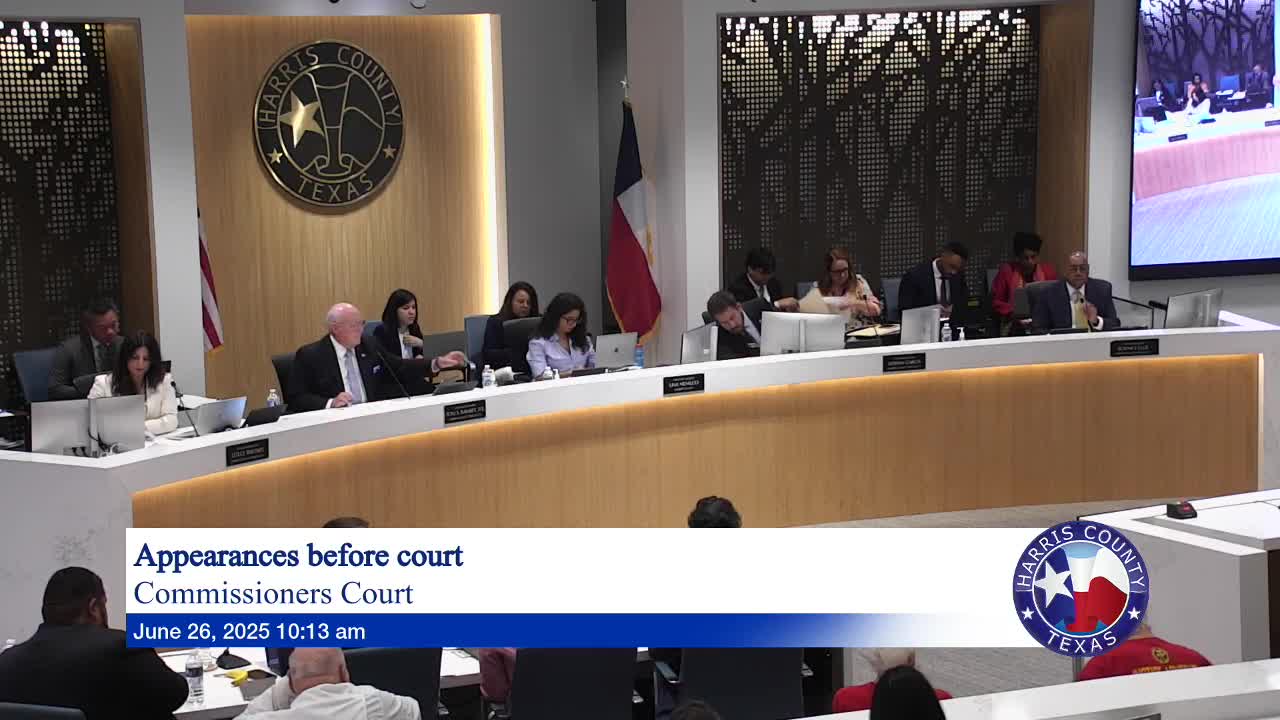
After weeks of public pressure and testimony from flood-impacted residents and advocates, Harris County Commissioners Court voted to fully fund current and future needs for projects in Quartile 1 under the 2022 prioritization framework and ordered a public project dashboard and further review of unassessed projects.
The Harris County Commissioners Court voted on June 26 to direct the Flood Control District to fully fund current and future needs for projects in Quartile 1 of the county's 2022 prioritization framework and to develop a publicly accessible flood-bond project dashboard. The court also directed the district to assess additional, high-impact projects not previously reviewed under the framework and to return with recommendations by Sept. 18, 2025.
The action came after a lengthy public-comment period in which more than three dozen residents and community advocates from neighborhoods including Northeast Houston, Sunnyside, Lakewood and Denver Harbor urged the court to honor the equity provisions approved when voters passed the 2018 flood bond. “The bond we voted for in 2018 requires equity,” said speaker Doris Brown, who identified herself as a resident and flood-bond advocate. “When this court discussed the bond, you promised the prioritization system would be followed to help flood-prone communities. This was your commitment.”
Advocates repeatedly told the court that the Flood Control District’s public reporting is incomplete or difficult to find. “We need a dashboard to where we can see where these projects start and when they finish,” Benjamin Broadway told the court. “Make it accessible for the visually impaired and the handicapped.” Bayou City Waterkeeper, the Northeast Action Collective, Texas Housers and other local groups urged that social-vulnerability metrics remain central to project selection and that partnership funding be counted in ways that do not disadvantage low-property-value neighborhoods.
The court’s motions followed a presentation and discussion that highlighted cost and scheduling challenges facing the flood-bond program. County staff and the Flood Control District told the court the original bond program envisioned about $2.5 billion in county funding and that partnerships and grants have expanded the program’s purchasing power to roughly $5.2 billion. The Flood Control director told the court that the program has spent roughly $1.5 billion and encumbered about $1.4 billion, and that rising project costs have created an estimated unfunded need (presented in scenarios) in the low hundreds of millions of dollars, depending on assumptions and project phases.
Commissioner Ellis — the mover of the motion to fully fund Quartile 1 — repeatedly stressed the county’s earlier commitments to equity in the bond order and in the subsequent 2022 prioritization framework, reminding the court the bond language directed the county to “provide a process for the equitable expenditure of funds.” Several residents recounted historic and recent flooding in their neighborhoods, personal losses during Hurricane Harvey, and ongoing gaps in completed construction for projects shown as “shovel ready” on the Flood Control website.
The court approved three related actions: (1) to fully fund current and future needs for projects classified in Quartile 1 under the 2022 prioritization framework and to ask the Flood Control District to return on Sept. 18, 2025 with a project schedule and recommendations; (2) to direct Flood Control to develop a public flood-bond project dashboard that includes project-level trackers, percent-complete, prioritization ranking and other details, updated at least every six months (or sooner as data is available); and (3) to direct Flood Control to assess flood-control projects with potential significant community impact that had not previously been assessed under the 2022 framework and report back by Sept. 18, 2025.
Court discussion emphasized that partnerships and grants remain an important source of funding but must not displace the prioritization framework that centers people most at risk. Flood-control staff told the court that partnership dollars have helped deliver projects but cautioned that some large projects face increased costs, right-of-way and environmental issues that complicate schedules.
Court members and advocates pressed for better procurement transparency after earlier audits showed inconsistent documentation for how engineering and construction contracts had been awarded. The County Auditor committed to provide a follow-up update to the court on the audit recommendations and the departments’ action plans.
The court’s directions do not change any individual project awards in the minutes; instead they set priorities and reporting requirements intended to increase transparency and preserve the equity-focused prioritization voters approved. The Flood Control District will prepare the dashboard and the additional project assessments and return with a fuller implementation plan and schedule at the Sept. 18, 2025 court meeting.