Get Full Government Meeting Transcripts, Videos, & Alerts Forever!
Get email alerts on the Juvenile Justice Use Of Force topic
No spam. Unsubscribe anytime.
Committee presses probation for clearer use‑of‑force baselines and independent oversight in juvenile facilities
Summary
Probation officers briefed the Children, Seniors and Families Committee on use‑of‑force reporting in juvenile custody; supervisors sought clearer demographic context, incident‑category refinement and a documented process for flagging patterns of excessive force.
The probation department presented its report on use‑of‑force incidents in juvenile custodial settings on June 26. Deputy Chief Jill Ugalde and facility managers answered committee questions about incident reporting, data categories and oversight.
What staff said: Ugalde explained the department has refined incident categories in the reporting system to simplify dropdown options (for example physical restraint, mechanical restraint, transport‑related restraint) and that each use‑of‑force incident is documented in an incident report with background, incident narrative and supervisory review. Medical staff conduct an evaluation after every use‑of‑force incident and incidents can be referred for further review.
Questions from supervisors: Members asked for more demographic context (age ranges and other de‑identified characteristics where permitted) tied to incident counts; staff said they will work with IT and research teams to present demographics where privacy permits and to include facility population context (average daily population) so tallies can be interpreted relative to population. Supervisors also asked how the department determines whether a staff member’s pattern of force is excessive and who is responsible for identifying trends. Probation described an internal review process (supervisors and managers review incident reports, video and medical evaluations) and said that multiple external oversight bodies — including the Board of State and Community Corrections (BSCC) audits and the Juvenile Justice Commission (JJC) — also review incidents.
Oversight and follow‑up requested: Supervisors pressed for clarity on how trends are defined and flagged (for example a threshold of incidents over time for a given staff member) and requested the department provide documentation of the mechanisms used to detect and escalate concerns. Probation said it will review internal processes for flagging patterns and provide a follow‑up that explains who reviews incident accumulations and how referrals to internal affairs or external investigators are triggered.
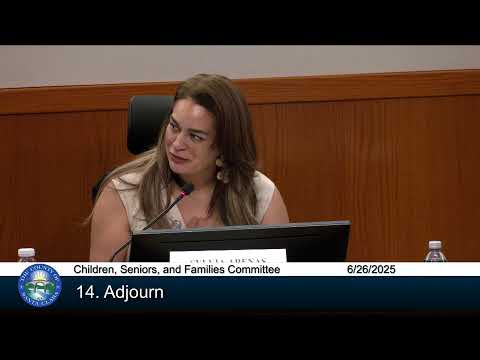
Action: The committee approved the report and directed a follow‑up to explain how the system determines a baseline for “excessive” use of force and identify who oversees that determination. Motion carried; vote recorded yes by Vice Chairperson Young and Chairperson Arenas.
What’s next: Probation will work with research and IT teams to improve reporting displays (include denominator population and de‑identified demographics where permissible), to document the internal flagging/escalation process and to present that information to the committee in a future update.