Get Full Government Meeting Transcripts, Videos, & Alerts Forever!
Get email alerts on the Reparations topic
No spam. Unsubscribe anytime.
Olympia council hears study on reparations options for descendants of enslaved people
Summary
At a June 24 study session the Olympia City Council reviewed a consultant—riefing on local reparations options, including housing-focused programs and legal and funding constraints. Councilmembers asked for clearer goals, coordination with state work and next steps for possible local programs.
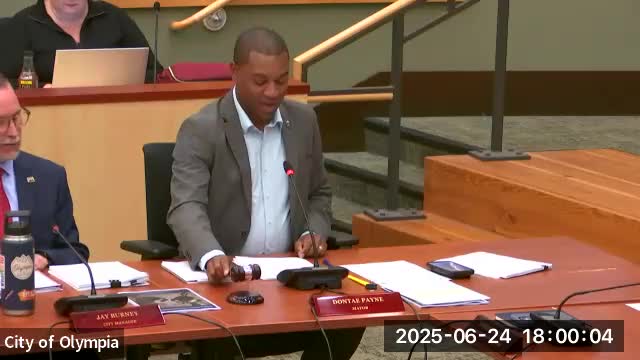
Mayor Payne convened the Olympia City Council study session on June 24, 2025 to receive a consultant briefing on reparations for descendants of enslaved African people and to discuss possible next steps for city-level action.
The briefing, prepared by consultants Dane Wolfram and Dr. Ashley Gardner of Trueclusion and introduced by Susan Grisham, assistant to the city manager, reviewed national examples, local data on racial disparities in homeownership, and a range of reparative options city leaders could consider. "At the heart of this work is repair," Grisham said, "We're looking at ways to address the generational harm caused by slavery and systemic racism and identify actions that can help descendants of enslaved African people in our community achieve healing, justice, and opportunity."
The consultants summarized their research on U.S. municipal reparations efforts and on Washington-state activity. They said they surveyed 23 U.S. cities and spoke with officials in several; the report notes that housing-focused remedies, including down-payment assistance, loan pools and home-repair programs, are the most commonly adopted first steps in cities studying reparations.
Why it matters: council members stressed that local reparations discussions must be grounded in legally and politically viable designs, measured goals and funding plans. Several councilmembers emphasized the connection between reparations and the city—s broader housing and equity work, including the Olympia 2045 housing element and tenant protection work on the council—s calendar.
Most of the meeting focused on policy options, legal constraints and program design. The consultants noted that a small number of cities have moved to direct cash or near-cash remedies: the report describes Evanston, Illinois— program, which distributed a total the consultants report as about $5,000,000 with a $25,000 per-recipient allocation in some components. City leaders and the consultants repeatedly cautioned that direct cash policies have prompted legal challenges elsewhere; as one consultant summarized the legal lesson, "if you say, 'this is for Black residents,' that—s where legal challenges arise; framing that assistance as for —descendants of enslaved people— is one strategy jurisdictions have used to narrow eligibility and reduce legal risk."
The presentation included local data the council used to frame needs. The consultants cited Black Home Initiative figures saying roughly 42% of Black households in Washington state have zero net worth compared with about 14% of white households. They also cited U.S. Census American Community Survey 2019'1:2023 five-year estimates showing homeownership rates in Thurston County of 70% for white non-Hispanic households and 51% for Black households, with an even wider disparity inside the city of Olympia where the report lists a 34% homeownership rate for Black households.
The council and consultants discussed a set of community-generated ideas identified by the city—s Social Justice and Equity Commission and by other jurisdictions: business grants and microloan programs, capacity-building for Black-owned businesses, various forms of housing assistance including down-payment assistance or loan pools, targeted home repair, and—less frequently implemented at the municipal level—direct cash payments. The commissioners— feedback to the council was described in the consultants— materials as a menu to explore, not an immediate set of mandates.
State role and next steps: Grisham and council members noted the state legislature provided a budget proviso of $300,000 to fund the Charles Mitchell and George Washington Bush study on reparative action for Washington state. That study, scheduled for 2025'27, will develop policy options the state could pursue. Grisham said the city intends to share its municipal study and the consultants— findings with state study teams to inform that larger body of work.
Council direction and outstanding questions: members asked for clearer, measurable local goals (for example, a homeownership goal for Black residents, which the November 2024 city resolution directed staff to study) and for legal analysis of eligibility frameworks. Several members urged using community-based, "by-and-for" partners to deliver programs and to test lower-cost, high-impact interventions such as expanded tax-credit outreach, voluntary free tax-preparation services and matched savings accounts. Councilmembers also flagged the risk that one-time municipal funds, if used for direct payments, could create long waiting lists without a sustainable revenue source.
What comes next: councilmembers and staff agreed to continue facilitated staff work to map possible links between reparations-related actions and ongoing planning efforts (the housing element update, the Olympia Strong goals and capital planning). The consultants and staff will provide updated drafts and the city will coordinate with the state study team.
Ending: No formal action or vote was taken during the study session. Councilmembers expressed continued interest and asked staff to return with more narrowly defined goals, legal options and funding scenarios consistent with both local priorities and the forthcoming state study.