Get Full Government Meeting Transcripts, Videos, & Alerts Forever!
Get email alerts on the Impact Fees topic
No spam. Unsubscribe anytime.
Conroe plans impact‑fee study with Freese & Nichols; timeline stretched by new state rules
Summary
Council heard a presentation from Freese & Nichols on how an impact‑fee program would work, the statutory framework under Texas Local Government Code chapter 395, and a proposed 10–18 month schedule that includes new public‑notice and advisory‑committee requirements under recent legislation.
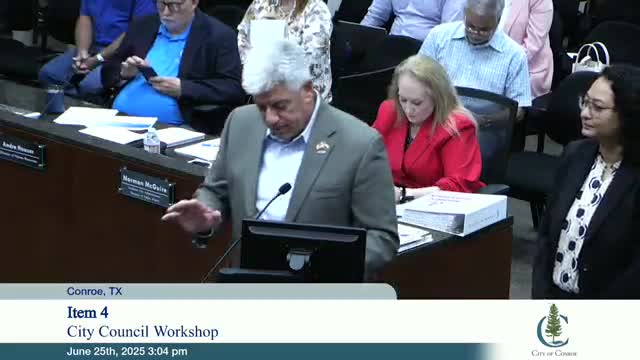
City staff and consultants from Freese & Nichols presented a proposal to study and implement an impact‑fee program for Conroe that would assess one‑time fees on new development for capital projects tied to growth.
What the study would do: Freese & Nichols would develop land‑use assumptions, identify eligible capital improvements from the city’s water, wastewater and thoroughfare plans, perform the statutory cost and credit analyses, and calculate per‑service‑unit fees. The firm told council the mechanics are rooted in Texas Local Government Code Chapter 395 and that the study includes a credit analysis that determines the legal maximum “ceiling” for any fee collection or alternatively a 50% crediting approach for existing capacity.
Advisory committee and new legislation: Consultants said the public process is prescribed by state law and includes an appointed capital improvements advisory committee (CIAC). They noted recent legislative changes require that at least 50% of the CIAC be members of the building/real‑estate/development industry; those changes lengthen the public‑hearing and notification steps, extending the timeline. Ishida Raman of Freese & Nichols said the overall study timeline will run roughly 10 months to complete the technical work and then additional months for the formal two‑step public hearing and adoption process; consultants and staff estimated the total timeframe at about 14–18 months under the new rules.
Scope and policy choices: The study would produce a fee schedule for single‑family and nonresidential uses and present benchmarking to compare Conroe options with other Texas cities; the council would set any policy decisions such as the collection rate below the legal ceiling, grandfathering rules and credits for developer‑built facilities. Consultants also said drainage impact fees could be considered later if a regional drainage plan identifies growth‑driven projects eligible under Chapter 395.
Cost/return considerations and prior work: Council members asked whether earlier work the city funded could be reused; staff said a prior study had been started but stalled and that previous data may be partly reusable but must be reconciled with updated water and wastewater master‑plan work. Councilmembers pressed for an estimate of how quickly fees would recoup the study cost; consultants said that depends on growth rates and the portion of development still subject to fees after existing development agreements are honored.
Next steps: Freese & Nichols and staff proposed stakeholder meetings, advisory‑committee formation, and a two‑step public hearing process to produce an ordinance if the council opts to adopt an impact‑fee program. Staff will provide the council a scope and schedule for formal consideration.