Get Full Government Meeting Transcripts, Videos, & Alerts Forever!
Get email alerts on the County Finance topic
No spam. Unsubscribe anytime.
Lubbock County treasurer asks for part-time hire to reduce reliance on interns, staff say heavy bond workload
Summary
County Treasurer Chris Winn told Commissioners Court his office is short-staffed, asking for a part-time position to ease cross-training limits and handle caseloads such as cash and surety bond processing.
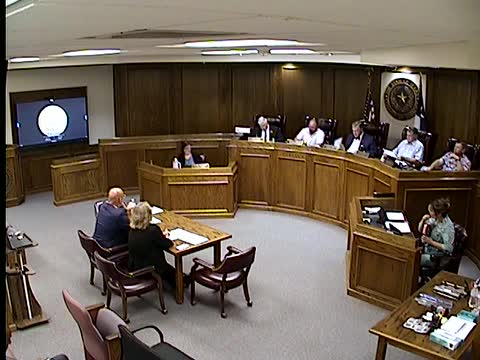
Lubbock County Treasurer Chris Winn asked Commissioners Court on June 25 to approve a new part-time position to ease heavy workloads and improve cross-training in his four-person office.
Winn told the court the treasurer’s office currently has one elected official, three full-time staff, one part-time employee and one intern, and “we respectfully request the addition of a . . . part time staff member.” He said the office has historically relied on interns for work equivalent to at least one full-time position and that intern absences during exams and school breaks have caused “significant disruptions.”
Winn and Assistant Treasurer Alice Solswiegel walked the court through updated performance measures that, they said, better capture the office’s work than prior measures. Solswiegel said the office handles county receipts, monthly and quarterly reports, bank reconciliations for eight county accounts, ACH and Citibank transfers (about 400–500 per year each), and substantial cash- and surety-bond work. She said quarterly reporting can consume “almost an entire month” of staff time.
Winn described how departures exposed knowledge gaps: when a longtime operations staffer left in February, many bond functions were known mainly to two people, forcing others to work long hours until a new operations controller was hired. He said the office is aiming to reduce reliance on multiple interns and scale the intern program to one at a time while adding the requested part-time employee focused on cash bonds.
On bond operations, Winn and Solswiegel described the county’s interaction with bail bond companies and with the Bail Bond Board. Winn said the county oversees more than $100,000,000 in surety valuation carried by bail companies and that when a bond company closes the county may work with the district attorney’s civil division or the bail bond board for recovery. “The system is covered by either an insurance company or cash or prop or . . . real property,” Winn said. Solswiegel described routine workflows for refunding bond payors when a case is dismissed and the logistical challenges when payors are difficult to reach.
Commissioners asked about training and travel line items and whether local training could replace some out-of-town conferences. Winn and Solswiegel said the office will work with the court’s direction; Solswiegel noted some training (for systems such as Munis and Odyssey) is hard to replicate locally and can be valuable for staff proficiency.
Clarifying details from the presentation: the treasurer’s office reported plans to receive roughly $300,000,000 in receipts for the fiscal year and jury pay near $200,000; payroll-related tax payments were estimated at roughly $20,000,000. The office reconciles eight bank accounts. Staffing currently is four full-time including the elected official, one part-time, and one intern returning in the fall. The office said it has not received approval for a new position in the last six years and that similar county financial administration departments typically have six to eight full-time staff.
The court did not take a vote at the June 25 work session; Winn said he was “thankful for your consideration” and left the request for the court’s budget deliberations.
What’s next: the treasurer asked the court to consider the requested position as part of fiscal-year-2026 budget deliberations. Commissioners discussed merit pay and evaluation processes for staff more broadly during the session, and the treasurer said his office performs evaluations and would participate in countywide evaluation processes if the court directs one.