Get Full Government Meeting Transcripts, Videos, & Alerts Forever!
Get email alerts on the Open Meetings Act topic
No spam. Unsubscribe anytime.
Nebraska webinar outlines Open Meetings Act rules for library boards
Summary
A Nebraska Library Commission webinar reviewed recent Open Meetings Act provisions and practical steps library boards should follow on notices, agendas, public comment, minutes, virtual meetings and closed sessions.
Lincoln — The Nebraska Library Commission’s Encompass Live webinar on the state Open Meetings Act reviewed how library boards and other public bodies must advertise and run meetings, what may be discussed in closed session, and how the public’s rights to notice, participation and records are protected.
Scott Childers, executive director of the Southeast Library System, told attendees that the presenters were “not lawyers, and more importantly, we are not your lawyers,” and said the session’s purpose was educational: to summarize statutory requirements and point boards to where they can get legal advice.
Why it matters: The Open Meetings Act is intended to ensure citizens know what their public bodies are doing and have an opportunity to provide input. Childers and Krista Porter of the Nebraska Library Commission walked through statutory requirements (cited in the webinar as Neb. Rev. Stat. sections 84-1407 to 84-1414) and practical steps libraries should take to avoid violations that can void actions and expose officials to fines.
Key requirements and guidance discussed
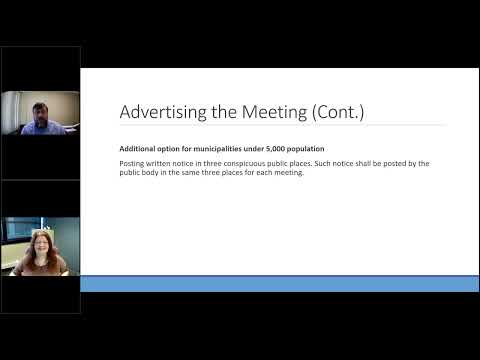
Notice and advertising: Childers said boards have two primary options for publishing meeting notices: a printed notice in a local newspaper or a notice on the newspaper’s website plus posting to the Nebraska Press Association’s statewide repository for public notices. Municipalities with populations under 5,000 may instead post a written notice in three public places that are reasonably accessible during business hours (examples noted included the library bulletin board, city hall or other community locations). The presenters said the law requires “reasonable” advance notice; as a rule of thumb they suggested following the city or allowing about 7–10 days when possible.
Agendas and timing: Childers said agendas must contain enough detail for citizens to understand the topics being covered (for example, “grant proposal to build a financial literacy collection” rather than a vague “books” item). By statute an agenda may be changed up to 24 hours before a meeting; after that point additions or changes are not allowed. Cities of the first class must post an up-to-date agenda on their websites no later than 24 hours before the meeting and must keep it posted for at least six months.
Public comment and recordings: The presenters said the law now requires that the public “shall always have an opportunity to speak at every meeting of a public body.” Boards may set reasonable time limits (the webinar recommended adopting a consistent limit such as three minutes per speaker), and may restrict placement of recording equipment only where it interferes with others’ access. Childers emphasized that the public may attend, record and broadcast meetings and cannot be required to identify themselves simply to attend.
Virtual meetings: Childers explained that library boards may hold some nonvoting virtual meetings to discuss items or prepare for a later in-person action, but library boards are not allowed to take action (vote) during a virtual meeting. A virtual meeting must be reasonably publicized (including a link or dial-in) and must provide a physical location with full access to the virtual meeting (microphone, speakers, screen) where at least one public-body member is present.
Minutes and records: Minutes must report the time and place of the meeting, who was present or absent, and the substance of matters discussed so readers can understand what led to decisions. Votes must be recorded by name (roll call). Minutes and documentation disclosed or received in the meeting must be available to the public within 10 days; cities of the first class must post minutes online within 10 working days and keep them available for at least six months.
Emergency, special and closed meetings: Childers reviewed special- and emergency-meeting rules. Emergency meetings may be held without the usual public notice but the minutes must state the reason, be limited to the emergency topic, and be made public no later than the next business day. Closed sessions are allowed only for specific purposes defined by statute (collective-bargaining strategy, real-estate negotiations, litigation strategy, security, certain personnel matters, investigations of alleged criminal misconduct). Boards must state the reason for going into closed session in open meeting and vote to do so; only the stated topic may be discussed in closed session, and any final votes must occur after the body returns to open session.
Enforcement and consequences: Childers said the Attorney General and county attorneys enforce the Open Meetings Act. Actions taken in violation of the Act can be voided; officials who knowingly violate the law may face fines or other penalties. He stressed there is no exemption for small communities simply because they are small.
Resources and next steps: Presenters pointed attendees to the statutory citations given during the webinar, the Nebraska Library Commission’s Encompass Live archives (recording and slides will be posted), and the League of Nebraska Municipalities for the Open Meetings Act poster. Childers advised boards to consult local city or county attorneys for legal interpretation where questions remain, especially on evolving matters such as the definition and use of virtual meetings.
Ending: The webinar recording, slides and resources will be posted to the Nebraska Library Commission’s Encompass Live archive and the commission’s YouTube channel; attendees who registered were told they would receive an email when those materials are available.